7 Best Craft Lamps For Low-light Knitting To Try
Struggling to see your stitches? We review the 7 best craft lamps for low-light knitting, focusing on brightness, color accuracy, and adjustable design.
Knitting in low light is a recipe for dropped stitches, uneven tension, and unnecessary eye strain that cuts your crafting sessions short. As someone who has spent two decades deciphering dark navy lace and complex black cables, I know that the right light is just as essential as your needles. A dedicated craft lamp transforms your workspace from a dark corner into a clear, productive studio. These seven picks are designed to help you see every single fiber, regardless of the time of day.
OttLite 2-in-1 LED Floor Lamp: Best Overall Choice


When you’re switching between a full-sized sweater project and a pair of delicate socks, versatility is king. This lamp earns the top spot because it transitions seamlessly from a floor-standing unit to a tabletop version, meaning it adapts to your favorite armchair or your dedicated craft desk.
The light quality here is exceptional for color accuracy, which is non-negotiable when you are working with variegated hand-dyed yarns. You don’t want to realize halfway through a colorwork project that your "complementary" shades actually clash under natural daylight.
The trade-off is that it lacks the heavy-duty articulation of a professional architect’s lamp. However, for 90% of knitters, the balance of footprint, brightness, and color rendering makes this the most reliable daily driver.
Brightech LightView Pro Magnifying Floor Lamp
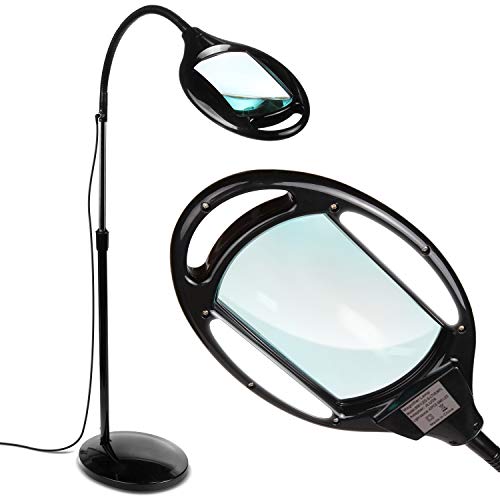
If you are working with lace weight mohair or trying to spot a split ply in a dark-colored yarn, magnification is your best friend. This lamp combines a high-quality glass lens with a bright LED ring, effectively illuminating your stitches while making them appear twice as large.
I often recommend this to knitters who struggle with "invisible" stitches in dark or fuzzy fibers. When you can actually see the path of the yarn, your muscle memory improves, and you stop relying on touch alone to find the next loop.
Be aware that the magnifying lens can take some getting used to. It creates a specific "sweet spot" for your hands, which might feel restrictive if you are an expressive knitter who moves your arms a lot while working.
Daylight Company Wafer 3 Lightbox for Precision

A lightbox is a secret weapon for knitters, especially when you are working on intricate charts or trying to verify your stitch count on a dense fabric. By placing your knitting over the illuminated surface, the light shines through the fabric, highlighting every increase, decrease, and yarn-over.
This is particularly useful for identifying dropped stitches in dark-colored, high-twist wools where the texture is otherwise hidden. It acts like an X-ray for your knitting, letting you spot errors before they become permanent fixtures in your work.
Since this is a flat surface, it is best suited for small-to-medium projects. Trying to fit a heavy, oversized cabled sweater on top of it might be cumbersome, but for complex lace or colorwork charts, it is unmatched.
Lepower Metal Architect Swing Arm Desk Lamp

Sometimes, you just need a sturdy, old-school light that stays exactly where you put it. The architect-style swing arm is a classic for a reason: it allows you to bring the light source inches away from your needles, which is vital for late-night knitting.
Because this lamp uses an E26 base, you have total control over the bulb you use. You can swap in a high-CRI (Color Rendering Index) bulb to ensure you are seeing the true colors of your fiber, rather than the yellow or blue tint of standard household LEDs.
It is a manual tool, meaning it doesn’t have fancy dimmers or touch sensors. If you prefer a simple "on-off" switch and a robust metal build that can withstand years of being bumped by your knitting bag, this is the one.
TaoTronics LED Desk Lamp with Flexible Neck
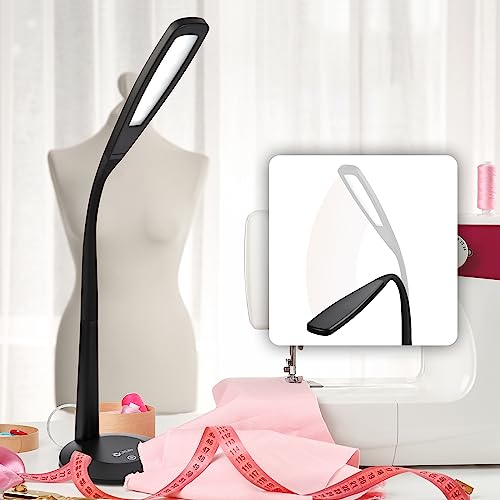
For the knitter with limited space, a flexible, compact lamp is often the most practical solution. The gooseneck design allows you to angle the light precisely over your hands, ensuring you aren’t casting shadows with your own wrists while you work.
This lamp is perfect for small apartment setups or bedside tables where you might be finishing a few rows before sleep. The multiple color modes let you shift from a cool, bright white for detailed work to a warmer tone that is easier on the eyes during late-night sessions.
The base is relatively lightweight, so if you have a habit of tugging your lamp around, you might need to secure it. It is an affordable, entry-level option that performs significantly better than a standard room lamp.
Verilux SmartLight LED Floor Lamp for Crafters

This lamp uses "full spectrum" light technology, which is designed to mimic the quality of natural daylight. For a knitter, this is the gold standard for avoiding eye fatigue during long sessions of working with dark fibers like charcoal or navy.
The "SmartLight" features include a flicker-free design, which is more important than people realize. Flickering lights, even if invisible to the naked eye, can cause headaches and strain when you are staring at the same spot for hours.
It is an investment piece, but if you knit daily, the comfort it provides is worth the cost. It is particularly effective for those who find that standard LEDs make their eyes feel "gritty" after a long evening of knitting.
Neatfi XL 2,200 Lumens LED Task Lamp Review
If you have a dedicated knitting studio or a large craft desk, the Neatfi XL is a powerhouse. With 2,200 lumens, it provides an incredible amount of light, ensuring that even the most intricate cable patterns are perfectly visible.
The wide lamp head covers a large area, meaning you won’t have to constantly adjust the lamp as you move your work across your lap. It is the closest you can get to having a "sunlight" station at home.
Because it is so bright, it can be overwhelming if you aren’t using the dimmer function. Always start at a lower setting and increase the intensity as your eyes adjust to the task at hand.
Why Lighting Color Temperature Matters for Fiber
Color temperature is measured in Kelvins (K), and it dictates whether your light looks "warm" (yellowish) or "cool" (bluish). For knitting, you generally want a range between 4000K and 5000K, which provides a neutral, daylight-like illumination.
If your light is too warm, you might mistake a dark green for a black or a deep purple for a navy. This can lead to disastrous results when you are trying to match dye lots or coordinate colors in a stranded project.
Cooler, daylight-balanced light reveals the true character of your yarn. It helps you see the actual structure of the ply and the subtle nuances in hand-dyed variegated colorways.
Lumens vs. Watts: Understanding Brightness Needs
Many knitters confuse watts with brightness, but watts actually measure energy consumption. When shopping for lamps, look for the lumen count—this is the true measure of how much light the bulb produces.
For detailed knitting, you want at least 800 to 1,000 lumens to ensure your workspace is adequately lit. If you are working with dark, textured fibers like black mohair or boucle, you will want to lean toward the higher end of that spectrum.
Don’t be afraid of "too much" light, provided the lamp has a dimmer switch. It is always easier to dim a bright light than it is to try to force a dim bulb to reveal the details of a dark stitch.
How to Position Your Lamp to Reduce Eye Strain
The goal of positioning is to eliminate shadows without creating glare. I recommend placing your lamp to the side of your dominant hand, slightly behind your shoulder, or directly overhead if possible.
If the light is directly in front of you, it will reflect off your needles, creating a glare that can be just as blinding as working in the dark. If you are using metal needles, this is especially problematic, as the shine can be quite intense.
Experiment with the angle so that the light hits your work from a shallow angle. This highlights the texture of the yarn and the individual stitches, making it much easier to see exactly where your needle needs to go.
Investing in your lighting is the single most effective way to improve your knitting experience and protect your eyesight for years to come. Whether you choose a high-lumen task lamp or a specialized magnifying unit, the key is to prioritize clear, neutral light that allows you to see your stitches with ease. Remember, your eyes are your most important knitting tool, so give them the support they deserve. Happy knitting, and may your stitches always be clear and your tension perfectly even.