6 Best Synthetic Wool Fibers For Vegan Felting
Discover the six best synthetic fibers for vegan felting. This guide explores durable, cruelty-free alternatives that offer excellent texture and versatility.
Exploring the world of vegan felting opens up a vibrant spectrum of possibilities for makers who prefer to avoid animal-derived fibers. While synthetic fibers lack the natural scales found in sheep’s wool, they can be manipulated to create durable, beautiful, and tactile art pieces. Understanding the unique properties of these materials is the first step toward mastering non-wool sculptural projects. Whether you are crafting toys, home decor, or accessories, these six synthetic options offer excellent alternatives for your creative toolkit.
DHG Dyed Polyester Top: Best for Needle Felting


DHG Polyester Top is a staple for those who want a consistent, high-quality fiber that mimics the handling of wool roving. Its primary advantage lies in the uniform length and alignment of the fibers, which makes it remarkably easy to feed through a needle.
If you are working on fine-detail needle felting—like facial features on a doll—the stability of this polyester is a game changer. It doesn’t fray as easily as cheaper acrylics, allowing for crisp edges and smooth transitions between colors.
The trade-off here is the "bounce." Because polyester lacks the natural memory of wool, your sculptures may feel slightly more springy or less dense than traditional felt. Focus on using a finer gauge needle to ensure the fibers lock together tightly without leaving visible puncture holes.
Living Felt Synthetic Batts: Best for Sculpting
When you need a fiber that holds a rigid shape, Living Felt synthetic batts are the gold standard. These batts are pre-carded, meaning the fibers are already oriented in multiple directions, which provides a solid foundation for building volume.
If you are sculpting a complex creature or a structural piece, these batts provide the internal integrity that loose roving often lacks. You won’t have to spend as much time "pre-felting" the material before you start shaping your core.
Keep in mind that these batts are quite dense, so they can be harder on your needles if you aren’t careful. Always use a multi-needle tool to distribute the resistance and prevent snapping your needles during the initial sculpting phases.
Ashford Corriedale-Style Acrylic: Best for Wet Work
Ashford’s synthetic offerings are specifically designed to mimic the crimp and texture of Corriedale wool, making them excellent for wet felting. Wet felting relies on friction and agitation to interlock fibers, and this fiber’s texture provides the necessary "grab."
If you are creating flat felted sheets or vessels, you will find that these fibers bloom beautifully when exposed to warm, soapy water. They don’t shrink as aggressively as wool, which makes calculating your final project size much more predictable.
The downside is that they require more agitation than natural wool to achieve a solid bond. Use a bamboo mat or a washboard to increase the friction during the felting process to ensure your project doesn’t fall apart after it dries.

Wool-Ease Thick & Quick: Best for Quick Projects
Wool-Ease Thick & Quick is a beloved blend that, while not 100% synthetic, is a fantastic choice for those transitioning to vegan-friendly felting. Its bulky weight allows you to build surface area rapidly, making it perfect for larger, less intricate projects.
If you are making a chunky felted trivet or a wall hanging, this yarn saves you hours of labor. You can simply pull the yarn apart into smaller strands to control the density of your work as you go.
Because it is a blend, it responds differently to heat and agitation than pure acrylic. Test a small swatch first to see how the specific fiber ratio in your chosen colorway reacts to your felting needles.
Lion Brand Feels Like Butta: Best for Soft Finish

If your goal is a project that feels velvety and luxurious to the touch, "Feels Like Butta" is an ideal choice. Its polyester composition creates a sleek, soft surface that lacks the "scratchiness" sometimes associated with lower-quality acrylics.
This yarn is particularly effective for surface embellishment or creating soft, stuffed ornaments. It doesn’t have the structural integrity of a stiff batt, but it excels when you want a plush, tactile finish.
Be aware that because the fiber is so smooth, it can be slippery to work with initially. Use a deeper, more aggressive needle to pull the fibers into the core of your project, ensuring they stay anchored despite the slickness of the yarn.
Craft County Acrylic Roving: Best for Beginners
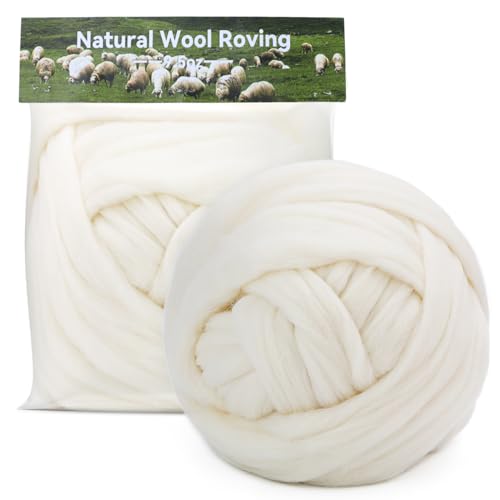
Craft County offers an affordable, accessible entry point for anyone curious about synthetic felting. This roving is soft, easy to handle, and comes in a wide variety of bright, saturated colors that don’t fade easily.
If you are just starting out, you don’t want to invest in expensive materials while you are still learning the mechanics of needle depth and tension. This fiber provides enough resistance to learn how to "sculpt" with a needle without being so tough that it causes hand fatigue.
The main trade-off is that it can produce more "fuzz" on the surface than higher-end synthetic tops. Use a finishing needle at the end of your project to gently tuck in any stray fibers and polish the surface.
Understanding Synthetic Fiber Felting Mechanics
Felting natural wool works because the fibers have microscopic scales that hook together under heat and agitation. Synthetic fibers, however, are smooth and lack these scales, meaning they rely entirely on mechanical entanglement.
When you needle felt synthetics, you are essentially creating a physical knot by pushing fibers into a core. This is why the "barbs" on your felting needles are so critical—they act as the hooks that the fiber itself lacks.
You must accept that synthetic felt will never achieve the same density as wool felt. View your project as a structural skeleton rather than a solid mass of fused fibers, and you will have much more success.
Why Vegan Fibers Require Needle Felting Tools
Because synthetic fibers cannot "felt" in the traditional sense of matting together, you cannot rely on the natural properties of the fiber to hold your shape. You are entirely dependent on the needle to do the heavy lifting.
This means your tool choice is non-negotiable. Using a dull needle on synthetic fiber is an exercise in frustration because it will simply push the fiber around rather than locking it into the core of your piece.
Invest in high-quality, sharp needles and replace them frequently. Synthetic fibers can be surprisingly abrasive, and a dull needle will not only make your work look messy but will also increase the risk of wrist strain.
Essential Techniques for Bonding Synthetic Fibers
The secret to bonding synthetic fibers is layering and multidirectional needling. Instead of stabbing in one spot, work in a circular or cross-hatch pattern to ensure the fibers are pulled in from all angles.
If you are joining two pieces together, use a "bridge" of fiber to connect them. Lay a small amount of loose roving across the seam and needle it into both sides, effectively sewing them together with the needle and fiber.
Always work on a firm foam pad. If your base is too soft, the needle will push the fiber through the project without actually creating the necessary tension to hold the fibers in place.
How to Care for Your Synthetic Felted Creations
Synthetic felt is generally more resilient than wool felt, as it is resistant to moths and does not shrink in the wash. However, it can still lose its shape if handled roughly or compressed for long periods.
If your piece becomes fuzzy over time, you can gently trim the surface with a pair of sharp embroidery scissors. Avoid pulling at the fibers, as this can loosen the internal structure you worked so hard to create.
For cleaning, a light spot-cleaning with cool water and a mild detergent is usually sufficient. Never put your felted sculptures in the dryer, as the high heat can melt the synthetic fibers or warp the structural shape of your work.
Mastering synthetic felting is a rewarding journey that requires patience, the right tools, and a shift in how you think about fiber. By choosing the right material for your specific project goals and respecting the mechanical nature of these fibers, you can create stunning, long-lasting art. Keep experimenting with different textures, and don’t be afraid to combine these synthetics to find your perfect blend. Happy crafting, and enjoy the endless possibilities of your next vegan-friendly fiber project.