7 Best Craft Knives For Intricate Leather Shapes
Master intricate leatherwork with our top 7 craft knife picks. Discover precision blades designed for clean, detailed cuts and superior control in every project.
Precision in leatherwork requires the same level of attention to detail as picking up a dropped stitch in a complex lace shawl. Just as the right needle tip can make or break your tension, the right craft knife determines the crispness of your leather edges. Selecting a cutting tool is a deeply personal choice that balances grip, blade geometry, and long-term comfort. This guide explores the best options to help you achieve professional-grade results in your leather projects.
X-Acto #1 Precision Knife: The Versatile Standard


Think of the X-Acto #1 as the bamboo circular needle of the leather world: it is ubiquitous, reliable, and found in almost every workshop. Its lightweight aluminum body is perfect for those who prefer a tool that doesn’t feel heavy in the hand during long cutting sessions.
Because it is so common, finding replacement blades is never a struggle, much like finding a standard worsted weight wool at any local craft store. The slim profile allows for excellent visibility, ensuring you can see exactly where your blade is meeting the leather.
However, the collet—the part that holds the blade—can sometimes loosen over time. If you find yourself constantly retightening it, consider it a sign that your grip might be too tense, similar to how a tight-knitter might fatigue their hands with thin metal needles.
Olfa AK-4 Professional Art Knife: Best for Control

The Olfa AK-4 is designed for those who need absolute stability, much like using a sturdy wooden needle when working with slippery silk yarn. Its rubberized grip provides a level of friction that prevents the tool from slipping during intricate cuts.
What sets this model apart is the weighted balance; it feels substantial without being cumbersome. This is a massive advantage when you are cutting thick vegetable-tanned leather, where a light, flimsy tool would simply bounce off the surface.
The blade-changing mechanism is also remarkably secure. You won’t have to worry about the blade wobbling mid-cut, which is essential when you are carving curves that require a steady, continuous motion.
Fiskars Detail Knife: Best Value for Beginners
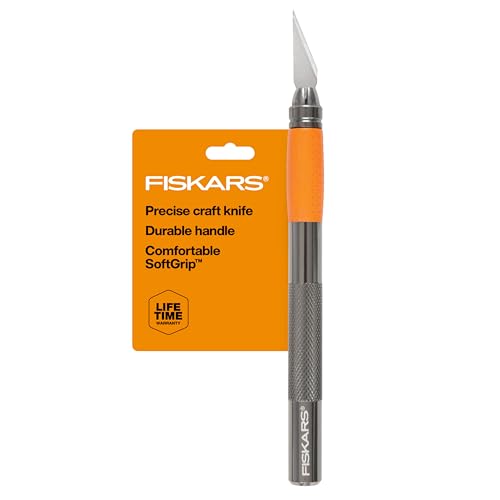
If you are just starting your leather journey, the Fiskars Detail Knife is a fantastic entry point. It is straightforward and functional, serving the same role as a basic set of aluminum needles for a knitter learning the fundamentals of stocking stitch.
The ergonomic shape is surprisingly comfortable for a budget-friendly tool. It lacks the bells and whistles of high-end surgical steel models, but it gets the job done without unnecessary complexity.
Keep in mind that the blade retention system is simpler than others on this list. It is perfectly adequate for light-to-medium leather projects, but it may show its limitations if you attempt to cut through heavy, multi-layered hide.
Excel Blades K1 Knife: Best for Heavy Duty Tasks
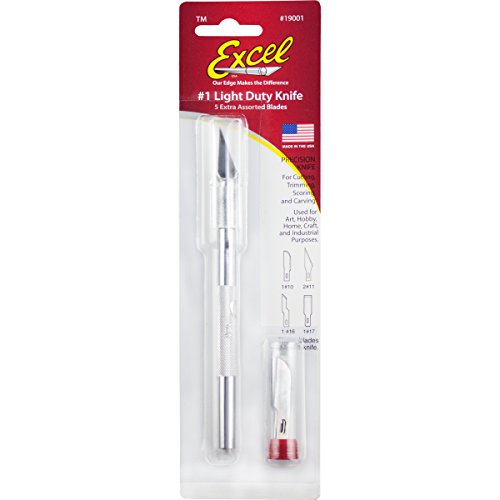
The Excel K1 is a workhorse, ideal for those who prefer the feel of a robust, heavy-duty needle when tackling a sweater made of chunky, unspun roving. Its solid construction means it can handle a bit more pressure without the handle flexing.
This knife excels when you need to make deep, clean cuts through thicker leather. It provides a level of rigidity that ensures your blade doesn’t deviate from your intended path.
The trade-off for this durability is a slightly heavier feel. If your project involves hours of continuous cutting, you might find your hand tiring faster than it would with a lighter, more delicate tool.
Swann-Morton Scalpel Handle: Precision Mastery

Using a Swann-Morton scalpel is like moving from standard needles to high-end, polished carbon fiber ones; the difference in performance is immediate and undeniable. These are the gold standard for surgical precision in leatherwork.
The blades are incredibly sharp and thin, allowing for effortless slicing through even the most stubborn grain. Because the blade is so thin, it creates almost zero resistance, which is perfect for intricate, tiny shapes.
Be warned: these blades are unforgiving. They are so sharp that they require a level of hand-eye coordination similar to managing a complex cable pattern without a cable needle.
NT Cutter D-400P Precision Knife: Ergonomic Pick

The NT Cutter D-400P is all about comfort, featuring a design that accommodates a natural, relaxed grip. If you have ever suffered from hand fatigue while knitting socks on tiny needles, you will appreciate how this tool keeps your wrist in a neutral position.
The body is designed to prevent rolling on your workbench, a small but significant feature that saves you from constantly chasing a dropped tool. It is a thoughtful design that prioritizes the maker’s comfort over time.
While it is excellent for long-term use, the blade changing process is slightly more involved than a simple twist-collet. It is a small price to pay for the ergonomic relief it provides during marathon crafting sessions.
Grafix Incredible Nib: Best for Intricate Curves
The Grafix Incredible Nib is a specialized tool, much like a specific needle size chosen for a particular gauge. It is not meant for straight lines, but for the tight, complex curves that define high-end leatherwork.
Its unique shape allows for a different angle of attack, making it easier to maneuver around tight corners. This is the tool you reach for when you are doing delicate inlay work or intricate decorative cutouts.
Because it is so specialized, it is not a "do-it-all" knife. Use it as a secondary tool to complement your main cutter, just as you would keep a set of double-pointed needles on hand for sleeves while using circulars for the body of a sweater.
How to Choose Blades for Detailed Leather Cutting
- Blade Geometry: Choose pointed tips for piercing and curved blades for sweeping, intricate cuts.
- Steel Quality: Higher carbon content stays sharper longer but can be more brittle.
- Blade Thickness: Thinner blades are better for intricate detail; thicker blades are better for structural integrity.
- Compatibility: Ensure your blade fits your handle securely; a loose blade is a dangerous blade.
Essential Safety Tips for Leather Crafting Tools
Always cut away from your body, maintaining a clear path for the blade in case of a slip. Keep your fingers behind the cutting edge at all times, treating the knife with the same respect you would a pair of sharp embroidery scissors.
Maintain a clean workspace, as clutter leads to accidents. When you are finished, always retract or cap your blade immediately, ensuring that your tools are stored safely out of reach.
Remember that a dull blade is more dangerous than a sharp one. A dull blade requires more force, which increases the likelihood of the knife jumping off the leather and causing an injury.
Maintaining Your Blades for Clean Leather Edges
Treat your blades like you treat your needles—keep them clean and free of debris. Wipe them down after every project to remove leather dust and oils, which can cause corrosion over time.
If you notice your cuts becoming jagged or requiring more force, it is time to change the blade. Think of it like replacing a damaged needle tip that snags your yarn; a fresh blade is the secret to a professional finish.
Finally, consider using a high-quality cutting mat to protect your blade edges. A hard surface will dull your blades faster than you can finish a row of purls, so always ensure you are cutting on a surface designed to preserve your edge.
Mastering the art of leather cutting is a journey of trial and error, much like finding your favorite yarn and needle combination. Don’t be afraid to experiment with different knives until you find the one that feels like an extension of your own hand. With the right tools and a bit of patience, your leather projects will achieve the same level of craftsmanship as your finest hand-knits. Happy crafting, and may your edges always be sharp and clean.