7 Best Lighting Lamps For Color Matching Artists Use
Achieve perfect color accuracy with our top 7 lighting picks. Learn which lamps provide the best CRI for artists to ensure precise, professional results.
Finding the perfect yarn color for a complex stranded colorwork project is a challenge that often ends in disappointment once you leave the shop. Natural daylight is the gold standard for color matching, but it is rarely available when we are deep into a midnight knitting session. The right lighting setup ensures that the subtle undertones of your wool don’t shift unexpectedly under artificial bulbs. Investing in high-quality illumination is just as important as choosing the right needle material for your specific tension.
Daylight Company Wafer 3: Best Overall Light Box


The Wafer 3 is a game-changer for those of us who spend hours squinting at charts or trying to distinguish between two nearly identical shades of navy yarn. Its ultra-slim profile means it doesn’t take up precious real estate on your pattern-cluttered desk.
Because it provides an even, edge-to-edge glow, you can lay your yarn skeins directly on top of the surface to see the true fiber composition. This is particularly useful when you are trying to spot "flaws" or variations in hand-dyed yarns before you commit them to a project.
The dimmable feature is essential here. You don’t need blinding intensity when you are just checking color contrast, but you will appreciate the boost when you are working with black mohair or other dark, light-absorbing fibers.
OttLite G-Series LED Floor Lamp: Best for Stash

When you have a dedicated corner for your yarn stash, you need a lamp that can reach across your shelves to illuminate every bin. The G-Series floor lamp is a workhorse that provides a wide, stable base of light, making it easy to pull colors and compare them in a larger space.
The adjustable neck allows you to direct light exactly where you need it, whether you are organizing your stash by color family or checking the labels on your superwash wools. It mimics natural daylight effectively, which prevents the frustration of buying a "neutral" yarn that turns out to be distinctly green once you get it home.
While it is a larger investment, the longevity of the LEDs means you won’t be changing bulbs every few months. It is a reliable, static solution for the knitter who wants a permanent, professional-grade lighting setup in their craft room.
BenQ ScreenBar Halo: Best Desk-Mounted Solution
If your knitting setup doubles as your computer desk, the ScreenBar Halo is the most elegant solution I have encountered. It clips onto the top of your monitor, casting light downward onto your workspace without creating any annoying glare on your screens or tablet.
This is ideal for those who follow digital patterns or watch knitting tutorials while they work. It keeps your desk surface clear, which is crucial if you are prone to spreading out multiple swatches and reference books while you plan your next sweater.
The auto-dimming sensor is a nice touch, but the real value is the focused beam. It illuminates your hands and your needles perfectly, reducing eye strain during long sessions of intricate lace or cabling where you need to see every stitch clearly.
Brightech Litespan LED Floor Lamp: Best Value
The Brightech Litespan is a fantastic middle-ground for the knitter who needs high-quality light without the premium price tag. It is lightweight, easy to move around, and offers a crisp, clear illumination that makes color-matching a breeze.
I often recommend this to beginners who are just starting to build their toolkit. It provides the essential high-CRI (Color Rendering Index) light you need to differentiate between subtle shades, which is vital when you are learning to read your stitches.
The base is sturdy enough to hold its position, but it is slim enough to slide behind a chair or a set of drawers. It’s a practical, no-nonsense tool that does exactly what it says on the box, leaving more room in your budget for high-quality yarn.
Neatfi XL 2,200 Lumens LED Lamp: Best Magnifier
For those of us working on fine-gauge projects, like delicate lace shawls on 2.00mm needles, the Neatfi XL is an absolute necessity. It combines a powerful light source with a massive magnifying lens, allowing you to inspect your work for dropped stitches or twisted loops with ease.
The 2,200 lumens provide an incredible amount of clarity. When you are using dark, high-twist yarns where the stitch definition is naturally harder to see, this lamp makes the texture pop, ensuring your tension remains consistent across every row.
The trade-off is the size; it is a substantial piece of equipment that requires a sturdy mounting point. If you have the desk space, however, the ability to see your work magnified and perfectly lit is a luxury that quickly becomes a standard part of your workflow.
Mighty Bright Stitch Light: Best Portable Option
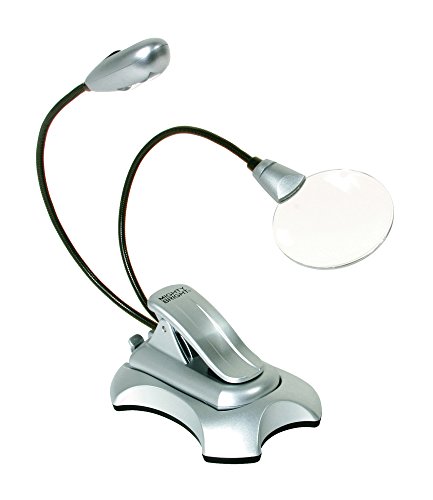
Sometimes you need to take your project to a knitting group or a long car ride, and the Mighty Bright Stitch Light is perfect for these scenarios. It clips directly onto your pattern holder or your shirt, providing a focused beam of light exactly where you need it.
It is not designed to light up a whole room, but it is excellent for keeping your hands and needles visible in low-light conditions. It is lightweight and compact, making it an easy addition to any project bag.
While it lacks the power of a full-sized floor lamp, it is a lifesaver when you are working on a project with dark yarn in a dimly lit environment. Keep a spare set of batteries in your notions pouch, and you will never be left in the dark.
Lepower Metal Architect Lamp: Best Budget Choice

The Lepower Architect Lamp is a classic for a reason: it is simple, adjustable, and affordable. Its swing-arm design allows you to position the light source at almost any angle, which is perfect for shifting light as your project grows or as you move your position in your favorite knitting chair.
It uses standard bulbs, which gives you the freedom to choose your own high-CRI LED bulb. This is a great way to customize your lighting environment without buying an entirely new lamp system.
Because it is made of metal, it is durable and holds its position well once tightened. It doesn’t have the bells and whistles of high-end lamps, but for the knitter who wants a reliable, adjustable light source on a budget, it is an excellent choice.
Why High CRI Lighting Matters for Color Matching
CRI stands for Color Rendering Index, a measurement of how accurately a light source reveals the true colors of an object. For knitters, a low CRI light can make a deep burgundy look like a muddy brown, which leads to disastrous colorwork combinations.
When you are stranded knitting or choosing contrasting colors for a project, you need a high CRI rating of 90 or above. This ensures that the red, blue, and yellow undertones in your yarn are rendered as they would appear in natural, midday sunlight.
High CRI lighting prevents the "color shift" that happens when you move from your craft room to the outdoors. If you are investing in expensive, hand-dyed wool, you owe it to your project to see the colors exactly as the dyer intended them to be seen.
Understanding Color Temperature and Kelvin Scale
Color temperature is measured in Kelvin (K), and it dictates the "mood" of the light. Lower Kelvin numbers (around 2700K) produce a warm, yellowish light, while higher numbers (5000K-6500K) produce a cool, daylight-like blue-white light.
For color matching, you want to aim for the 5000K to 5600K range. This is the "sweet spot" that mimics natural daylight, providing the most neutral environment for assessing how different yarn colors interact with each other.
Avoid using warm, yellow-tinted bulbs for color work, as they will wash out subtle differences between light colors. Conversely, extremely high Kelvin bulbs can make your workspace feel clinical and harsh, which might lead to eye fatigue during long knitting sessions.
Tips for Setting Up Your Ideal Knitting Workspace
Your workspace should be designed around your specific knitting habits, not just aesthetics. Start by ensuring your chair provides adequate lumbar support, as good posture is the foundation of long-term comfort while knitting.
Position your light source to minimize shadows on your needles. If you are right-handed, place your lamp on your left side to prevent your own hand from blocking the light as you work; reverse this if you are left-handed.
- Keep your tools organized: Use small trays for your stitch markers and scissors so they don’t clutter your light path.
- Use a neutral background: A light-colored desk or mat helps reflect light back onto your project, improving visibility.
- Test your lighting: Take a swatch outside in the sun, then bring it to your workspace; if the colors look drastically different, adjust your bulb’s Kelvin rating.
Lighting is the silent partner in every successful knitting project, often making the difference between a garment you love and one you never wear. By choosing high-quality, daylight-balanced lamps, you ensure that your color choices remain vibrant and accurate regardless of the time of day. Take the time to adjust your setup to minimize shadows and reduce eye strain, and your hands will thank you for years to come. Remember, the best tools are the ones that disappear into your workflow, allowing you to focus entirely on the rhythm of your stitches.