6 Best Rotary Cutters For Uniform Fringe Length
Achieve perfect, consistent fringe with these six top-rated rotary cutters. Our guide highlights precision tools designed for uniform, professional results.
Achieving perfectly uniform fringe on a hand-knitted shawl or a woven wall hanging can be the difference between a professional finish and a messy, amateur look. While scissors often lead to jagged, uneven edges, a sharp rotary cutter provides the clean, single-pass slice necessary for high-quality fiber work. This guide explores the best tools to ensure your fringe is as precise as your stitch gauge. With the right equipment, you can elevate your finished pieces to gallery-ready status.
OLFA 45mm Rotary Cutter: Best Overall Choice
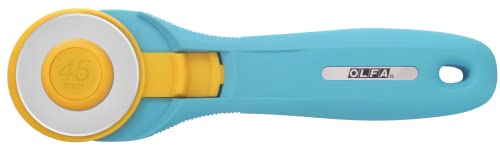

The OLFA 45mm is the gold standard for a reason, acting as the reliable workhorse of the quilting and fiber arts world. Its design is deceptively simple, focusing on a balance of weight and blade stability that prevents the "wobble" often seen in cheaper models.
When you are trimming a heavy wool fringe, you need a tool that doesn’t flex under pressure. The OLFA’s robust housing ensures the blade stays perpendicular to your cutting mat, which is critical for getting that crisp, blunt edge on thick yarn bundles.
The real beauty here is the blade change mechanism, which is intuitive and secure. If you are working with a delicate fiber like silk or bamboo, a dull blade will fray the ends; this cutter makes swapping to a fresh blade quick enough that you won’t be tempted to "just make it work" with a blunt one.
Fiskars 45mm Comfort Loop: Best Ergonomic Pick
If you suffer from hand fatigue after hours of knitting or finishing work, the Fiskars Comfort Loop is a game-changer. The unique loop handle allows you to maintain a grip without constantly squeezing, which is a massive relief for anyone with arthritis or carpal tunnel.
This design shines when you have to trim a long row of fringe, such as on a large rectangular wrap. Because the handle is shaped to fit your palm naturally, you can exert consistent downward pressure across the entire length of the project without your hand cramping up.
Keep in mind that the loop handle is quite large, which might feel bulky to those with smaller hands. However, the trade-off is superior leverage, making it easier to cut through multi-ply wools or dense cotton cords in one smooth motion.
Gingher 45mm Rotary Cutter: Precision Performance
Gingher is a name synonymous with high-end shears, and their rotary cutter carries that same reputation for industrial-grade precision. This tool feels substantial in the hand, offering a level of control that feels more like a surgical instrument than a craft tool.
For the knitter who demands perfection, the blade stability on the Gingher is unmatched. There is virtually no lateral movement in the blade, meaning your fringe will be perfectly square rather than angled or "chewed" at the base.
It is a heavier tool, which helps it glide through thick, lofty fibers like unspun roving or bulky-weight alpaca. While it may be overkill for light lace-weight fringe, it is an investment piece for the maker who produces large-scale fiber art regularly.
Clover 45mm Rotary Cutter: Best for Beginners
Clover tools are famous for their user-friendly design, and their rotary cutter is no exception. It features an easy-to-activate blade guard that snaps back into place the moment you release the handle, providing a layer of safety that is essential when you are still learning the rhythm of rotary cutting.
The handle is lightweight and slim, making it an excellent choice for beginners who aren’t yet used to the heft of professional cutting tools. It handles standard worsted and DK weight yarns with ease, providing a clean cut without requiring excessive force.
One thing to note is that the blade housing is slightly less rigid than the heavy-duty options. For most knitting projects, this is perfectly fine, but avoid trying to cut through extremely thick, braided rug yarns as you may notice a slight deflection in the blade.
Dritz 45mm Deluxe Cutter: Reliable Daily Tool

The Dritz Deluxe is the quintessential "utility" cutter that you’ll find in almost any well-stocked sewing room. It is straightforward, affordable, and gets the job done without any unnecessary bells or whistles.
Its strength lies in its consistency; it is a no-nonsense tool that is easy to disassemble for cleaning. If you are working with fibers that shed, like mohair or angora, being able to wipe out the housing easily is a major advantage.
While it lacks the specialized ergonomic grips of more expensive models, it is perfectly balanced for short sessions. It is the ideal "backup" cutter to keep in your project bag for quick fringe adjustments on the go.
Martelli 45mm Ergonomic: Best for Hand Strain
The Martelli cutter utilizes a unique, patented ergonomic handle that encourages a neutral wrist position. If you are a prolific knitter who spends your evenings finishing multiple projects, this tool is designed specifically to prevent the repetitive strain that comes from repetitive cutting motions.
The handle is designed to be held in a way that uses your arm strength rather than just your fingers. This makes it incredibly effective for cutting through multiple layers of fringe at once, which saves time when you are finishing a large shawl.
The learning curve for this handle shape is slightly steeper than a standard straight-handle cutter. Give yourself a few minutes to get used to the angle, and you will likely find that your fringe-cutting speed and accuracy improve significantly.
Why Rotary Cutters Are Essential for Fringe
Scissors are excellent for clipping yarn ends, but they are notoriously difficult to use for long, uniform lines. Even the sharpest shears tend to "push" the yarn as you close the blades, leading to a fringe that looks uneven or scalloped.
A rotary cutter, by contrast, uses a rolling motion that pins the yarn against the mat while slicing it. This prevents the fibers from shifting, ensuring that every strand of your fringe is exactly the same length.
- Consistency: Achieve perfectly straight lines across wide projects.
- Speed: Trim an entire shawl fringe in seconds rather than minutes.
- Cleanliness: Avoid the jagged, "chewed" look common with dull scissors.
How to Choose the Right Blade for Fiber Arts
Not all rotary blades are created equal, and the type of fiber you are working with dictates the blade you should use. For standard wool yarns, a sharp, standard-edge blade works perfectly.

If you are working with slippery fibers like silk or rayon, a slightly duller blade might actually cause the yarn to pull and fray. Always ensure you are using a fresh, high-quality steel blade to prevent these fibers from bunching up under the guard.
- Standard Blade: Best for general wool and acrylic yarns.
- Pinking Blade: Creates a decorative, zigzag edge for a unique aesthetic.
- Wave Blade: Produces a soft, undulating fringe for a more organic look.
Safety Tips for Using Rotary Cutters on Yarn
Rotary cutters are essentially razor-sharp circular knives, so treat them with the same respect you would a high-quality pair of shears. Always engage the safety lock the moment you finish a cut, even if you are just reaching for your next skein of yarn.
When cutting fringe, always use a self-healing cutting mat underneath your project. Cutting on a hard surface will dull your blade instantly, and cutting on a soft surface like a table or carpet will damage your furniture.
- Always cut away from your body.
- Keep fingers clear of the blade path.
- Never leave the blade exposed on your workspace.
Maintaining Your Blades for Clean Fringe Cuts
A dull blade is the enemy of a clean finish. As soon as you notice you have to apply extra pressure to get through the yarn, or if you see fibers snagging, it is time to change the blade.
To extend the life of your blades, avoid cutting through pins or metal markers that might be left in your knitting. After each session, wipe the blade with a soft cloth to remove any lint or fiber dust, which can build up inside the housing and interfere with the rotation.
- Change blades at the first sign of pulling.
- Store blades in their original case to prevent nicks.
- Use a dedicated cutting mat to protect the edge.
Mastering the art of the perfect fringe is a simple way to elevate your hand-knitted items from "homemade" to "heirloom." By choosing the right rotary cutter and maintaining your blades, you ensure that every project you finish looks as sharp as the stitches you worked so hard to create. Experiment with these tools, find the one that fits your hand best, and watch your finishing work transform. Happy crafting, and may your fringe always be perfectly aligned.