6 Best Loom Project Organizers For Supplies To Try
Keep your weaving supplies tidy with our top 6 loom project organizers. Discover durable, efficient storage solutions to streamline your crafting workflow today.
Keeping your loom supplies organized is the difference between a meditative crafting session and a frustrating search for misplaced pegs. Whether you are managing complex double-knitting projects or simple stockinette scarves, a chaotic workspace inevitably leads to dropped stitches and lost momentum. These six organizers offer practical solutions to keep your tools accessible and your creative flow uninterrupted. Investing in the right storage system saves you time, allowing you to focus entirely on your tension and pattern execution.
Everything Mary Rolling Craft Case: Best Overall


When you have a dedicated studio space or frequently travel to knitting guilds, the Everything Mary Rolling Craft Case is a game-changer. Its sheer volume allows you to store not just your loom and pegs, but also bulky skeins of yarn and project bags.
The rolling design is essential for protecting your back and shoulders, especially if you are hauling heavy wool or multiple looms. It features deep interior pockets that are perfect for keeping your circular needles and loom hooks upright, preventing them from bending or snagging delicate fibers.

However, consider your storage space before purchasing. This case is substantial and requires a dedicated footprint in your craft room. If you are working in a smaller apartment or a shared living area, the footprint might be too large for daily use.
ArtBin Super Satchel Box: Best For Loom Storage
The ArtBin Super Satchel is a classic for a reason: it is designed specifically for the dimensions of standard craft equipment. Its depth accommodates most knitting looms without requiring you to disassemble your setup, which is a major time-saver when you are in the middle of a project.
The box is made of durable, acid-free plastic, which is vital if you are storing vintage looms or delicate wooden accessories. You won’t have to worry about chemical off-gassing affecting your natural fibers or wooden tools over time.
While it is excellent for loom storage, it lacks internal dividers for smaller accessories like row counters or tapestry needles. You will likely need to pair this with smaller pouches or tins to keep your tiny notions from rattling around.
Creative Options Pro-Latch Box: Best For Small Parts
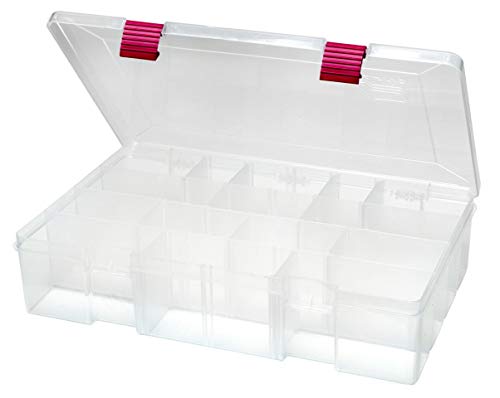
If you find yourself constantly losing your loom pegs or stitch markers, the Creative Options Pro-Latch Box is your best defense. The adjustable dividers allow you to customize the compartment sizes to fit specific items, ensuring that your 2.25mm sock needles don’t get mixed up with your tapestry needles.
The "Pro-Latch" mechanism is sturdy and reliable, which is a critical feature if you tend to toss your bag into the car on your way to a knit night. There is nothing worse than arriving at a group session only to find your pegs scattered at the bottom of your tote.
The primary tradeoff here is the rigid plastic construction. It is not ideal for storing yarn, as the edges of the compartments can catch on delicate mohair or hand-dyed wool if you aren’t careful. Keep this strictly for your hardware and hard tools.
Sterilite Stack & Carry Organizer: Best Budget Pick
The Sterilite Stack & Carry is the ultimate solution for the knitter on a budget who needs modularity. Because the units stack vertically, you can start with one or two layers and expand your collection as your stash grows.
These are perfect for separating your supplies by project type or gauge. For instance, you could dedicate one tray to your fine-gauge loom tools and another to your bulky-weight loom accessories.
Be mindful that these are intended for light-duty storage. The plastic latches are functional, but they are not as heavy-duty as the professional-grade cases. If you travel frequently, use a strap to secure the stacks together to prevent them from separating in transit.
Plano 3700 StowAway Utility Box: Best For Sorting

Originally designed for fishing tackle, the Plano 3700 has become a staple in many knitting rooms for a reason: the sheer variety of compartment configurations is unmatched. It is the best choice for knitters who have an extensive collection of loom pegs in various sizes and shapes.
The transparent lid allows you to see exactly what you have at a glance. When you are trying to decide between a 1/2 inch or 5/8 inch gauge loom for a new hat pattern, being able to identify your tools without opening every box is incredibly efficient.
The only downside is the lack of depth. These boxes are thin, meaning they won’t hold larger items like your loom hooks or measuring tapes. They are best used as a secondary organizer to complement your larger storage solutions.
Beadsmith Large Tool Organizer: Best For Loom Pins

If your loom setup involves intricate pin-work or specialized loom pins that are easily damaged, the Beadsmith Large Tool Organizer is a superior choice. Its padded or compartmentalized interior is designed to protect delicate metal components from scratching or bending.
When you are working with precision tools, you want a container that prevents them from clattering against each other. This organizer keeps everything in its place, which helps maintain the integrity of your tools over years of use.
While it is fantastic for pins and needles, it is not a "catch-all" organizer. It lacks the space for bulky items, so think of this as a specialized tool chest rather than a primary storage solution for your loom itself.
How To Select The Right Loom Supply Organizer Case
Choosing an organizer comes down to your specific project habits and storage environment. If you primarily knit on the go, focus on cases with secure, locking lids and a compact profile. If you have a permanent studio, prioritize capacity and ease of access.
Consider the material of your loom and tools as well. Plastic organizers are generally safe, but ensure they are BPA-free if you are storing delicate, hand-dyed yarns alongside your metal tools to prevent any unwanted chemical reactions.
Finally, always overestimate your storage needs. We have a tendency to accumulate needles, pegs, and notions over time, so leaving 20% of your storage space empty is a smart move for future growth.
Essential Loom Supplies Every Knitter Should Keep
Beyond the loom and pegs, your kit should always include a few non-negotiable items. A high-quality loom hook is essential; a poorly made one will snag your yarn and cause fraying, especially with single-ply or loosely spun fibers.
- Tapestry needles: For weaving in ends and seaming.
- Row counter: Vital for keeping track of pattern repeats and cable crossings.
- Measuring tape: Essential for checking gauge and project length.
- Stitch markers: Helpful for marking increases or decreases on the loom.
Don’t forget a small pair of sharp embroidery scissors. Keep them in a protective sheath inside your organizer to ensure they stay sharp and don’t damage your yarn stash.

Tips For Organizing Your Loom Pegs And Accessories
The best way to organize pegs is by size or color-coding if your system allows it. If you have multiple looms, keep the pegs for each loom in separate, clearly labeled containers to avoid the frustration of trying to fit a large peg into a small-gauge hole.
Use small silicone cups or magnetic trays inside your larger boxes to hold the pegs you are currently using for a project. This prevents them from rolling off the table and disappearing into the carpet, which is a common hazard for knitters.
If you are using a clear plastic box, keep an index card inside with the gauge of the loom the pegs belong to. This simple step saves you from having to measure the pegs every time you start a new project.
Maintaining Your Loom Tools For Long Term Longevity
Your loom tools are an investment, and proper maintenance will keep them functioning for decades. After every project, wipe down your loom and pegs with a soft, dry cloth to remove any natural oils or fiber dust that may have accumulated.
If you use wooden looms, consider a light application of beeswax or a specialized wood conditioner once a year to prevent the wood from drying out or splintering. For metal tools, ensure they are stored in a dry environment to prevent any potential oxidation or rust.
Always check your loom hooks for burrs or rough edges before starting a new project. If you find a snag, use a fine-grit sanding sponge to smooth it out; a smooth tool is the secret to even, consistent tension and a professional finish.
Organizing your loom supplies is an act of respect for your craft and your time. By choosing the right case and maintaining your tools with care, you create a space where your creativity can thrive without the interference of clutter. Take the time to set up a system that works for your unique knitting style, and you will find that your projects become much more enjoyable. Happy knitting, and may your stitches always be even.