7 Best Stitch Counters For Circular Knitting To Try
Keep track of your circular knitting projects with ease. Explore our top 7 stitch counter picks to ensure accuracy, improve efficiency, and simplify your craft.
Keeping track of your rows while working on a circular project can be the difference between a perfectly symmetrical sweater and a frustrating case of misaligned cables. Whether you are working on a simple stockinette cowl or an intricate lace yoke, a reliable counting system is an essential part of your knitting toolkit. With so many options available, finding the right tool depends entirely on your personal rhythm and project complexity. This guide explores the best stitch counters to help you maintain your flow and finish your projects with confidence.


Cocoknits Maker’s Keep: Best Wearable Counter
The Maker’s Keep is a brilliant solution for those of us who constantly lose our tools in the sofa cushions. It functions as a stylish silicone slap bracelet embedded with a powerful magnet, keeping your row counter, stitch markers, and tapestry needles within arm’s reach.

When you are working on a complex circular project, you don’t want to break your concentration to hunt for a dropped counter. By wearing your tools, you keep your focus on the tension and the stitch pattern, which is vital when working with delicate fibers like alpaca or silk.
The primary trade-off here is the bulk on your wrist, which might feel cumbersome if you are knitting tight, fast-paced stranded colorwork. However, for the knitter who values organization above all else, this is an unmatched tool. Keep your most-used notions attached to your wrist to minimize distractions.
Clover Kacha-Kacha: The Classic Clicker Choice
The Kacha-Kacha is a staple in many knitting bags for good reason. Its satisfying, tactile "click" provides immediate auditory feedback, confirming that you have successfully logged your row.
This counter is particularly useful for circular knitting because it can be locked to prevent accidental clicks when it’s tossed into a project bag. If you are working on a large-scale project like a circular blanket, the lock feature ensures your row count remains accurate even when the bag is jostled during travel.
Some knitters find the plastic construction feels a bit "cheap," but its lightweight nature is a major benefit during long knitting sessions. It is a simple, no-nonsense tool that does exactly what it promises without requiring batteries or complex menus. Choose this if you want a reliable, mechanical counter that never runs out of power.
Row Counter Ring: Sleek And Minimalist Design
If you prefer a low-profile approach, the row counter ring is an elegant choice that sits discreetly on your finger. By simply rotating the dial with your thumb, you can track your progress without ever putting down your needles.
This is exceptionally helpful for circular knitting, where maintaining a consistent tension is key to avoiding "laddering" between needles. Because your hands stay in the knitting position, you are less likely to lose your place in a complicated repeat.
The downside is that these rings can be finicky for knitters with larger fingers or those who prefer a looser grip on their needles. It requires a bit of dexterity to spin the dial, but for many, it becomes a seamless part of the knitting motion. This is the best option for knitters who want to keep their hands on the needles at all times.
KnitIQ Digital Counter: Best For Large Projects

Digital counters like the KnitIQ offer features that mechanical ones simply cannot, such as multiple row counts and a backlit display. When you are juggling several circular projects at once, being able to save your progress is a game-changer.
If you are working on a large garment with complex shaping, the ability to track different sections simultaneously is invaluable. You can keep one count for the overall length and another for your sleeve increases, ensuring you don’t lose track of your math mid-project.
The trade-off is the reliance on a battery, which can fail at the most inconvenient moment. Always keep a spare battery in your notions kit if you choose a digital model for a long-term project. Invest in a digital counter if your projects involve complex math or multiple simultaneous counts.
ChiaoGoo Plastic Counter: Reliable And Simple

The ChiaoGoo plastic counter is a classic "pendant style" counter that hangs around your neck or attaches to your project bag. It is lightweight, inexpensive, and incredibly easy to read at a glance.
For circular knitting, especially when using circular needles with long cables, this counter is unobtrusive. You can simply hang it from your work or keep it on the table beside you, making it a great "set it and forget it" option.
While it lacks the bells and whistles of digital models, its simplicity is its greatest strength. It is durable enough to withstand being dropped on a hardwood floor, and it doesn’t require any technical knowledge to operate. This is a fantastic entry-level choice for knitters who want a reliable, no-fuss counting method.
Susan Bates Hand Counter: The Budget Favorite
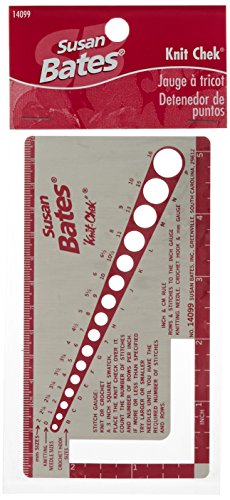
The Susan Bates hand counter is a tried-and-true classic that many knitters have used for decades. It is a simple, handheld device that you manually click, offering a very tactile way to track your progress.
Because it is small and fits comfortably in the palm of your hand, it doesn’t interfere with your knitting technique. This is perfect for those who find wearable counters too distracting or bulky.
The main disadvantage is that it is easy to misplace or accidentally click if it rolls around in your bag. However, given its low price point, it is an excellent tool to keep in multiple project bags so you are never without a way to track your rows. Buy a few of these to keep stashed in every project bag you own.
Knitter’s Pride Row Counter: Best For Needles

This clever device slides directly onto your needle, allowing you to track rows as you work. It is designed to fit specific needle sizes, which keeps your count directly attached to your current project.
This is particularly useful for circular knitting because it keeps the counter right where your eyes are naturally focused. You don’t have to look away from your work to find your place, which helps maintain your rhythm and gauge.
The catch is that you must be mindful of the needle size you are using; if you switch from a 3.5mm needle to a 5.0mm needle, you will need a different counter. It can also add a slight weight imbalance to one side of your circular needle, which some sensitive knitters might notice. Use this if you prefer your tools to be physically integrated with your needles.
How To Choose A Counter For Circular Knitting
Choosing the right counter often comes down to your personal "knitting style." Do you prefer to keep your hands still, or do you enjoy the tactile click of a button?
Consider the weight and ergonomics of the tool. If you are knitting with heavy wool or large-diameter needles, a bulky counter on your wrist might cause fatigue. Conversely, if you are working on lace with fine needles, a light, unobtrusive counter is essential to avoid distorting your stitches.
Ultimately, the best counter is the one you actually remember to use. If you find yourself forgetting to click, you need a system that is integrated into your natural flow, such as a wearable ring or a needle-mounted counter.
Manual Versus Digital: Which Style Suits You?
Manual counters are the workhorses of the knitting world. They are durable, require no batteries, and offer a satisfying physical sensation that many knitters find grounding.
Digital counters are better suited for the "data-driven" knitter. If you are working on a project with complex charts or multiple stitch patterns, the ability to store counts and use a backlight is a significant advantage.
However, remember that digital tools introduce a point of failure. If your battery dies mid-row, you might lose your place entirely. If you choose digital, always have a backup plan, like keeping a paper notepad nearby to jot down your row count at the end of every session.
Tips For Staying On Track With Complex Patterns
When working on complex circular patterns, don’t rely solely on your counter. Use stitch markers to denote repeats or the start of a new section, as these provide a visual check that aligns with your row count.
If you are working on a project with multiple repeats, write your count on a sticky note and attach it to your project bag. This acts as a secondary verification, ensuring that even if you accidentally click your counter twice, you have a baseline to refer back to.
Finally, always count your stitches at the end of a pattern repeat. A row counter tracks your progress, but stitch counts confirm your accuracy; using both in tandem is the best way to catch errors before they become impossible to fix.
Finding the perfect stitch counter is a journey of trial and error that reflects your unique way of working with fiber. Whether you opt for the simplicity of a manual clicker or the precision of a digital display, the goal remains the same: to keep your hands moving and your mind at ease. Choose a tool that feels natural to your process, and you will find that your circular projects become much more enjoyable. Happy knitting, and may your row counts always be accurate.