6 Best Glare Free Task Lamps For Dark Mohair Projects
Struggling to see dark mohair stitches? We’ve tested 6 glare-free task lamps that provide superior illumination to help you craft with precision and ease.
Working with dark mohair is notoriously difficult because the halo of the fiber tends to swallow light, making it nearly impossible to see your stitches. Without the right task lighting, you risk dropping stitches or miscounting rows in your lace patterns. These six lamps are curated specifically to cut through the darkness and provide the high-contrast illumination necessary for fine-gauge fiber work. Investing in a quality light is just as important as choosing the right needles for your project.
BenQ Genie E-Reading Lamp: Best Overall Choice


The BenQ Genie is a game-changer because of its unique curved head, which provides a remarkably wide, uniform pool of light. When you are working on a large shawl in midnight blue mohair, you need coverage that doesn’t create hot spots on your yarn.
This lamp excels because it eliminates the harsh glare that typically bounces off metallic needles. If you have ever felt eye strain after a long session of brioche knitting, the flicker-free LED technology here will be a welcome relief.
The trade-off is the significant footprint of the base on your side table. However, for the sheer consistency of the illumination, it is the gold standard for long-term projects.
OttLite ClearSun LED Floor Lamp for Precision

OttLite is famous for its proprietary ClearSun technology, which mimics the natural spectrum of daylight. When you are color-matching dark mohair or trying to distinguish between charcoal and black, this lamp offers the most accurate color rendering on the market.
Precision is the name of the game when you are working with mohair. Because the fiber is so fuzzy, you need to see the exact structure of the stitch to avoid snagging the yarn with your needle tip.
While the base is sturdy, the neck can sometimes be a bit stiff to adjust. It is a small price to pay for the clarity it provides during late-night knitting sessions.
Lepower Architect Desk Lamp for Mohair Work

If you prefer a classic, industrial aesthetic, the Lepower Architect lamp is a reliable workhorse. Its adjustable arm allows you to position the light source directly over your hands, which is crucial for minimizing shadows when working with dark, airy fibers.
This lamp is particularly effective for knitters who like to move their light source frequently. You can clamp it to a table or use the base, making it versatile for different knitting nooks.
The main downside is that the bulb is not always integrated, so you must choose your own LED bulb carefully. Look for a "Daylight" balanced bulb to ensure you aren’t casting a yellow hue over your work.
Brightech Litespan LED Magnifying Floor Lamp
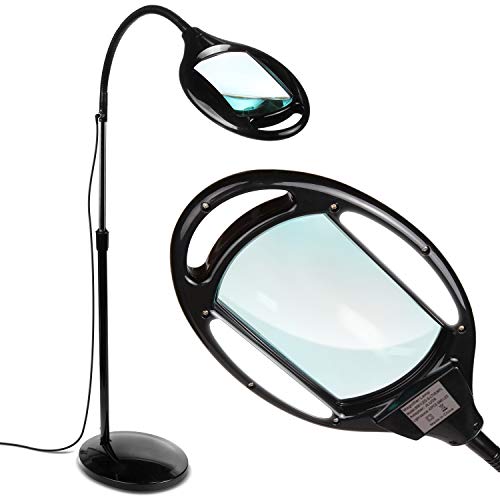
Magnification is often the secret weapon for knitters working with dark, lace-weight mohair. The Brightech Litespan combines a bright LED ring with a high-quality glass lens, allowing you to see the "anatomy" of every stitch clearly.
This is ideal for checking your work for dropped stitches or verifying that your yarn-overs haven’t twisted. If you find yourself squinting at your dark mohair, the magnification will instantly reduce that fatigue.
Be aware that the focal length on magnifying lamps takes a little getting used to. You will need to position your needles at just the right distance to keep the stitch in sharp focus.
TaoTronics LED Desk Lamp with Eye Care Tech

The TaoTronics lamp offers a fantastic array of color temperatures and brightness levels, which is vital for different times of the day. Sometimes, a cooler light is better for seeing dark fibers, while a warmer tone is easier on the eyes during the evening.
Its sleek, foldable design makes it perfect for knitters with limited space. You can tuck it away when you aren’t working on your mohair project, keeping your craft area tidy.
While it lacks the heavy-duty reach of a floor lamp, it is arguably the best "bang for your buck" for a dedicated knitting desk. It provides enough focused light to make dark mohair visible without overwhelming your space.
Daylight Company Slimline 3 LED Floor Lamp

The Slimline 3 is a professional-grade tool favored by many knitters who do this for a living. It features a very long, slim head that illuminates a huge area, ensuring that your entire knitting project—not just the needle tips—is bathed in light.
The light output is exceptionally bright, which is exactly what you need when dealing with the light-absorbing properties of mohair. It is dimmable, so you can dial back the intensity once your eyes have adjusted.
It is an investment piece, but the build quality is superior. If you are a prolific knitter who finishes several sweaters a year, this lamp will pay for itself in saved eyesight.
Understanding Color Temperature for Fiber Arts
Color temperature is measured in Kelvin (K), and it dictates the "mood" of your light. For dark mohair, you generally want to aim for the 5000K to 6500K range, which is considered "Daylight" or "Cool White."
- 2700K – 3000K: Warm, yellow light; great for cozy reading, but poor for dark yarn.
- 4000K – 5000K: Neutral white; a good middle ground for general crafting.
- 5000K – 6500K: Cool daylight; essential for seeing stitch definition in dark fibers.
Using a light that is too yellow can make dark colors look muddy and indistinguishable. Always check the Kelvin rating on your bulbs or lamps before purchasing.
Why Glare Free Lighting Saves Dark Mohair Work
Dark mohair is a nightmare for glare because the halo reflects light differently than smooth, plied wool. If you have a glossy needle, a cheap light will create a "glare spot" that blinds you every time you move your hands.
Glare-free lighting uses diffusers to spread the light evenly, preventing those harsh reflections. This allows you to focus on the stitch definition rather than fighting against the light bouncing off your tools.
When you can see the structure of the stitch without glare, your tension becomes more consistent. You aren’t just working faster; you are working with more confidence.
Positioning Your Lamp to Avoid Stitch Shadows
The biggest mistake knitters make is placing the light directly behind them, which casts your own shadow over your work. Instead, position your lamp to the side of your dominant hand, angled slightly toward your needles.
If you are left-handed, reverse this to ensure your hand doesn’t block the light source. The goal is to have the light hit the yarn from an angle that highlights the texture of the mohair.
If you are using a floor lamp, try to place it slightly behind your shoulder, angled down. This creates a "wash" of light that covers your lap and your needles simultaneously.
Essential Features for Knitting Task Lighting
When shopping for your next lamp, prioritize these specific features to ensure it serves your fiber arts needs:
- Dimmability: Allows you to adjust intensity based on the time of day.
- Adjustable Neck/Arm: Crucial for directing light exactly where the action is.
- High CRI (Color Rendering Index): Look for a CRI of 90+ to ensure colors look true to life.
- Flicker-Free Technology: Essential for preventing the subtle eye strain that ruins a long knitting session.
Don’t settle for a generic desk lamp. Your eyes are your most important tool, and they deserve a light source that supports your craft rather than hindering it.
Choosing the right lamp for dark mohair is an investment in your long-term comfort and the quality of your finished garments. By focusing on high color rendering, adjustable positioning, and glare-free diffusion, you can transform a frustrating project into a joy to knit. Remember that your lighting needs may change as you move between different yarn weights and colors, so prioritize versatility. Happy knitting, and may your stitches always be easy to see.