6 Best Blending Boards For Gradient Batts To Try
Discover the top 6 blending boards for creating stunning gradient batts. Learn which tools offer the best control and texture for your custom fiber projects.
Crafting your own gradient batts is one of the most rewarding ways to control the color flow and texture of your handspun yarn. By blending fibers on a board, you can transition seamlessly between shades or mix textures to create a truly one-of-a-kind spinning experience. Choosing the right blending board is the first step toward transforming raw, chaotic fiber into a cohesive, artistic masterpiece. Let’s explore the top tools that will help you master the art of the gradient.
Strauch Petite Blending Board: Best for Portability
If you find yourself wanting to blend fiber while traveling or during guild meetings, the Strauch Petite is a game-changer. Its compact footprint means it won’t dominate your limited table space, yet it retains a high-quality carding cloth that grips fiber effectively.
The smaller surface area is ideal for those who prefer working in smaller batches. You won’t be overwhelmed by the amount of fiber you’re handling at once, which makes it much easier to control the precision of your color transitions.
However, keep in mind that a smaller board means smaller batts. If you are planning to spin a large-scale project like a heavy sweater, you will spend more time blending multiple small batts rather than one large one.
Ashford Blending Board: The Industry Gold Standard


The Ashford board is a staple in studios worldwide for a reason. Its sturdy construction and reliable carding cloth make it the go-to choice for spinners who want a consistent, professional-grade tool that will last for decades.
The board features a generous surface area, allowing you to layer your colors with plenty of room to spare. This is particularly helpful when you are working with long-staple fibers that need extra space to be laid out without tangling.
Some may find the board a bit heavy, but this weight acts as an anchor, keeping it from sliding around while you work. It’s a reliable workhorse that handles everything from delicate silk blends to robust, greasy wools with ease.
Brother Sister Fiber Co. Board: Premium Craftsmanship

When you pick up a blending board from Brother Sister Fiber Co., you are immediately struck by the beautiful woodwork. These boards are handcrafted with an attention to detail that elevates the entire fiber preparation process from a chore to a ritual.
Beyond the aesthetics, the functionality is top-tier. They often feature specialized carding cloth that is incredibly gentle on delicate fibers, which is essential if you are working with luxury blends like angora or cashmere.
The higher price point reflects the artisan quality of the construction. If you view your fiber tools as an investment that should be both functional and beautiful to look at, this is the board for you.
Woolery Adjustable Blending Board: Best Ergonomics
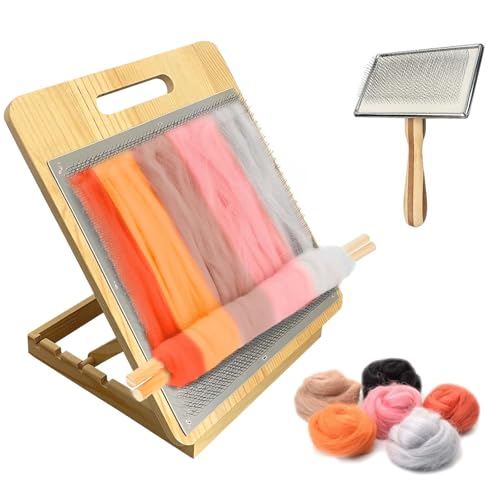
Spinning and blending can be taxing on your wrists and shoulders if your posture isn’t optimized. The Woolery’s adjustable design allows you to change the angle of the board, reducing strain during long blending sessions.
Being able to tilt the board toward you means you can see your color gradients more clearly as they develop. This is a massive advantage when you are trying to achieve a subtle, painterly transition between two distinct hues.
While the adjustable mechanism adds a layer of complexity to the design, it is well worth it for the physical comfort it provides. It is an excellent choice for makers who have experienced repetitive strain or simply want to prioritize ergonomic health.
Schacht Blending Board: Durable and High Capacity
Schacht is well-known for their robust looms and wheels, and their blending board follows that same philosophy of heavy-duty utility. This board is built to withstand heavy use and is perfect for those who like to create large, dense batts.
The carding cloth is exceptionally durable, meaning it won’t lose its "bite" even after years of processing coarse wools. It’s a fantastic option if you tend to blend a lot of high-volume, structural fibers for rug yarn or heavy-duty outerwear.
Because of its high capacity, it can be a bit intimidating for a total novice. However, if you are looking for a tool that will never let you down, the Schacht is a reliable, long-term partner for your studio.
Nancy’s Knit Knacks Board: Great for Beginners
Nancy’s Knit Knacks offers a board that prioritizes ease of use and clear, logical design. It is the perfect entry point for someone who has never touched a blending board but wants to start experimenting with color blending immediately.
The board is lightweight and approachable, removing the "fear factor" that often comes with complex fiber tools. It is designed to be intuitive, allowing you to focus on the creative process rather than the mechanics of the board itself.
While it may lack the advanced features of a professional-grade studio board, it is more than capable of producing stunning gradients. It’s the ideal tool to learn on before deciding if you need to upgrade to something more specialized later.
Understanding TPI: Choosing Your Carding Cloth Density
TPI, or "teeth per inch," is the most critical technical specification when buying a board. A higher TPI means the teeth are packed more closely together, which is essential for fine, short-staple fibers like Merino or cotton.
Conversely, a lower TPI is better suited for long-staple, coarser wools like Lincoln or Border Leicester. If you use a high-TPI cloth on coarse fiber, you will find it incredibly difficult to pull the fiber off the board, leading to frustration.
- 108 TPI: Best for fine, delicate fibers.
- 72 TPI: The "all-rounder" for medium-staple wools.
- 54 TPI: Ideal for long, coarse, or lustrous fibers.
Essential Tools for Creating Perfect Gradient Batts
You cannot create a perfect batt with the board alone; you need a few key accessories to ensure the fiber is evenly distributed. A good set of blending brushes is non-negotiable for pushing fiber into the teeth of the board.
A blending dowel is also essential for rolling your finished batt off the board. Without a smooth, sturdy dowel, you risk distorting your carefully crafted gradient as you remove it from the cloth.

- Blending Brushes: For smoothing and securing fibers.
- Blending Dowel: For rolling off clean, uniform batts.
- Tensioning Tool: To ensure your fiber is laid down evenly.
How to Properly Clean and Maintain Your Fiber Tools
Fiber tools are magnets for dust, grease, and vegetable matter. If you don’t clean your board regularly, the teeth will become clogged, making it impossible to get a smooth, consistent blend.
Use a stiff-bristled brush to clear out stray fibers after every session. Occasionally, you may need to use a specialized cleaning comb to remove deeply embedded debris from the base of the carding cloth.

Avoid getting the wooden base wet, as this can cause it to warp over time. Keeping your board in a dust-free environment when not in use will significantly extend the life of the carding cloth.
Technique Tips for Smooth Gradient Batt Transitions
To achieve a seamless gradient, start by laying down a thin base layer of your lightest color. Gradually introduce your second color in small, overlapping sections, rather than trying to blend two large blocks of color at once.
Use your blending brush to gently "flick" the colors together at the transition point. The key is to work in small, incremental layers, building up the depth of the color slowly until the transition is invisible to the eye.
Don’t be afraid to pull the fiber off and re-card it if the transition looks too abrupt. The beauty of a blending board is that you can always re-process the fiber until the gradient is exactly the way you envisioned it.
Mastering the blending board is a journey of patience, color theory, and tactile discovery. Whether you choose the portable Strauch or the robust Schacht, the best tool is the one that invites you to sit down and create. Take your time with your gradients, experiment with different fiber combinations, and remember that every batt you blend brings you closer to your perfect handspun yarn. Happy blending!