7 Best Blocking Boards For Final Shaping Reviewed
Discover the top 7 blocking boards to perfect your knitwear. We review materials and features to help you achieve professional-grade shaping for every project.
Blocking is the single most transformative step in the knitting process, turning a lumpy, uneven fabric into a professional-looking garment. Choosing the right blocking board can be the difference between a frustrating afternoon of pinning and a seamless finishing experience. Whether you are working with delicate lace or heavy wool sweaters, the right surface ensures your hard work maintains its intended shape. This guide explores the best tools currently available to help you achieve that perfect, final finish.
Knitter’s Pride Knit Blockers: Best Overall Pick


These aren’t traditional boards, but they are the most revolutionary tool for anyone tired of wrestling with individual T-pins. The Knit Blockers are essentially wide plastic combs with multiple rust-proof pins embedded in them.
They allow you to secure long, straight edges in seconds rather than minutes. If you’re blocking a scarf or the side seams of a sweater, they provide consistent tension that individual pins simply cannot match.
The tradeoff here is that they don’t work well for tight curves or complex, circular motifs. However, for the vast majority of standard garments, they are a massive time-saver that keeps your edges perfectly straight.
Grass Roots Foam Blocking Mats: Best for Large Items

When you are blocking a full-sized adult sweater or a large circular shawl, standard-sized boards feel like a game of Tetris. Grass Roots mats are designed to be expansive, providing a massive, continuous surface area.
The foam is dense enough to hold pins securely without feeling like it’s disintegrating after a few uses. This durability is essential when you have heavy, wet wool that needs to be stretched and held under tension for 24 hours.
If you have the floor space, these mats are an investment in your sanity. Just be mindful that they take up significant room; if you live in a small apartment, ensure you have a dedicated space where they can stay undisturbed while the project dries.
Exquisite Knits Wooden Boards: Best for Lace Work
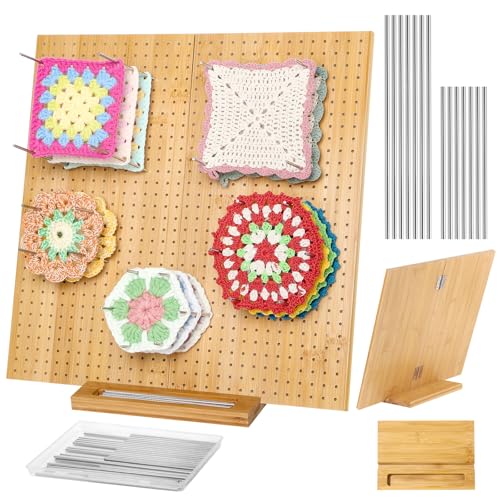
For those who prioritize precision and longevity, wooden blocking boards are the gold standard. Exquisite Knits offers a surface that feels substantial and provides a rigid base for delicate lace work.
Lace requires aggressive stretching to open up the yarn overs and intricate stitch patterns. A wooden board provides a firm resistance that won’t flex or bow under the tension of high-gauge lace projects.
While they are heavier and less portable than foam, they are an heirloom-quality tool. They are best suited for the knitter who frequently works with silk, alpaca, or fine wool blends that require careful, deliberate shaping.
Clover Blocking Mats: Best for Small Projects

If your knitting life revolves around socks, mittens, or baby hats, you don’t need a massive floor setup. Clover mats are compact, portable, and incredibly easy to store in a project bag or drawer.
The surface is specifically engineered to be gentle on delicate fibers, ensuring you don’t snag your yarn while pinning. They are perfect for blocking items that require frequent, small-scale maintenance.
Because they are smaller, they are also easier to move around your home to find the perfect drying spot. If you are a beginner who mostly knits accessories, start here before investing in a full-sized floor system.
Magma Blocking Mats: Best Heat Resistant Surface
Steam blocking is a powerful technique for acrylics and wools, but it can melt cheaper foam mats. Magma mats are designed specifically to handle the heat of a steam iron or a garment steamer without warping.
This heat resistance is a game-changer for knitters who work with synthetic fibers or superwash wools that respond better to steam than wet blocking. You can press your iron directly over the surface with much more confidence.
They are a bit more expensive than standard foam, but the peace of mind is worth the cost. If you find yourself frequently using steam to "set" your stitches, this is the safest choice for your workspace.
KnitIQ Blocking Mats: Best for Grid Accuracy
Precision is vital when you are blocking two sweater sleeves to match perfectly. KnitIQ mats feature a very clear, durable grid printed directly onto the surface, which acts as a built-in ruler.
This grid takes the guesswork out of symmetry. You can align your stitches to the lines, ensuring that your left and right panels are identical in width and length.
The material is also high-density, meaning it won’t crumble even after years of heavy pin use. For the perfectionist knitter, the grid is not just a feature—it’s a necessity for professional-grade results.
Cocoknits Blocking Tiles: Best Modular Design
Cocoknits has mastered the modular approach, offering tiles that connect seamlessly to create any shape you need. Whether you are blocking a long, narrow scarf or a wide, boxy pullover, you can reconfigure the tiles to fit.
The material is sturdy and the connectors are tight, so you won’t end up with gaps between your boards. They also store flat, making them an excellent choice for knitters with limited storage space.
The aesthetic is clean and modern, which is a nice bonus if your blocking area is in a shared living space. These are the most versatile option for a knitter whose project sizes fluctuate wildly from month to month.
Essential Features to Look for in Blocking Boards
When evaluating any blocking surface, prioritize the density of the material. If the foam is too soft, your pins will tilt, causing your edges to lose their crisp, intended shape.
Look for a thickness of at least 0.5 to 1 inch. This depth allows for the full length of a T-pin to be inserted securely, ensuring the board grips the fabric even when the yarn is heavy with water.
- Grid markings: Essential for symmetry.
- Heat resistance: Non-negotiable if you use steam.
- Modular connectivity: Vital for storage and versatility.
- Surface texture: Should be grippy, not slick, to prevent fabric from sliding.
Why Grid Markings Matter for Precision Shaping
A grid is more than just a visual guide; it is a tool for consistency. When you are blocking a garment, you are essentially "training" the fabric to hold its final dimensions.
If you block one side of a cardigan to 20 inches and the other to 20.5 inches, your seams will never align correctly during assembly. Grid markings allow you to measure as you pin, ensuring that your gauge remains consistent across all pieces.
Don’t rely on your eye to judge length; even experienced knitters can be off by half an inch. Use the grid to verify your measurements, and you will find that your finishing work becomes significantly easier and more professional.
Care and Maintenance Tips for Your Blocking Mats
To keep your mats in top condition, always ensure your items are damp, not dripping wet, before pinning. Excess water can pool on the surface, potentially causing the foam to degrade or the grid markings to fade over time.
When you are finished, allow the mats to dry completely in a well-ventilated area before stacking them. Storing damp mats can lead to mildew, especially if they are tucked into a tight closet or storage bin.
Finally, avoid using rusty or blunt pins. Sharp, stainless steel T-pins are the only way to protect your mats from unnecessary tearing and your yarn from staining.
Investing in a quality blocking board is one of the most effective ways to elevate your knitting from "homemade" to "handmade." Whether you choose the modular flexibility of Cocoknits or the grid-perfect precision of KnitIQ, your choice should reflect the types of projects you love most. Take the time to consider your available space, the fibers you use, and your need for portability before making your final selection. With the right board in your kit, you can approach the final shaping of your garments with total confidence.