
6 Best Drying Racks For Heavy Blankets To Use
Drying heavy blankets requires sturdy, reliable racks. Discover the six best options designed to support weight and improve airflow for efficient drying.
Drying a heavy, hand-knit blanket is a high-stakes moment that can either celebrate your hundreds of hours of work or ruin it in an afternoon. Proper support is non-negotiable when dealing with the sheer mass of wet wool or cotton, which becomes incredibly heavy and prone to distortion. Choosing the right rack isn’t just about floor space; it’s about structural integrity and ensuring your stitches dry in their intended shape. Here are the best options to keep your heirloom projects safe from sagging and stretching.
IKEA Mulig Drying Rack: Best Budget Option


The Mulig is a minimalist’s dream, offering a simple, wall-mounted or freestanding solution that keeps your floor clear. It is surprisingly sturdy for its price point, making it a favorite for knitters who need a quick drying spot for smaller throws or baby blankets.
However, its simplicity is also a limitation. Because it lacks the sprawling surface area of larger racks, you will likely need to fold a heavy blanket over the bar, which can cause a permanent crease if left too long.
If you are on a strict budget, this is a solid entry-level choice. Just be prepared to rotate your project frequently to ensure even airflow and to prevent the weight from concentrating on a single fold line.
Honey-Can-Do Heavy Duty Foldable Drying Rack

This rack lives up to the "heavy duty" moniker with a robust frame that handles the weight of a water-logged wool afghan without buckling. The accordion-style design provides multiple tiers, which is essential for distributing the weight of a large blanket.
The spacing between the rungs is generous, allowing for better air circulation than many flimsy alternatives. For a knitter working with heavy, absorbent fibers like Peruvian Highland wool, this rack provides the structural support necessary to prevent the piece from drooping.
The only real tradeoff here is the footprint. It takes up a significant amount of floor space, so make sure you have a dedicated corner where your blanket can rest undisturbed for 24 to 48 hours.
Whitmor Portable Foldable Clothes Drying Rack

The Whitmor is a reliable workhorse that folds down into a slim profile when not in use. It is particularly well-suited for knitters who live in apartments and need to hide their blocking setup when company arrives.
The coated steel construction prevents the snagging issues often found on cheaper, rougher wire racks. When blocking a delicate lace blanket, the last thing you want is a sharp metal burr catching on your yarn; the Whitmor’s finish is generally smooth enough to avoid this disaster.
While it is sturdy, I wouldn’t recommend piling a king-sized, soaking-wet cotton blanket on it. It works best for medium-weight projects where you can spread the mass across the top tiers to maintain an even distribution.
Leifheit Pegasus 200 Solid Deluxe Drying Rack

This rack is the gold standard for those who treat blocking as a professional necessity. Its "wings" provide extra length, which is crucial for those wide, cabled blankets that simply don’t fit on standard-sized equipment.
The frame is remarkably stable, meaning you won’t experience that nerve-wracking wobble when you drape a heavy, saturated project across the top. It also comes with extra accessories like small-item holders, which are perfect for drying the matching swatches or small pillows.
It is an investment, but for a dedicated knitter, the durability and specialized design are worth every penny. It is built to last through years of heavy-duty blocking sessions without losing its tension or alignment.
Songmics Foldable Laundry Rack for Blankets

Songmics offers a great middle-ground for the knitter who needs more surface area than a basic rack but doesn’t want to spend a fortune. The design is wide and low, which is perfect for heavy blankets because it keeps the center of gravity close to the floor.
The stability of this rack is its standout feature. When you are blocking a heavy project, you need a rack that won’t tip over the moment you shift the weight; this model feels planted and secure.
Do keep an eye on the plastic connectors over time, as they can become brittle if stored in direct sunlight. Otherwise, it is a sturdy, functional tool for managing those massive, multi-skein projects that threaten to take over your living room.
Household Essentials Expandable Drying Rack
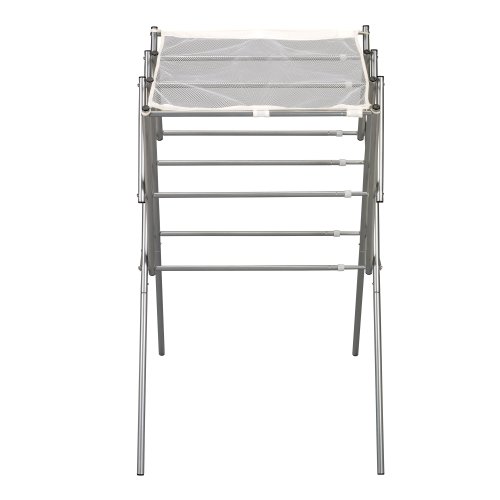
This rack is a clever solution for the knitter who oscillates between small baby blankets and massive, oversized throws. The expandable bars allow you to adjust the width, providing a custom fit for whatever project is currently on your needles.
The ability to customize the width is a game-changer for blocking. You can set it to the exact dimensions of your project, which helps maintain the intended stitch gauge and prevents the edges from curling or sagging due to lack of support.
It is slightly more complex to set up than a standard folding rack, but the versatility makes it worth the extra minute of effort. If you frequently switch between different blanket patterns, this is the most flexible tool in your arsenal.
Weight Distribution Tips for Heavy Blankets
When drying a heavy blanket, the most common mistake is letting the weight concentrate in one spot. Water-logged fibers are incredibly heavy, and gravity will stretch your stitches into an unsightly, distorted mess if you aren’t careful.
- Always use a flat surface if possible: If the blanket is too heavy for a rack, lay it flat on a water-resistant mat.
- Rotate the fold: If you must use a rack, move the blanket every few hours so the crease isn’t always in the same place.
- Support the center: Use a towel under the center of the blanket to help distribute the weight across the rungs.
By spreading the load, you ensure that the yarn retains its natural elasticity. Never let a heavy, wet blanket hang vertically, as the weight of the water will pull the fiber beyond its breaking point.
Why Fiber Content Matters for Drying Knits
The fiber content of your blanket dictates how much water it will retain and how much it will "grow" when wet. Superwash wool, for instance, is notorious for stretching significantly when saturated, while cotton is heavy and slow to dry.
- Wool: Needs careful support; tends to hold shape if not over-stretched.
- Cotton: Extremely heavy when wet; prone to sagging if not dried perfectly flat.
- Acrylic: Lighter, but can lose its structural integrity if left to hang too long.
Always check your yarn label for care instructions, but remember that the "dry flat" recommendation applies to the drying process, not just the final state. If you are working with a high-twist yarn, be extra cautious, as the tension is already high and moisture can cause it to snap back or elongate unpredictably.
Avoiding Stretching When Blocking Blankets
Blocking is the final act of your knitting project, and it should never be rushed. If you stretch a blanket too far while it is wet, you are essentially setting the stitches in a distorted state that is difficult to reverse.
Use blocking wires if you have them, as they help distribute tension evenly along the edges of the blanket. If you don’t have wires, use rust-proof pins, but place them close together to avoid "scalloping" the edges of your work.
The goal is to gently coax the fabric into its intended dimensions, not to force it. If the blanket feels like it is fighting back, stop, let it rest, and re-evaluate your tension before continuing the pinning process.
Essential Care for Large Hand-Knit Projects
Large projects are an investment of time and resources, so treat your drying racks as essential tools for preservation. Always ensure your rack is clean before starting, as dust and debris can easily transfer onto a damp, absorbent blanket.
Store your racks in a dry place to prevent rust, which can ruin a light-colored project in seconds. If you notice any rough spots on your rack, sand them down lightly or cover them with a soft cloth before draping your work.
Finally, be patient with the drying time. A heavy blanket may take days to dry completely; do not be tempted to use heat or direct sunlight to speed up the process, as this can shock the fibers and cause uneven shrinkage.
Investing in a quality drying rack is just as important as choosing the right needles or the perfect yarn for your project. By understanding how weight, fiber, and gravity interact, you can ensure your hard work stays beautiful for years to come. Take your time, support your stitches, and enjoy the satisfaction of a perfectly blocked heirloom. Happy knitting, and may your blankets always dry in perfect form.
