7 Best Digital Kitchen Scales For Precise Dye Ratios
Achieve perfect color consistency with our top 7 digital kitchen scales. These precise tools ensure accurate dye ratios for professional-grade results every time.
Achieving the perfect colorway in hand-dyed yarn requires more than just artistic intuition; it demands the clinical precision of a laboratory. When you are working with concentrated pigments, a difference of even a fraction of a gram can be the difference between a soft, dusty rose and a jarring, neon pink. Choosing the right digital scale is the most important investment you can make to ensure your color recipes are repeatable and professional. Here are seven scales that offer the accuracy needed for consistent, beautiful results in your dye studio.
My Weigh iBalance i2500: The Professional Standard


If you are serious about scaling up your dyeing from a hobby to a small business, the iBalance i2500 is the gold standard. It offers a level of sensitivity that standard kitchen scales simply cannot match, particularly when measuring small amounts of powder dye.
The stainless steel platform is durable and easy to wipe clean, which is vital when you are working with loose pigment particles. It also features a high-contrast backlit display, making it easy to read even in the dim, moody lighting of a basement studio.
Because this scale measures to the hundredth of a gram, it eliminates the "guesstimation" that often ruins large dye batches. It is a heavier piece of equipment, so it is best suited for a dedicated workspace rather than a portable setup.
Ozeri ZK14 Pronto: Best Value for Fiber Artists
The Ozeri Pronto is a workhorse that many knitters reach for when they are first experimenting with acid dyes. It is incredibly affordable and remarkably consistent for measuring larger quantities of dye stock or fiber weight.
While it lacks the hyper-precision of a laboratory scale, it is more than adequate for most home-dyeing projects. If you are dyeing a sweater’s worth of yarn and need to weigh out 500 grams of wool, this scale will handle the load without blinking.
The buttons are tactile and responsive, which is a lifesaver when your hands are slightly damp from rinsing skeins. Just keep in mind that it may struggle with very tiny increments, so it’s best used for bulk measurements rather than micro-dosing concentrated powders.
Escali Primo Digital Scale: Reliable Daily Choice
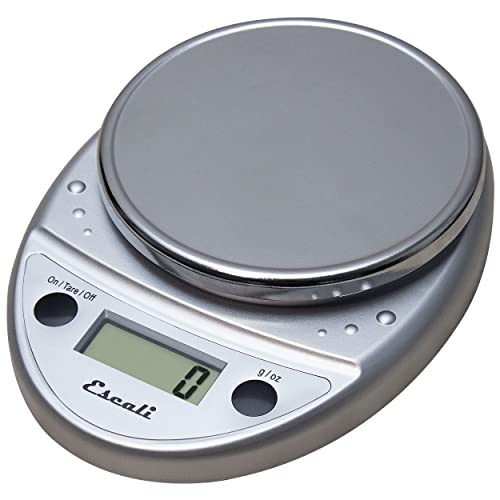
The Escali Primo is a staple in many kitchens, and it translates perfectly to the dye studio. Its simple, two-button interface means you aren’t fumbling with complex menus when you’re in the middle of a messy dyeing process.
The scale is compact and features a sealed control panel, which helps protect the internal electronics from accidental dye spills. This is a crucial feature, as one stray drop of liquid dye can easily ruin a less robust scale.
It is highly reliable for weighing yarn before and after the dyeing process to calculate absorption rates. While it isn’t the most precise tool for tiny pigment adjustments, its consistency makes it a favorite for day-to-day studio use.
Jennings CJ-4000: Precision for Small Dye Batches

The Jennings CJ-4000 sits in the sweet spot between a basic kitchen scale and a high-end analytical balance. It is specifically designed for environments where precision is paramount, making it an excellent choice for complex color mixing.
One of its standout features is the ability to handle both heavy fiber loads and light pigment measurements with high accuracy. It also features a draft shield, which prevents air currents from fluctuating the weight reading—a common frustration when using sensitive scales.
If you are mixing custom color palettes for a stranded colorwork project, this scale provides the stability you need. It is a slightly larger investment, but it pays for itself by preventing wasted dye and ruined yarn batches.
AWS Blade Series: Compact Tool for Travel Dyeing

Sometimes you need to dye on the go, whether at a retreat or a workshop, and the AWS Blade Series is built for that reality. It is slim enough to slide into a project bag alongside your circular needles and stitch markers.
Despite its small size, it offers impressive precision for measuring out small quantities of dye powder. It is ideal for "spot dyeing" or adding subtle variegated touches to a finished skein while you are away from your main studio.
The protective cover doubles as a weighing tray, which is a clever bit of engineering. Just be aware that its small surface area means it isn’t suitable for weighing large hanks of yarn; use it strictly for your pigments and additives.
Etekcity Food Scale: Simple and Accurate Option

If you are a beginner looking for a straightforward, no-nonsense scale, the Etekcity is a perfect entry point. It is inexpensive, easy to store, and provides clear, accurate readings for basic dyeing recipes.
It features a tare function that is incredibly easy to use, allowing you to zero out your mixing container effortlessly. This is essential when you are layering colors or adding leveling agents to your dye bath.
While it doesn’t have the high-end sensors of a professional scale, it is more than enough for someone learning the ropes of fiber reactive dyes. It’s a great "starter" tool that you can eventually relegate to your kitchen once you upgrade to a more advanced model.
GreaterGoods Digital Scale: Best for Ease of Use

The GreaterGoods scale is all about user experience, featuring a wide platform that accommodates larger bowls and containers with ease. If you find yourself juggling multiple dye pots, the readability of this display is a major advantage.
It is designed with a focus on simplicity, removing the clutter of unnecessary features that often confuse the user. The accuracy is consistent, and it responds quickly, which is helpful when you are trying to reach a specific weight target without overshooting.
This scale is a fantastic choice for the knitter who values a clean, efficient workspace. It is reliable, easy to clean, and provides the consistent data points necessary for keeping accurate records of your dye experiments.
Why Precision Matters in Hand-Dyeing Fiber Arts
In hand-dyeing, precision is the difference between a planned aesthetic and a happy accident. When you are aiming for a specific tonal shift or a precise match for a previous lot, "eyeballing" your pigment levels will almost always lead to disappointment.
- Color Consistency: Precise ratios ensure that your colors remain stable across different dye sessions.
- Cost Efficiency: Concentrated dyes are expensive; accurate measurements prevent you from wasting material.
- Repeatability: If you ever want to recreate a favorite colorway, you need a written recipe based on exact weights.
Think of it like knitting gauge; if you don’t measure your tension, your sweater won’t fit. If you don’t measure your dye, your yarn won’t match.
Essential Features to Look for in a Dye Scale
When shopping for a scale, don’t just look at the price tag. Consider how the tool will actually function in a wet, messy, and fast-paced studio environment.
- Sensitivity: Look for a scale that measures in 0.1g or 0.01g increments for pigments.
- Capacity: Ensure the scale can handle the total weight of your wet fiber plus the container.
- Durability: A water-resistant surface and a sturdy, spill-proof design are non-negotiable.
- Readability: A backlit screen is essential for reading measurements in various lighting conditions.
Always prioritize a scale that allows for a "tare" function, as this is the only way to measure ingredients accurately within a container.
Best Practices for Mixing Accurate Color Recipes
The best scale in the world won’t help you if your process is sloppy. Always maintain a dedicated notebook to record the exact weight of every component in your dye bath, including the water, the fiber, and the pigment.
Before you begin, ensure your scale is on a perfectly level, stable surface. Even a slight tilt can cause a digital scale to provide an inaccurate reading, which will throw off your entire color ratio.
Finally, treat your dye pigments with the same respect you would a fine yarn. Keep your powders stored in airtight containers and use a dedicated scoop for each color to avoid cross-contamination.
Investing in a quality digital scale is the single most effective way to take control of your hand-dyeing practice. By moving away from guesswork and toward precise measurements, you ensure that every skein you produce meets your highest standards. Take the time to choose the tool that fits your specific workflow, and you will find that your colorwork becomes infinitely more consistent and rewarding. Happy dyeing, and may your colors always turn out exactly as you envisioned.