7 Best Head-Mounted Magnifiers For Fine Gauge Knitting
Struggling with fine gauge knitting? Discover the 7 best head-mounted magnifiers to enhance your precision, reduce eye strain, and perfect every tiny stitch.
Fine gauge knitting, especially when working with dark lace-weight yarns or intricate stranded colorwork, can quickly lead to eye fatigue and missed stitches. Head-mounted magnifiers provide the essential clarity needed to maintain consistent tension and spot dropped stitches before they cascade down your work. By bringing your knitting into sharp focus, these tools allow you to enjoy marathon sessions without the squinting that often causes headaches. Investing in the right optics is as important as choosing the right needle material for your project.
Carson Optical MagniVisor: Best Overall Choice
The Carson MagniVisor is widely considered the gold standard for hobbyists because it balances optical clarity with a surprisingly lightweight frame. When you are working on a complex lace shawl with a 2-ply silk blend, the last thing you want is a heavy headset weighing down your neck.
This model features multiple interchangeable lenses, allowing you to swap between magnifications depending on the yarn weight. If you are switching from a fingering weight sock project to a cobweb-weight lace project, the quick-change mechanism is a lifesaver.
The key advantage here is the ergonomic design that distributes weight evenly across your forehead. It avoids the "nose-pinching" sensation common in cheaper models, making it ideal for those long Sunday afternoon knitting sessions.
Donegan OptiVISOR: The Professional Standard
The OptiVISOR is a piece of equipment that feels like it belongs in a jeweler’s workshop, which is exactly why many advanced knitters swear by it. Its glass lenses offer a level of distortion-free clarity that plastic lenses simply cannot match.
Because it is built for durability, it is a bit heavier than modern plastic alternatives. However, the precision glass allows you to see the individual fibers of a dark, fuzzy mohair yarn with absolute crispness.


If you are a professional finisher or someone who repairs vintage textiles, this is the tool for you. Just be aware that the fixed-focus distance requires you to adjust your posture slightly to find the "sweet spot" where your needles remain in perfect focus.
Fancii LED Head Magnifier: Best for Low Light
Knitting with black or navy yarn is notoriously difficult, even for experienced hands. The Fancii LED Head Magnifier solves this by integrating bright, directional lights directly into the visor frame.
The lighting is positioned to illuminate your needles without creating harsh glare on your yarn. This is particularly helpful when working with high-sheen materials like mercerized cotton, which can reflect light and cause visual flickering.
The adjustable brightness settings are a thoughtful touch for late-night knitting. You can dim the lights if you are working in a moderately lit room or crank them up when you are struggling to see your stitches in a dim hotel room.
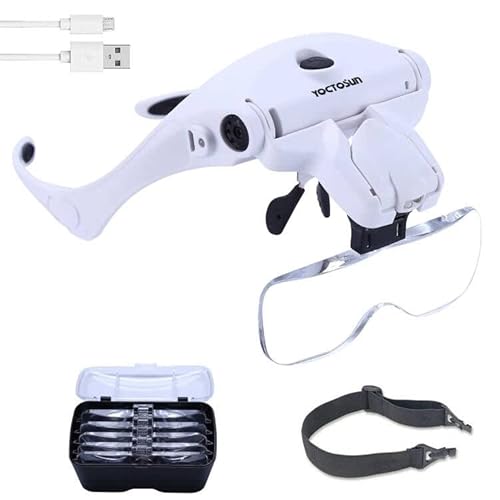
YOCTOSUN Rechargeable Magnifying Glasses
Many knitters find the constant need for batteries to be a nuisance, which is where the YOCTOSUN rechargeable model shines. It functions more like a pair of glasses than a bulky visor, making it feel less intrusive during your knitting process.
The rechargeable battery life is impressive, lasting through several long projects without needing a charge. It is a great choice if you prefer a minimalist setup that doesn’t feel like you are wearing a piece of heavy machinery.
Because these are lighter and more compact, they are excellent for travel knitting. You can easily tuck them into your project bag alongside your circular needles and notions pouch without taking up much space.

BEVA LED Headband Magnifier: Best Value
If you are just beginning to explore the world of magnification, you don’t need to spend a fortune to get a functional tool. The BEVA LED Headband offers a solid feature set at a price point that won’t break your yarn budget.
It includes a variety of lens plates, allowing you to experiment with different magnification levels. This is helpful for beginners who aren’t yet sure how much "zoom" they need to comfortably see their 2.25mm needles.
While the build quality is more utilitarian, it gets the job done reliably. The adjustable headband is the standout feature here, ensuring that the unit stays securely in place even if you are moving your head frequently to check your pattern.
Neatfi Ultra-Clear LED Magnifying Visor
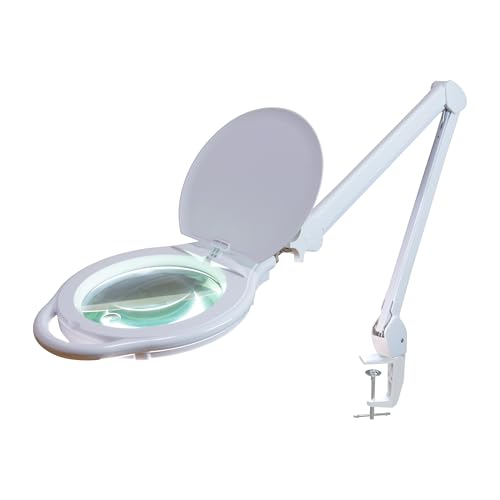
The Neatfi visor is designed for those who prioritize a wide, clear field of view above all else. Its larger lens area allows you to see a wider section of your knitting without constantly moving your head back and forth.
This is a massive benefit when you are working on colorwork charts where you need to track multiple stitches across a row. You can keep your eyes on the pattern and the needles simultaneously, which helps keep your rhythm consistent.
The optical-grade glass is highly resistant to scratches, which is important for a tool that lives in a bag with knitting needles and scissors. It is an investment, but for those who knit daily, the comfort and clarity are worth the cost.
Tomkas Hands-Free Magnifier for Knitters

The Tomkas model is specifically designed with the hands-free experience in mind, emphasizing stability and ease of use. It is lightweight enough that you can wear it for hours without feeling like you need a break.
It is particularly useful for knitters who suffer from neck strain, as it doesn’t require you to hunch over your work to see the details. By sitting upright and letting the magnifier do the work, you can maintain better posture while you knit.
The ergonomic balance is the primary selling point here. It sits comfortably on the head, allowing you to focus entirely on your tension and stitch manipulation rather than the tool itself.
How to Choose Magnification for Fine Knitting
Choosing the right magnification is a balance between clarity and the depth of field. If the magnification is too high, your working distance becomes very short, forcing you to hold your hands awkwardly close to your face.
- 1.5x to 2x: Best for general knitting and seeing larger stitches clearly.
- 2.5x to 3x: Ideal for fine gauge work, lace, and spotting dropped stitches in dark yarn.
- 3.5x and above: Generally too powerful for knitting; it limits your field of view too much.
Always remember that less is often more. Start with a lower magnification and only move up if you find yourself still squinting at your work.
Comfort and Fit: Adjusting Your Headset Properly
A magnifier is only as good as its fit. If the headset is too loose, it will slide down your nose; if it is too tight, you will end up with a headache within thirty minutes.
Spend time adjusting the straps or the frame width before you start your project. The weight should be supported by your forehead and the crown of your head, not your ears or the bridge of your nose.
If you wear prescription glasses, look for a model that can be worn over your existing eyewear. Compatibility is key to ensuring you don’t have to choose between seeing your pattern and seeing your needles.
Lighting Tips to Reduce Eye Strain While Knitting
Even with a high-quality magnifier, lighting is the single most important factor in reducing eye fatigue. Always aim for a "cool white" or "daylight" spectrum bulb, which mimics natural light and makes colors easier to distinguish.
Position your light source so that it shines onto your work from over your shoulder or from the side. Avoid having the light shine directly into your eyes or reflecting off your needles, as this creates glare that can tire your eyes out faster.
Finally, remember the 20-20-20 rule: every 20 minutes, look at something 20 feet away for 20 seconds. This simple habit, combined with your new magnifier, will keep your eyes fresh for years of knitting to come.
Finding the right head-mounted magnifier is a personal journey that depends on your specific projects, your eyesight, and your comfort preferences. Don’t be afraid to try a few options to see which lens clarity and weight distribution feel most natural for your knitting style. Once you find the perfect pair, you will wonder how you ever managed to knit fine gauge projects without them. Happy knitting, and may your stitches always be clear and your tension perfectly even.