7 Best Gauge Rulers For Measuring Stitch Density
Discover the 7 best gauge rulers for precise stitch density. Learn how these essential tools ensure accurate sizing and professional results in your knitting.
Achieving the perfect fit in a hand-knit garment starts long before you pick up your needles. Precise gauge measurement is the bridge between a beautiful swatch and a sweater that actually fits your body. Investing in a reliable gauge ruler is a small cost that saves you from the heartbreak of an ill-fitting final project. These seven tools offer different approaches to ensuring your stitch density is exactly what your pattern demands.
Cocoknits Maker’s Keep: Best Magnetic Gauge Tool
The Maker’s Keep is far more than a simple ruler; it is a wearable workstation designed for the knitter who frequently misplaces their tools. By incorporating a magnetic slap bracelet, it keeps your needles and stitch markers within arm’s reach while you work.
For those who find themselves constantly searching for a needle gauge while mid-row, this is a game-changer. It eliminates the frustration of digging through project bags to verify a needle size during a colorwork transition.
However, the magnetic feature is the primary draw here, not the precision of the ruler itself. If you prioritize convenience and workflow efficiency over a dedicated, minimalist measuring tool, this is the gold standard.


HiyaHiya Stainless Steel Needle Gauge and Ruler

Stainless steel is the gold standard for durability in a knitting toolkit. The HiyaHiya gauge is thin, rigid, and resistant to the warping that often plagues plastic tools over time.
Because it is made of metal, the needle holes are precisely milled and won’t stretch or distort with repeated use. This is vital when you are trying to differentiate between closely sized needles, such as a 2.25mm and a 2.50mm, which can be difficult to distinguish by eye.
The trade-off is that it can be a bit slick and prone to sliding off your lap while you work. If you prefer a tool that stays put, you might find yourself wishing for a bit more grip.
ChiaoGoo Plastic Needle Gauge and Stitch Ruler

ChiaoGoo’s plastic gauge is a functional, no-nonsense tool that gets the job done without any unnecessary bells and whistles. It is lightweight, making it an excellent addition to a travel project bag where every ounce counts.
The printed markings are generally clear, which is helpful when you are counting stitches under low light. It covers a wide range of needle sizes, making it a versatile choice for someone who jumps between lace-weight shawls and chunky-weight cowls.
Keep in mind that plastic can eventually crack or the printed numbers may fade with heavy use. It is an inexpensive, utilitarian choice that works well until it doesn’t.
Susan Bates Knit Chek: The Classic Budget Choice
The Knit Chek has been a staple in knitting bags for decades for a very good reason. It combines a needle gauge, a stitch counter, and a ruler into one incredibly compact, affordable package.
It is the tool most of us started with, and it remains a reliable reference point. Its simplicity is its strength; there is nothing to break, and it is small enough to fit inside even the tiniest notions pouch.
The downside is that the plastic can be brittle, and the markings can wear off after years of friction against yarn and needles. Treat it as a reliable entry-level tool that will serve you well until you decide to upgrade to something more permanent.
Clover Knitting Needle Gauge with Built-in Ruler

Clover is known for thoughtful design, and their gauge is no exception. It features a clean, easy-to-read layout that helps you quickly identify both needle size and gauge density without squinting.
The inclusion of both metric and imperial measurements is a thoughtful touch for those who use international patterns. It bridges the gap between different sizing systems, which is essential if you are trying to convert a European pattern to American needles.
It is a sturdy plastic tool that feels substantial in the hand. If you want a reliable, mid-range option that balances durability with a clear design, this is a solid choice.
Katrinkles Wooden Gauge Ruler: Best for Aesthetics

Katrinkles gauges are crafted from wood, offering a tactile warmth that plastic and metal tools simply cannot replicate. They are beautiful to look at and feel wonderful in the hand, making them a favorite for knitters who appreciate the "slow craft" aesthetic.
Beyond their looks, they are surprisingly functional and often feature clever cutouts for measuring stitch counts. Because they are laser-cut, the edges are precise and won’t snag your delicate fibers like some cheaper plastic molds might.
Do note that wood can be sensitive to moisture and extreme temperature changes. Keep them away from your steaming iron during blocking to prevent warping.
Brittany Birch Needle Gauge and Stitch Ruler
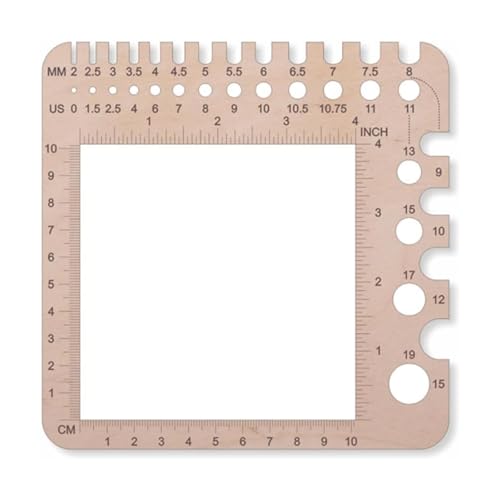
Brittany’s birch tools are a testament to the beauty of natural materials. Like their famous needles, these gauges are smooth, lightweight, and possess a gentle, earthy quality.
They are particularly well-suited for knitters who use wooden needles, as they share a similar aesthetic and grip. The markings are burned into the wood, meaning they won’t rub off over time like printed plastic.
They are a bit thicker than metal gauges, which can make them slightly less convenient for measuring very small-diameter needles. However, for those who value sustainable, natural materials, they are the clear winner.
Why Gauge Accuracy Is Essential for Knit Projects
Gauge is the most important measurement in knitting because it dictates the final dimensions of your project. If your stitch density—the number of stitches and rows per inch—differs from the designer’s, your finished sweater could end up two sizes too big or unwearably small.
Even if your needle size matches the pattern recommendation, your personal tension can vary wildly based on the fiber content of your yarn. A superwash wool, which is slippery and prone to growing, will behave differently than a rustic, sticky Highland wool.
Always swatch with the exact yarn and needles you intend to use for the project. Never assume that because you "usually" get gauge with a 4.0mm needle, you will get it with every yarn you encounter.
How to Properly Measure Your Stitch Density Gauge
To measure your gauge, knit a square that is at least four inches by four inches, then block it exactly as you would the finished garment. Blocking—the process of washing and shaping your swatch—is non-negotiable because it allows the fibers to relax and bloom into their final state.
Lay your gauge ruler flat across the center of the swatch, avoiding the edges where tension is often inconsistent. Count your stitches per inch, including fractions of a stitch if necessary.
Never stretch the fabric while measuring, as this will artificially inflate your count. Let the fabric rest naturally on a flat surface to get an accurate representation of how the garment will behave while worn.
Common Mistakes When Using a Metal Gauge Ruler
One of the most common errors is measuring a swatch while it is still on the needles. The tension near the needle tips is often tighter than in the body of the swatch, leading to an inaccurate reading.
Another mistake is failing to account for the "rounding" of stitches. When using a metal ruler, ensure you are looking straight down at the markings to avoid parallax error, where the angle of your eyes makes the measurement appear slightly off.
Finally, remember that stitch density is not just about the number of stitches; it is also about the number of rows. Check your row gauge as well, especially for garments that require specific length measurements, like sleeves or sweater bodies.
Choosing the right gauge ruler is a personal decision that balances your need for precision with your preferred aesthetic. Whether you choose the durability of stainless steel or the warmth of birch, the most important step is simply using the tool consistently. Always remember that your gauge is a living, breathing thing that changes with your mood, your yarn, and your needles. Happy knitting, and may all your swatches match your patterns perfectly.