6 Best Cotton Twines for Practice Sessions Worth Using
Discover the top six cotton twines for your practice sessions. This guide evaluates durability and texture to help you choose the best cord for your needs.
Mastering the art of knitting requires hundreds of hours of repetition, and using the right practice yarn can make the difference between building muscle memory or developing frustration. Cotton twine offers a unique, non-elastic experience that forces you to refine your tension control in ways that forgiving wools simply cannot. By choosing the right cotton for your swatch sessions, you turn every practice row into a masterclass in technique. These six selections represent the best tools for honing your craft without breaking the bank or your spirit.
Peaches & Crème Solids: The Budget-Friendly Pick
When you are casting on your tenth practice swatch of the week, cost matters. Peaches & Crème is the quintessential workhorse yarn found in almost every craft aisle, offering a reliable, sturdy structure that won’t punish your wallet.
Because it is a thicker, slightly coarser cotton, it is incredibly forgiving for beginners who are still learning how to manipulate the yarn. It doesn’t split easily, and the lack of "fuzz" means you can clearly see every individual stitch you form.
The trade-off here is a slight stiffness that can be hard on the hands during long sessions. If you find your fingers cramping, try switching to a smooth wooden or bamboo needle to add a bit of warmth and grip to the process.
Lily Sugar’n Cream: Best for Texture Practice


Lily Sugar’n Cream is a staple for a reason: it has a distinct, matte finish that makes it the gold standard for practicing complex stitch patterns. If you are learning cables or bobbles, the structure of this yarn ensures the motifs pop with high definition.
The yarn has a relatively tight twist, which makes it excellent for seeing how your stitches lean. If you are practicing increases or decreases, the visibility of the stitch mount—the way the yarn sits on the needle—is unparalleled.
Be aware that this yarn can be quite heavy and dense. It isn’t the best choice for a garment, but for a practice square where you want to see if your purls are consistent with your knits, it is ideal.
KnitPicks Dishie: Best Softness for Cotton Twine

If you find standard cotton twines too abrasive, KnitPicks Dishie is a revelation. It is significantly softer than the big-box alternatives, making it much more pleasant to handle for hours of repetitive swatching.
The fiber is tightly spun, which gives it a lovely, smooth hand that glides over your needles. This is the perfect yarn to use if you are transitioning from practicing with acrylic to wanting a more natural, professional feel.
The only downside is that it can occasionally be a bit "slippery" compared to coarser cottons. If you are a loose knitter, you might find your stitches sliding off your needles more easily than you are used to.
Hobbii Rainbow Cotton 8/8: Best for Color Variety
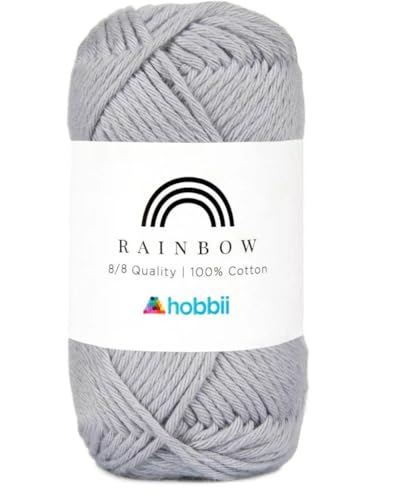
Sometimes practice sessions become monotonous, and having a vibrant palette of colors can keep your motivation high. Hobbii Rainbow Cotton 8/8 offers an incredible spectrum, allowing you to practice stranded colorwork or stripes without needing to buy massive skeins.
The 8/8 weight—meaning it is an 8-ply yarn—gives it a lovely, plump feel that is very satisfying to work with. It is consistent and round, which helps in achieving a very even, uniform gauge across your practice pieces.
Because it is a slightly thicker weight, ensure you are using the correct needle size to avoid a fabric that feels like a stiff rug. Always check your gauge, even if you are just practicing a simple stockinette stitch.
Lion Brand 24/7 Cotton: Best for Stitch Clarity

Lion Brand 24/7 Cotton is mercerized, meaning the fiber has been treated to increase its luster and strength. This process results in a yarn that is incredibly smooth, almost like a thin cord, which makes your stitches look crisp and professional.
This is the best yarn for practicing intricate lace or fine-gauge work where stitch definition is paramount. Because it has almost no halo or fuzz, every mistake you make is visible, which is exactly what you want when you are trying to improve.
The slickness of this yarn can be a challenge for beginners. If you are struggling to keep your stitches on the needle, pair this yarn with a pair of nickel-plated or high-grip needles to help maintain control.
Rowan Creative Linen: Best for Advanced Swatches

Rowan Creative Linen is a blend of cotton and linen, providing a sophisticated texture that behaves differently than 100% cotton. It is the perfect training ground for knitters ready to move beyond basic cottons and understand how different plant fibers drape and react.
The linen component adds a slight "crunch" and a rustic feel that is excellent for learning how to manage fibers that don’t stretch. It is a fantastic choice for practicing summer-weight projects where you need to manage tension carefully to avoid sagging.
This yarn is more expensive and requires a more delicate touch. Treat this as your "advanced" practice yarn; use it when you are ready to refine your tension for professional-grade, high-end garments.
Why Cotton Twine Is Ideal for Knitting Practice
Cotton twine is an unforgiving teacher, and that is exactly why it is so valuable for practice. Unlike wool, which has natural elasticity and "bloom" that can hide uneven tension, cotton shows every single variation in your stitch size.
When you knit with cotton, you cannot rely on the yarn to stretch and compensate for a loose stitch. You are forced to develop consistent finger tension, which will make you a much better knitter when you return to more forgiving fibers.
It is also an excellent medium for learning how to "read" your knitting. Because the yarn is smooth and clear, you can easily identify where you dropped a stitch or twisted a loop, allowing you to troubleshoot your mistakes in real-time.
Understanding Cotton Fiber and Its Lack of Bloom
Cotton is a cellulose fiber, meaning it lacks the microscopic scales found in sheep’s wool that allow fibers to grip one another. This lack of "bloom"—the fuzzy halo that fills in gaps—means your stitches will look sharper but also more exposed.
For a knitter, this means that your gauge is absolute. If your needles are too small, the fabric will be stiff and board-like; if they are too large, the fabric will be lacy and unstable.
When you practice with cotton, pay close attention to the relationship between your needle size and the yarn weight. You will quickly learn that cotton demands a tighter gauge than wool to achieve a fabric that doesn’t look overly holey or thin.
How to Properly Tension Non-Elastic Plant Fibers
Tensioning cotton requires a more deliberate approach than working with wool. Because the fiber has no "memory," you must consciously maintain the same distance between your needle and the working yarn for every single stitch.
If you find yourself struggling with uneven rows, try wrapping the yarn around your fingers in a way that creates a consistent path of resistance. This helps "guide" the yarn so that you aren’t pulling too tightly on one stitch and too loosely on the next.
Remember to take breaks. Knitting with non-elastic fibers can be taxing on the hands because your muscles have to do the work that the yarn’s elasticity would normally handle.
Troubleshooting Common Issues With Cotton Yarn
The most common issue with cotton is "splitting," where the needle tip catches the middle of the yarn ply. If this happens, your needle tip might be too sharp; try a slightly blunter needle tip to glide over the plies more easily.
Another common complaint is the "stiff fabric" syndrome. If your practice swatch feels like cardboard, you are likely knitting too tightly or using needles that are too small for the yarn weight.
Finally, if your stitches look messy, don’t blame your hands immediately. Sometimes, it’s just a matter of blocking—soaking your swatch in water and laying it flat to dry—which can help the fibers settle into their final, uniform position.
Practice is the silent work that separates the hobbyist from the craftsman, and cotton twine is the ultimate tool for that journey. By embracing the lack of elasticity and the demand for precision, you will build a foundation of skill that translates to every project you tackle. Remember that every uneven row is just a lesson in disguise, so keep your needles clicking and your focus sharp. Happy knitting, and enjoy the process of refining your craft one stitch at a time.