
6 Best Finishing Sprays For Clay Project Protection
Protect your creations with the 6 best finishing sprays for clay project protection. Explore our top expert-tested recommendations and seal your art today.
Clay projects require a final protective layer to ensure longevity, much like how a finished wool sweater needs proper blocking to hold its shape and drape. Whether crafting custom buttons for a cardigan or delicate ornaments to adorn a gift, the surface treatment determines both the aesthetic appeal and the durability of the piece. Selecting the right finish is an exercise in balancing the desired sheen against the specific needs of the clay medium. This guide evaluates six top-tier sprays to help makers achieve professional, resilient results on every project.
Krylon Crystal Clear Acrylic Coating: Best Overall


Krylon Crystal Clear stands as the industry standard for general-purpose sealing, much like a reliable stainless steel needle is the go-to for standard wool projects. It provides a robust, non-yellowing barrier that protects against dust and minor scuffs without obscuring the details of the clay work.
This spray is highly versatile, working equally well on intricate textures or smooth, burnished surfaces. It dries quickly, allowing for multiple thin coats that build up protection without creating a gummy or tacky texture.
Consider this the workhorse of the studio. It provides a consistent, reliable finish that behaves predictably across most clay types, making it the most sensible starting point for any maker.
Mod Podge Clear Acrylic Sealer: Best for Decoupage
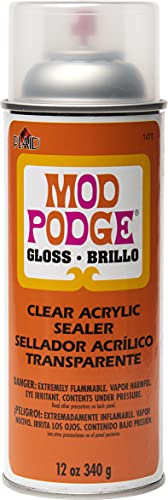
Mod Podge is synonymous with mixed-media projects where paper, fabric, or other fibers are bonded to the clay surface. When using this sealer, the goal is to lock in the decoupage materials while ensuring the edges of the applied elements remain flush and secure.
This sealer is particularly effective at preventing the lifting that often occurs when moisture touches paper embellishments. It dries to a clean finish that enhances colors without the risk of clouding, ensuring that the visual impact of the added design remains sharp.
For those who treat their clay pieces with the same care as a hand-dyed merino fiber, this sealer provides the necessary structural support. It is the preferred choice for projects where adhesion is just as critical as the final aesthetic shine.
Sculpey Gloss Glaze: Perfect for Polymer Clay

Sculpey Gloss Glaze is formulated specifically for the chemical composition of polymer clay, much like specialized detergents are engineered for sensitive silk or alpaca fibers. Because polymer clay can react poorly to certain solvent-based sprays, a brand-specific glaze ensures compatibility and prevents long-term stickiness.
Applying this via spray or brush results in a high-shine finish that mimics the look of professional ceramic work. It is ideal for pieces meant to be worn, such as pendants or pins, as it provides a harder, more resilient surface against friction.
Avoid the temptation to use generic hardware store sprays on high-end polymer pieces until compatibility is confirmed. Stick to this dedicated glaze when the structural integrity of the polymer material is the priority.
Aleene’s Spray Acrylic Sealer: Best Matte Finish
Aleene’s is the preferred solution for makers who want to protect their work without the distracting glare of a high-gloss finish. A matte surface is often more sophisticated, highlighting the raw, earthy texture of the clay rather than masking it.
This sealer excels in preventing fingerprints and surface oils from dulling the piece over time. It offers a soft, muted look that feels organic and intentional, much like the difference between a high-sheen synthetic yarn and a matte, rustic linen.
Choose this when the clay project is intended to look natural or historical. It provides essential protection while maintaining the aesthetic integrity of the original matte surface.
Plaid LiquidLeaf Sealer: For Metallic Effects
Metallic finishes are notorious for dulling or oxidizing when exposed to standard sealers, a frustration familiar to anyone who has seen silver-coated buttons tarnish. Plaid LiquidLeaf Sealer is engineered to preserve the shimmer of metallic pigments or gold leafing without causing the “crinkle” effect that ruins fine detailing.
The key to its performance is a stable formula that doesn’t dissolve the metallic components upon application. It provides a clear, high-fidelity barrier that keeps metallic highlights bright and reflective.
Use this only when metallic highlights are the focus of the piece. It is a specialized tool that performs a specific job better than any general-purpose alternative.
Golden Archival Varnish w/ UVLS: Pro-Grade Pick
For projects intended for long-term display, such as home decor or fine art sculptures, Golden Archival Varnish represents the professional choice. It contains UV Light Stabilizers (UVLS) which prevent the color fading that occurs when clay is exposed to prolonged sunlight.
This is the “heirloom quality” finish. It is highly resistant to environmental stressors and creates a long-lasting, flexible film that moves slightly with the material rather than cracking under tension.
While it carries a higher price point, the investment is justified for pieces that are meant to last for years. It is the gold standard for protecting against the inevitable degradation caused by environmental exposure.
How to Choose the Right Finish: Matte vs. Gloss
The choice between matte and gloss is rarely about durability and almost entirely about the intended personality of the piece. Gloss finishes draw the eye to color depth and light reflection, while matte finishes emphasize the tactile, sculpted shape of the clay.
If a project has extensive surface carving or detailed sculpting, a matte finish will often make those details pop by reducing distracting reflections. Conversely, if the project is painted with vibrant, flat colors, a gloss finish can provide a “pop” that makes the colors appear more saturated.
Always consider the final environment. High-traffic items like buttons or keychains benefit from the durability of a glossy, hard-shell finish, while decorative figurines often benefit from the subtle, sophisticated look of matte.
Applying Sealer for a Streak-Free Finish
Achieving a streak-free finish requires patience and an understanding of the spray mechanics, much like maintaining consistent tension when switching between knit and purl stitches. The goal is to build thin, translucent layers rather than saturating the piece in a single pass.
Always spray in a sweeping motion that begins before the spray hits the object and ends after it passes it. This prevents the “puddling” of sealant that leads to uneven textures and streaks.
Maintain a consistent distance of 8 to 12 inches from the project. Moving too close results in uneven application, while moving too far away leads to a grainy, “fuzzy” finish that can ruin the surface quality.
Is Your Clay Project Food Safe After Sealing?
A critical, often misunderstood point in the crafting community is the distinction between “sealed” and “food safe.” Even with high-quality sealants, most clay projects remain unsuitable for direct contact with food.
Most acrylic sprays are formulated to be non-toxic once cured, but they are not FDA-approved for consumption or contact with liquids. Sealing a cup or bowl made of air-dry or polymer clay will not make it safe for hot beverages or acidic foods.
If a project must be food-safe, look for specific, food-grade epoxy resins explicitly labeled as such. Otherwise, treat all sealed clay items as purely decorative to ensure the safety of those using them.
Sealing Air-Dry Clay vs. Polymer Clay: What to Know
The substrate dictates the sealer choice, much like the fiber content dictates the washing instructions for a finished garment. Air-dry clay is porous and water-sensitive, meaning it requires a sealer that can penetrate the surface to provide a solid base before the final coat is applied.
Polymer clay is non-porous and oil-based. It requires sealers that do not contain solvents, as some chemicals will cause the clay to remain permanently tacky or degrade over time.
Always test on a scrap piece of the same clay type before committing to the final product. A small, inconspicuous swatch test prevents the heartbreak of ruining a multi-hour project with a chemically incompatible sealer.
Properly finishing your clay work is the final, essential step in your creative process. By selecting a sealer that complements the material and respects the intended use of the object, you ensure your handiwork remains a treasured piece for years to come. Regardless of the project, taking the time to test your finishes will yield the polished, professional look you desire.