7 Best Hobby Pliers For Bending Metal For Precision Work
Find the 7 best hobby pliers for bending metal with precision. Elevate your craft and achieve professional results today by exploring our top expert recommendations.
Precision is just as vital in metalwork as it is when managing the tension of a complex lace chart or executing a perfectly grafted kitchener stitch. Just as a knitter needs the right needle material to manage slippery silk or grabby wool, a metalworker needs the right pliers to manipulate wire without marring the finish. Choosing the wrong tool often leads to bent wire, fatigued hands, or frustratingly inconsistent loops. This guide breaks down the essential pliers for those looking to elevate their jewelry making or wire-knitting projects to professional standards.
Lindstrom RX 7890: The Ultimate Precision Plier


The Lindstrom RX 7890 represents the pinnacle of handle design and jaw alignment for those who refuse to compromise on accuracy. Its micro-adjustable tension screw allows for a custom feel, ensuring the spring action never fights against the hand.
When working on intricate wire-wrapping projects that demand hours of focus, hand fatigue is the enemy of quality. These pliers feature a unique ergonomic handle shape that distributes pressure evenly across the palm. This is similar to choosing an ergonomic wooden needle over a standard metal one to alleviate tension during long sessions of knitting stockinette.
These tools come at a premium price point, which serves as a barrier for some makers. However, for those dedicated to high-end wire jewelry, the investment pays off in the longevity and precision of the finished piece. Think of these as the rosewood needles of the jewelry world—a refined tool that rewards a skilled hand.
Wubbers Classic Chain Nose: Best for Wire Wrapping

Wubbers Classic Chain Nose pliers are a staple for anyone who prioritizes control and leverage. The jaws are slightly thicker than ultra-precision models, which provides the necessary surface area for gripping stiff metal wire securely.
If the goal is to create consistent, structural wire loops, the stability offered by the Wubbers design is unmatched. They provide enough feedback through the handle that the user can feel exactly how much pressure is being applied to the metal. This sensory feedback is much like feeling the weight and drape of a yarn through the needle, allowing for subtle adjustments to tension mid-stitch.
Because the jaws are robust, they are less likely to flex or “skid” when working with thicker gauges of wire. While they may lack the delicate nose of a specialized detail plier, they are the reliable workhorse needed for the repetitive, demanding tasks of jewelry assembly.
Xuron 450 TweezerNose: For Ultra-Fine Detail
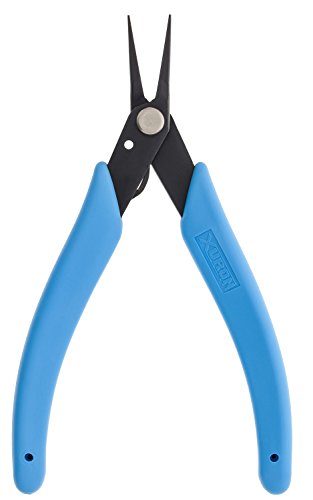
The Xuron 450 TweezerNose is designed specifically for tasks where standard pliers are simply too bulky to reach the desired point. The needle-thin tips allow for surgical precision when opening small jump rings or tucking wire ends into tight, finished loops.
Precision of this magnitude is essential when working with delicate findings that might snap under too much pressure. Much like using a 1.5mm needle to pick up stitches in a fine lace border, these pliers enable the maker to work within tiny margins of error. The bypass cutting action of similar Xuron models also makes them a favorite for clean, burr-free cuts.
Note that because the tips are extremely fine, they are susceptible to damage if used for heavy-duty tasks like bending thick-gauge wire. Reserve these for the finishing work and fine adjustments where finesse is required over raw strength.
Beadsmith Ergonomic Pliers: Most Comfortable Grip
Beadsmith Ergonomic pliers prioritize the physical comfort of the maker, featuring soft, contoured grips that prevent calluses during marathon jewelry-making sessions. They are designed to sit naturally in the hand, reducing the strain that often leads to cramping during repetitive tasks.
These are an excellent entry point for makers who are concerned about repetitive strain or for those who simply value long-term comfort. The spring-loaded action is smooth and responsive, preventing the user from having to manually reset the jaws after every maneuver. This ease of use is reminiscent of the “no-drag” feel of a high-quality coated aluminum knitting needle.
While they may not offer the extreme technical precision of a professional jeweler’s tool, they provide a comfortable, reliable experience for most hobbyists. For hobbyists who spend their weekends wire-weaving, the ergonomic benefit often outweighs the need for specialized, industrial-grade features.
Tronex 544 Flat Nose: A Premium, Long-Lasting Tool
Tronex 544 Flat Nose pliers are constructed with high-grade steel that maintains its shape and jaw alignment even under constant, heavy-duty use. The flat nose provides a broad, stable surface that is ideal for creating sharp, clean bends in wire.
The construction quality of these pliers is undeniable; they feel substantial and balanced in the hand. For a maker who expects their tools to last for years rather than months, the build quality of Tronex is a worthwhile investment. Much like a hand-turned wooden knitting needle that improves with age and use, these pliers are designed to become an extension of the maker’s technique.
They are particularly useful for flattening wire ends or gripping components that require a wide, secure hold. While they are a professional-grade item, their ease of handling makes them accessible enough for dedicated hobbyists who want to minimize tool-related frustrations.
Knipex Electronics Pliers: German Engineering
Knipex is synonymous with industrial durability, and their electronics pliers are no exception. These tools are built to exact tolerances, ensuring that the jaws meet perfectly from tip to base, which is crucial for handling delicate materials without slippage.
In the world of metalwork, “German engineering” translates to tools that handle repetitive stress without losing their calibration. This is the equivalent of a stainless steel needle that refuses to bend or warp, regardless of the tension used by the knitter. The high-quality finish on the jaws also minimizes the risk of marking or scratching the wire during manipulation.
These pliers are intended for those who appreciate a no-nonsense, highly durable instrument that performs consistently over thousands of cycles. Expect a stiffer spring action initially, which loosens up over time to provide a satisfying, reliable snap.
Beadalon Slim Round Nose: Perfect for Beginner Loops
Beadalon Slim Round Nose pliers are the go-to tool for creating smooth, circular loops in wire. The tapered, round jaws allow for varying loop sizes simply by moving the wire further up or down the nose of the plier.
For someone just starting out, mastering the round loop is the “casting on” of the jewelry world—a foundational skill that must be practiced for consistency. These pliers simplify that process with their balanced, slim design. They remove much of the guesswork associated with creating uniform jump rings or ear wires.
While they may not feature the high-end steel alloys of professional bench tools, they are perfectly suited for learning and standard hobby projects. They are a practical, affordable choice that allows a maker to learn the mechanics of wire manipulation without a significant financial commitment.
Plier Jaws Explained: Flat, Chain, or Round Nose?
Understanding jaw shape is the first step toward successful wire manipulation. Each shape serves a distinct purpose, and using the wrong one will result in poor finishes or damaged materials:
- Flat Nose: Ideal for holding, flattening, and making sharp, 90-degree bends.
- Chain Nose: These have a flat interior and rounded exterior, making them versatile for holding, bending, and reaching into tight spaces.
- Round Nose: The essential tool for creating loops, curves, and coils in wire.
If you are just starting your toolkit, begin with a pair of Chain Nose pliers, as they offer the best balance between a Flat and Round nose. As your projects become more complex, you can add specialized shapes to your collection to tackle specific challenges like tight loops or perfectly uniform wire angles.
Choosing Pliers Based on Your Specific Project
Selection criteria should always be driven by the gauge and hardness of the wire being used. Thicker, dead-soft wire requires a robust plier with a strong jaw to prevent slippage, while thin, half-hard wire requires a delicate touch to avoid unintentional kinks.
If you are working with precious metals like sterling silver, prioritize pliers with smooth, polished jaws to prevent marring the surface. If you are experimenting with inexpensive craft wire, you have more leeway, but using high-quality tools will still produce a cleaner, more professional-looking result.
Finally, consider the scale of your work. Larger projects require pliers with longer handles for better leverage, while miniature or detailed components demand shorter, more nimble tools that allow for delicate adjustments.
Caring For Your Tools: Tips for a Lifetime of Use
Proper maintenance is the secret to extending the life of your pliers. Regularly wipe down the jaws with a soft cloth to remove any metal filings or residue that could scratch your wire. A tiny drop of machine oil on the pivot point once or twice a year will keep the action smooth and responsive.
Avoid using your pliers as wire cutters unless they are specifically designed for that purpose, as this will quickly nick the jaws and ruin their precision. When storing your tools, avoid damp environments to prevent rust, and store them in a rack or tray so the tips don’t bang against each other.
By treating these tools with the same respect you show your favorite knitting needles, you ensure they remain reliable partners for years to come. A clean, well-maintained tool is the hallmark of a confident maker.
Selecting the right pliers is not about finding the single “best” tool, but about matching the functionality of the instrument to the specific demands of the project. Whether you are creating wire-wrapped jewelry or custom findings, investing in high-quality tools will significantly improve the accuracy and enjoyment of your craft. Take the time to understand how your tools interact with your materials, and your work will reflect that dedication to precision.