6 Best Jewelry Kits For Absolute Beginners To Start With
Ready to start crafting? Discover the 6 best jewelry kits for absolute beginners and learn how to create your own professional-looking accessories at home today.
Diving into jewelry making feels remarkably similar to learning to read a complex lace chart; it requires patience, the right tools, and an understanding of how individual components interact. Just as a knitter must learn to balance tension across different needle materials, a jewelry maker must master the delicate tension of wire and the structural integrity of findings. Selecting a starter kit is the essential first cast-on, providing the foundational equipment needed to experiment without overwhelming the budget. These six kits offer varying entry points into the craft, ensuring there is a suitable path for every aspiring maker.
Paxcoo Jewelry Supplies Kit: Best All-In-One
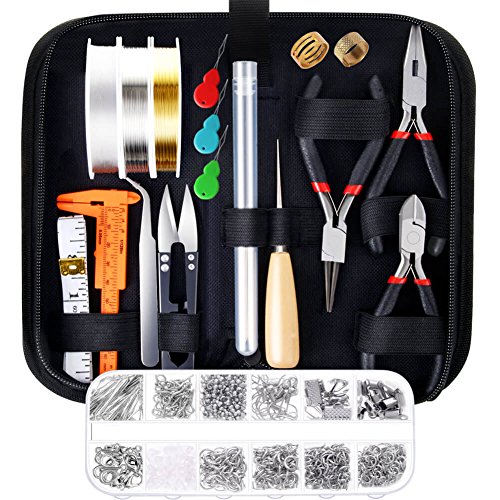

This kit functions much like a master needle set that covers every possible gauge and length. It includes a comprehensive array of findings, wires, and essential pliers, making it a reliable starting point for those who want to jump straight into production.
The sheer volume of components allows for extensive experimentation, similar to having a diverse yarn stash at the ready. However, the sheer quantity can be intimidating, much like staring at a massive sweater quantity of hand-dyed wool without a pattern.
For the maker who values having every base covered, this is the most logical investment. It is the equivalent of buying a full set of interchangeable needles; it eliminates the need for future small-item purchases.
Cousin DIY Jewelry Starter Kit: Top Tool Kit

The tools are the most critical investment in any craft, much like choosing ergonomic needles to prevent hand fatigue during long lace-knitting sessions. This kit prioritizes high-quality, durable pliers over a massive surplus of beads.
Beginners often overlook the importance of tool weight and grip, but precision is non-negotiable. If the pliers lack a firm grip or leave burrs on wire, the finished piece will snag and unravel, just as a sharp-tipped needle might split fragile silk yarn.
Focusing on the tool-to-material ratio makes this the superior choice for those intending to source their own specialized beads later. Prioritize the longevity of your tools, as they will serve you through years of increasingly complex designs.
Bead Landing Bracelet Kit: Easiest First Project
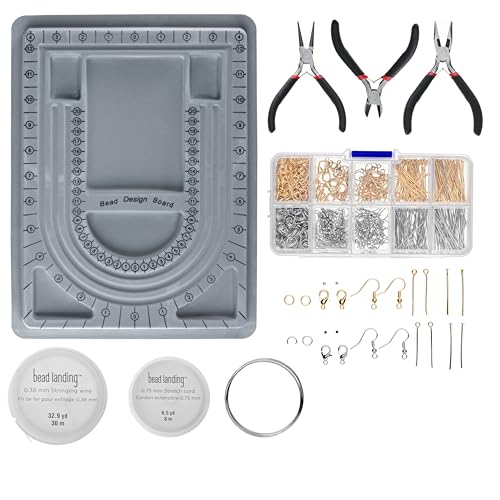
Starting with a dedicated bracelet kit is akin to knitting a simple garter stitch scarf. It removes the stress of complex engineering and allows a focus on basic techniques like color theory and sequence.
The included materials are often pre-coordinated, removing the guesswork involved in selecting findings that match the color palette. This is an excellent way to practice fine motor skills without the frustration of structural failure.
If the goal is to create a wearable finished object within an hour, this approach is unbeatable. Use these kits to learn the basics of knotting and finishing before graduating to wire-wrapping or soldering.
Modda Deluxe Earring Kit: For Quick Results
Earring kits focus on small-scale construction, which requires a steady hand and a keen eye for detail. The components are tiny and delicate, similar to working with lace-weight yarn on 1.5mm needles.
Because earrings are small and lightweight, they are much faster to finish than necklaces or heavy statement pieces. This allows for rapid iteration, where lessons learned from one design can be applied to the next immediately.
Take care with the ear wires, as the metal quality can affect sensitive skin. Treat this kit as a series of miniature design challenges that sharpen technical precision.
Jtivcs Jewelry Making Kit: Best for Gifting
A curated, attractive presentation makes this kit a thoughtful choice for a budding maker. It combines enough variety to keep interest piqued without being so disorganized that it causes immediate overwhelm.
Like a high-quality fiber subscription box, the experience of opening the kit and seeing the color-coordinated components encourages creativity. It is designed for the person who needs a gentle, aesthetic entry into the craft.
While the components may not be of professional jeweler grade, they are perfectly suitable for learning core assembly techniques. It is the perfect starting point for someone who thrives on visual inspiration and structured discovery.
Klutz Friendship Bracelets: A Fun, No-Tools Start
Not all jewelry making requires heavy-duty metalwork; some of the most intricate designs are purely fiber-based. This kit introduces the fundamental concepts of patterning and tension through knots and braids.
Knitting involves manipulating thread into structure, and knot-based jewelry follows a similar logic of geometry and repetition. This is an accessible way to understand how fibers behave under tension, which translates perfectly to working with fine wire.
The bottom line is that these techniques build the dexterity required for all forms of jewelry making. It is a low-stakes, high-reward method for mastering the art of construction without a single pair of pliers.
How to Pick Your First Jewelry Making Kit
Evaluate your personal learning style before purchasing; some makers prefer a full tool kit, while others want a pre-selected project. Consider the project type—wire-wrapping demands sturdier pliers, while bead-stringing requires more delicate finishing tools.
Avoid kits that focus too heavily on low-quality plastic beads if the goal is to create lasting jewelry. Ensure the kit provides “findings,” which are the functional components like jump rings, clasps, and ear wires.
Always check the included pliers for a comfortable grip. If you have ever suffered from hand cramps after hours of tight, stranded colorwork, you know that ergonomics will determine whether you continue with the craft.
Essential Jewelry Tools Explained for Beginners
Three types of pliers are mandatory for any beginner: needle-nose, round-nose, and wire cutters. Needle-nose pliers act like a third hand, holding components steady while you work.
Round-nose pliers are the engine of jewelry making, used specifically for creating loops and bends in wire. Wire cutters must be sharp and precise; using blunt cutters will pinch the metal, creating jagged edges that will catch on clothing.
Think of these tools as your standard needle kit: you can get by with basic versions, but professional-grade, spring-loaded pliers will make the work faster and cleaner. Invest in quality steel over plated metal whenever possible.
Understanding Jewelry Findings: Clasps and More
Findings are the invisible workhorses of the jewelry world, serving the same function as the bind-off or the hidden seam in a knit garment. A jump ring is a small metal hoop that connects pieces, while a clasp is the essential closure.
Crimp beads are another critical finding, used to secure jewelry wire to the clasp. Mastering the crimp is the jewelry equivalent of mastering the kitchener stitch; it must be done with precision to ensure the piece doesn’t pop open.
Study how these findings attach to your materials, as improper closure is the number one cause of broken jewelry. Quality findings are the difference between a project that falls apart during the first wear and a piece that stands the test of time.
From Kit to Custom: Your Next Jewelry Project
Transitioning away from kits involves sourcing materials independently, which allows for true creative control. Once the techniques are mastered, begin shopping for specific high-quality stones, silver or gold-filled wire, and specialized findings.
This shift mirrors the move from following commercial patterns to designing custom sweaters. Analyze the structural components of pieces you admire to understand how they are built, then replicate the technique with your own material choices.
Keep a notebook of your designs, noting the wire gauges and bead sizes used. As your technical skill grows, your ability to execute your own ideas will define your path as a maker.
Choosing the right kit is only the first step in a lifelong journey of tactile discovery and design. Whether you gravitate toward the precision of wire-wrapping or the rhythm of bead-knotting, consistency in your practice is the ultimate key to excellence. Keep your tools sharp, your tension steady, and your curiosity high as you craft your next piece.