7 Best Embroidery Lighting Kits For Workstations
Illuminate your craft with our guide to the 7 best embroidery lighting kits for workstations. Discover the perfect bright setup and improve your precision today.
Stitching dark navy wool at midnight requires more than just good eyes; it demands professional-grade illumination to avoid missed stitches and split plies. Poor lighting is the silent enemy of consistent tension, often leading to eye strain that cuts short a productive knitting session. This guide explores the best task lamps designed to turn dim workspaces into vibrant, high-clarity environments for every fiber craft. Choosing the right light is as fundamental to a successful project as picking the correct needle material for a specific yarn.
Brightech LightView Pro Flex: Best Overall Pick


The Brightech LightView Pro Flex balances functionality with a modest footprint, making it ideal for those who toggle between small-scale needlework and larger garment construction. Its standout feature is the integrated magnifying lens, which provides a clear, undistorted view of intricate cable crosses or complex lace charts.
For anyone working with dark, high-twist yarns where the stitch definition is easily lost, the magnification helps prevent accidentally dropping a stitch. The flexible gooseneck allows for precise positioning, ensuring that the light hits the fabric directly without casting deep, distracting shadows across the needles.
While the magnification is excellent for detail, the lamp remains unobtrusive enough for general tasks. It serves as a reliable workhorse for those who want one tool to handle everything from intricate finishing work to daily row-by-row knitting.
Neatfi XL 2,200 Lumens Task Lamp: Most Powerful
If the goal is to illuminate a wide workspace, such as a large knitting table covered in swatches, reference books, and multiple balls of yarn, the Neatfi XL is the definitive choice. Its impressive 2,200 lumens output mimics bright daylight, which is essential for accurate color matching when working with hand-dyed fibers or complex stranded colorwork.
This lamp excels when the room lacks natural ambient light, effectively cutting through the gloom to reveal the true depth of a colorway. By spreading light evenly across a wide surface, it minimizes the need to constantly shift the lamp to see different sections of a large project like a heavy wool blanket.
However, the sheer power of this lamp requires a stable mounting surface. Ensure that the desk or table is sturdy enough to hold the clamp securely, as the arm assembly is substantial and heavy-duty.
OttLite Wellness Glow LED Lamp: Best for Eye Strain
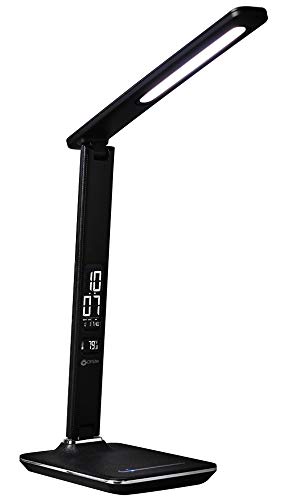
Knitting sessions that stretch into the late evening often result in tired, dry eyes if the ambient lighting is too harsh or flickers. The OttLite Wellness Glow is designed specifically to reduce visual fatigue by providing a steady, flicker-free light source that approximates the spectrum of the sun.
This natural light quality is particularly beneficial when comparing subtle shade variations in tweed or heathered yarns. Because the light is soft yet focused, it helps maintain focus on the knitting without causing the glare that often reflects off smooth metal or carbon fiber needles.
Investing in a lamp that minimizes eye strain is essentially an investment in the longevity of the knitting practice. It allows for longer, more comfortable periods of work, especially when tackling fine-gauge projects on tiny needles.
Daylight Company Lumi Task Lamp: Top Pro Choice

The Daylight Company is well-regarded among professionals who require absolute color accuracy and consistent lighting for hours at a time. The Lumi Task Lamp provides a wide, even spread of high-quality light that eliminates the “hot spots” often found in cheaper LED models.
This level of precision is vital for professional finishing techniques, such as grafting seams or picking up stitches along a neckline. When working with delicate silk or mohair blends, seeing every fiber clearly is necessary to ensure the final result looks as polished as a commercial knit.
While the price point is higher, the build quality reflects the professional-grade focus. It is a long-term tool intended to last through years of demanding, high-volume project work.
Phive LED Architect Desk Lamp: Best Value Option

The Phive LED Architect lamp brings professional design elements to a more accessible price point. Its adjustable, multi-jointed arm allows for a high degree of control, making it possible to position the light at the exact angle needed to see the path of the yarn through each loop.
This lamp is an excellent entry point for knitters who are transitioning from basic projects to more technical work. It provides enough illumination to reveal errors in complex patterns, allowing for quick troubleshooting before too much progress is made.
The primary tradeoff is the simplified interface compared to premium models. However, for most knitters, the combination of a dimmable LED and a robust, space-saving arm provides exactly what is needed for daily practice.
BenQ e-Reading LED Desk Lamp: Premium Feature Set
The BenQ e-Reading lamp stands apart with a unique curved light head that creates a significantly wider lighting area than traditional lamps. For those who spread their charts, needles, and multiple yarn cakes across a large desk, this wide beam provides uniform visibility across the entire workspace.
It includes advanced features like an ambient light sensor that automatically adjusts the brightness based on the room conditions. This is a subtle but effective way to maintain consistent lighting quality as the sun sets or the room environment changes during a long afternoon of knitting.
While this is an expensive piece of equipment, its longevity and ease of use make it a compelling choice for a permanent, dedicated studio space. It is designed for the serious maker who spends significant time refining their craft.
Glocusent Neck Reading Light: Best for Portability
Sometimes, the best light is the one that moves with the maker, especially when knitting in an armchair or traveling to a local knitting group. The Glocusent neck light rests comfortably around the neck, directing focused beams exactly where the needles meet the yarn.
This is the ultimate solution for avoiding the bulk of a desk lamp, particularly when knitting in dimly lit public spaces or during long commutes. It is lightweight, rechargeable, and adjustable, allowing the light to stay focused on the work even as the body moves.
The tradeoff is the limited battery life compared to a plug-in lamp. However, for portability and hands-free convenience, it is an indispensable addition to any knitting bag.
How to Choose the Right Light for Your Workspace
Choosing the right lamp involves evaluating the physical constraints of the workspace and the specific needs of the projects typically undertaken. Consider the footprint of the lamp base and whether a clamp or a weighted base is more appropriate for the surface.
Think about the adjustment range of the arm; a lamp that can reach deep into the lap while the knitter is seated on a sofa is fundamentally different from one meant to hover over a dining room table. Finally, ensure the controls are easily accessible while the hands are busy with needles and yarn.
- Clamp vs. Base: Use a clamp to save desk space, but ensure the edge of the furniture is compatible.
- Arm Length: Longer, multi-jointed arms provide more flexibility for deep workspaces.
- Control Placement: Look for buttons located on the light head rather than the base for easier adjustment mid-row.
Lumens vs. Color Temperature: What Matters Most?
Understanding the technical specs of a light bulb is crucial for avoiding frustration. Lumens measure the total brightness of the light, while color temperature, measured in Kelvins, describes the “warmth” or “coolness” of the glow.
For fiber arts, a neutral color temperature (around 4000K to 5000K) is generally best because it represents colors most accurately. Warmer lights (3000K) can shift the appearance of yarn colors, making a blue look slightly green, while cooler lights (6000K+) can look harsh and clinical.
- Below 3000K: Warm, amber glow; good for atmosphere but poor for color accuracy.
- 4000K–5000K: Neutral white light; the industry standard for clarity and color representation.
- Above 6000K: Cool, blueish light; can be overly harsh and cause eye strain over long periods.
Magnifier or No Magnifier? A Stitcher’s Guide
Magnification is a personal preference that depends heavily on the project type and the individual’s eyesight. For working with fingering weight yarn or smaller, or when executing complex lace patterns with many yarn-overs, a magnifier can be a game-changer.
However, beginners might find that a magnifier disrupts their natural depth perception, making it harder to gauge the spacing between stitches. If the main goal is simply better visibility of color and stitch structure, a high-quality lamp without a magnifier may be more than sufficient.
Test a magnifier before committing to it for long-term use. If it helps in spotting dropped stitches and reading charts without feeling disorienting, keep it; if it feels like a barrier between the hands and the work, opt for a standard, high-lumen light instead.
By matching the right light to the specific demands of a project and the layout of the workspace, a knitter can significantly improve their accuracy and comfort. A well-lit workspace not only makes the process more enjoyable but also helps preserve the longevity of one’s eyesight for years of future projects.