7 Best Lightbox Boards For Tracing Intricate Layouts
Discover the 7 best lightbox boards for tracing intricate layouts with precision. Browse our expert reviews and find your perfect drawing tool today.
Tracing intricate charts and lace layouts requires precision that standard room lighting simply cannot provide. For those working with complex stranded colorwork or delicate charts for lace, a lightbox acts as an essential tool to ensure every stitch aligns perfectly with the pattern. Having a clear, illuminated view of your graph paper or printed chart eliminates eye strain and prevents costly mistakes in your row counts. These devices transform the tedious task of pattern following into a clear, efficient process.
Cricut BrightPad Go: Best Cordless Lightbox


The Cricut BrightPad Go stands out for its portability, making it an ideal companion for knitters who move between their favorite armchair and a dedicated craft room. Because it is cordless, there is no risk of tangling cables with your working yarn or knocking over a project bag while trying to reach a power outlet.
This model features a rechargeable battery that offers several hours of consistent light, which is more than enough for long knitting sessions. The surface is durable enough to handle being moved frequently, though it is slightly smaller than some specialized artist-grade tables.
When working with complex lace charts that require constant focus, the ability to adjust the brightness ensures the light does not produce a glare that fatigues the eyes. For the knitter who values a tidy, wire-free workspace, this is an excellent, reliable investment.
Daylight Wafer 2: Best for Large Quilt Blocks

The Daylight Wafer 2 offers a generous surface area, making it the superior choice for those who work with large, expansive knitting patterns. When laying out a full-sized shawl diagram or mapping out a modular blanket project, having the extra width ensures the entire chart remains illuminated at once.
This model is remarkably slim, which keeps your hands at a natural, ergonomic level while marking off rows. Its consistent, edge-to-edge LED lighting ensures there are no dark spots that could lead to misreading a complex cable or lace instruction.
While it does require a power cord, the sheer workspace capacity is unmatched by smaller, battery-operated units. If the goal is to view a complex intarsia template without having to shift your paper constantly, the Wafer 2 is the professional choice.
Artograph LightPad Pro: The Professional’s Pick

Artograph is widely respected for producing equipment that stands up to daily, heavy-duty use. The LightPad Pro features a sophisticated, dimmable surface that allows you to calibrate the light intensity precisely for the thickness of the paper you are using.
If you are working with thick, high-quality graph paper or heavy cardstock to track complicated Fair Isle patterns, the sheer brilliance of this pad makes the grid pop clearly. The surface is also exceptionally smooth, meaning it will not snag on your yarn if you happen to have a project resting nearby.
This unit is a serious tool for the dedicated fiber artist who views their pattern preparation as a critical part of the craft. It is priced as a premium item, but the build quality and optical consistency justify the cost for high-volume makers.
HUION A4 Light Pad: Top Ultra-Thin Budget Buy
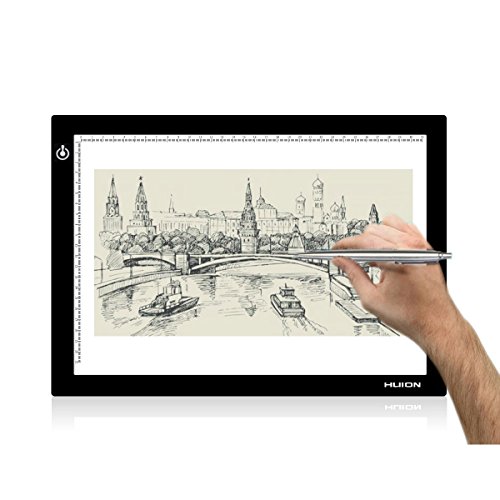
The HUION A4 Light Pad proves that effective tools do not need to command a massive budget. This ultra-thin board is incredibly light, allowing it to slide easily into a project bag alongside your circular needles and notions pouch.
Its simplicity is its greatest strength, offering a straightforward power button and consistent illumination. While it lacks some of the advanced features found in professional-grade drafting tables, it performs the core task of backlighting a pattern perfectly well.
For a knitter who is just beginning to explore chart-heavy projects, this provides a clear view without overwhelming the user with unnecessary controls. It is an affordable way to upgrade a workspace and improve accuracy in pattern reading.
LitEnergy A4 Light Box: Most Portable Option

The LitEnergy A4 Light Box is a minimalist’s dream, focusing entirely on a slim, lightweight frame that is easy to store. Because it weighs very little, it is the ideal selection for knitters who travel to workshops or knit groups and need a reliable way to reference their charts on the go.
The illumination is surprisingly bright for its modest price point, making it suitable for standard graph paper and printed pattern sheets. It connects via USB, which allows it to be powered by common phone chargers or even a portable power bank.
This portability means you never have to guess at your chart when you are away from your main desk setup. It is a no-frills, highly efficient tool that does exactly what it promises without any unnecessary complications.
Gaomon GB4 Light Pad: Best for Detailed Work
The Gaomon GB4 provides a level of clarity that is particularly beneficial when deciphering extremely dense, tiny print on older or complex knitting patterns. Its design focuses on high color accuracy and even light distribution, which helps prevent the visual distortion that can occur with lower-quality panels.
This pad is designed for fine detail, ensuring that even the most intricate cable symbols remain legible and crisp. For the maker who is meticulously checking a chart for a garment with 20+ row repeats, this clarity is invaluable.
The sturdy construction ensures it remains flat on your table, preventing any wobbling while you track your stitches. It is a reliable workhorse for those whose patterns require intense, sustained focus over several hours.
TOLOMPO A4 Light Box: Best Entry-Level Model
The TOLOMPO A4 Light Box is an accessible, entry-level option that is perfect for those new to using lightboxes for fiber arts. It provides a reliable light source that helps beginners avoid the common pitfall of losing their place on a complicated chart.
Its controls are intuitive, allowing for quick adjustments without a steep learning curve. While it is basic, it effectively illuminates most types of pattern charts, from simple lace to basic colorwork grids.
This model is a low-risk entry point into the world of electronic pattern tracking. It serves its purpose well, providing just enough light to keep your project organized and your mistakes to a minimum.
How to Choose the Right Lightbox Size for You
Choosing the right lightbox size depends largely on the complexity and scale of your knitting patterns. A4 is the standard size for most documents and is usually sufficient for individual chart pages or standard-sized notebook paper.
However, if you frequently work from large-format pattern books or design your own garments on oversized drafting paper, you will quickly find an A4 pad limiting. An A3-sized board offers the extra real estate needed to see a full pattern repeat without needing to slide the paper around.
Always consider the physical footprint of your crafting space before buying. A massive board is a wonderful asset, but only if it fits comfortably alongside your yarn, needles, and notions without causing clutter.
Wired vs. Cordless: Which Lightbox Is Best?
Wired lightboxes are generally more powerful and offer more consistent, long-term brightness without the need for charging. They are the standard for dedicated studios where you have a permanent place to plug in and work for extended hours.
Cordless models offer unmatched freedom, allowing you to move from the kitchen table to the sofa without finding an outlet. This is a significant advantage for knitters who prioritize comfort and the ability to work in various spots around the home.
The tradeoff lies in battery maintenance and potential dimming as the charge fades. If you have the patience to keep devices charged, the convenience of a cordless pad often outweighs the reliability of a wired connection.
Lightbox Brightness and Surface: What Matters
Brightness control is the most critical feature to look for in a lightbox intended for chart reading. Knitting charts, especially those printed on recycled or thin paper, can often suffer from “bleed-through,” where the light is too intense and makes the lines on the back of the paper distracting.
A dimmable surface allows you to adjust the light output based on the thickness of your paper and the ambient light in the room. This prevents eye fatigue during long sessions of tracking stitch patterns.
Finally, look for a surface that is scratch-resistant and easy to clean. Since you will be working with yarn and potentially snacks or drinks nearby, a smooth, non-porous surface is essential for longevity and maintaining clear visibility over time.
Investing in a quality lightbox is one of the most effective ways to elevate your knitting practice and minimize the frustration of chart errors. By selecting a device that aligns with your specific space and the scale of your projects, you ensure that every stitch is placed with confidence and precision. Whether you choose a portable cordless model or a large-format wired board, the clarity provided will undoubtedly improve the final quality of your fiber art. Happy knitting, and may your rows always stay true.