
6 Best Lens Mount Adapters For Using Vintage Glass
Discover the 6 best lens mount adapters to attach your favorite vintage glass to modern mirrorless cameras. Explore our top expert picks and upgrade your kit today.
Integrating vintage glass elements into modern knitting projects requires a specific set of tools and careful technique to ensure longevity and aesthetic harmony. Whether working with delicate antique beads or heavy, statement-making glass buttons, the right equipment transforms a frustrating process into a seamless craft. The following tools provide the precision and support necessary to handle fragile materials without risking the integrity of your hand-knit fabric. Choosing the correct adapter or assistive device is the difference between a professional heirloom piece and a project that begins to fray or break after a single wash.
The OttLite 2-in-1 Magnifier: Best Floor Lamp


Working with fine-gauge yarn and dark-colored glass beads often leads to significant eye strain during long evening sessions. An OttLite 2-in-1 floor lamp provides the necessary illumination and magnification to ensure every bead placement is accurate.
The ability to switch between a floor stand and a tabletop configuration makes this a versatile investment for a dedicated knitting corner. High-contrast lighting helps distinguish between similar-sized beads, preventing the common mistake of incorporating a slightly off-sized glass element that disrupts the rhythm of a row.
Opt for this tool if primary knitting sessions happen in low-light environments or involve intricate lace patterns where every stitch must be visible. While the footprint is larger than a standard task lamp, the optical clarity provided is unmatched for detailed bead placement.
Carson DeskBrite 200 Magnifier: Best for Tables
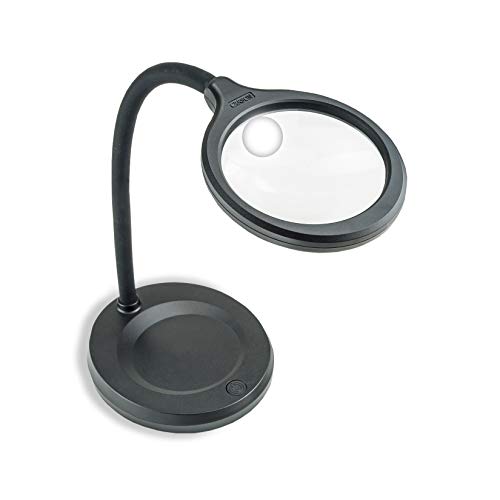
For knitters who prefer to keep their supplies neatly organized within arm’s reach, the Carson DeskBrite 200 offers a compact alternative to floor lamps. Its integrated LED lights provide a focused beam, reducing the shadows that often occur when hands hover over the knitting needles.
This magnifier is particularly useful when checking for small flaws in glass beads, such as micro-cracks or rough edges that might cut through expensive silk or fine wool yarn. Catching these defects before they are knit into a garment saves the time and heartache of having to rip back later.
Keep in mind that while it offers excellent clarity, the field of vision is narrower than larger floor models. Use this for specific tasks like checking bead alignment, rather than as a primary light source for an entire sweater.
Beadsmith Big Eye Needles: For Vintage Beads

Threading vintage glass beads often proves difficult because the internal holes are frequently inconsistent or clogged with age. Big Eye needles are designed with a collapsible center that opens along the entire length of the needle, allowing for effortless threading of even the most stubborn beads.
These needles are indispensable when working with fragile antique beads that cannot withstand the pressure of a standard needle eye. They glide through most yarn weights without snagging, which is essential when adding embellishments to delicate fibers like lace-weight alpaca or cashmere.
Be aware that these needles are more flexible than stainless steel sewing needles and can bend if pushed too hard. Always use a gentle, guiding motion to prevent the needle from losing its shape while navigating through a dense stitch.
Clover Antique Yarn Threader: Best for Buttons
Vintage buttons often possess shanks that are too thick for standard sewing needles to pass through comfortably. The Clover Antique Yarn Threader bridges the gap between bulky yarn and narrow button shanks, acting as a bridge to pull the fiber through without abrasion.
Using the correct threader prevents the yarn from fraying or snapping during the attachment process. This is especially critical when working with high-twist wools that tend to fuzz when pulled repeatedly through a small, potentially sharp glass shank.
A good threader ensures that the button sits flush against the fabric, maintaining the structural balance of the garment. It is a small, inexpensive tool that effectively protects the investment made in both the vintage button and the hand-knit fabric.
The LoRan Button-Fast Tool: Securing Glass Buttons
Glass buttons, especially heavier vintage pieces, require a secure anchor point to prevent them from drooping or pulling on the knit fabric. The LoRan Button-Fast tool assists in creating a stable shank, ensuring the button remains elevated and functional.
Properly spacing the button away from the fabric is vital for thick, textured knits. If a glass button is sewn directly against the fabric, it will cause puckering and may eventually wear a hole in the surrounding stitches.
The tool provides the necessary clearance to wrap the thread securely around the shank, creating a professional and durable finish. It is the preferred method for anyone aiming to mimic the construction standards found in high-end knitwear design.
Pro-Bead-A-Loom: Best for Intricate Beadwork
When a project demands a high density of glass beads, such as an intricate beaded collar or a cuffs section, manual bead placement becomes impractical. The Pro-Bead-A-Loom allows for the pre-stringing of large quantities of beads in a specific sequence.
This tool streamlines the workflow by removing the need to stop and thread each bead individually during the knitting process. It is highly effective for patterns that require consistent color gradients or complex mosaic bead layouts.
Understand that using a loom changes the tension of the project slightly, as the weight of the beads is distributed differently across the row. Always perform a test swatch to adjust the needle size if the beads make the fabric drape too heavily.
Choosing a Magnifier for Detailed Stitch Work
When evaluating magnifiers, prioritize optical clarity over high magnification power. Extreme magnification often leads to a smaller field of vision, which can be disorienting when working on a long circular needle.
Look for features like adjustable arms and sturdy bases that do not wobble during use. A magnifier that shifts with the weight of the hand will disrupt the focus and increase frustration rather than reducing it.
- Fixed base: Best for stable, desk-bound knitting.
- Clip-on: Best for travel or tight spaces.
- Headband style: Offers the most freedom of movement but can feel heavy over long periods.
Bottom line: Choose a magnifier that remains stable without requiring constant adjustment while the hands are busy.
How to Securely Sew on a Vintage Glass Button
Sewing a vintage glass button onto a knit requires a buffer to protect both the glass and the yarn. Always use a heavy-duty thread or a silk buttonhole twist, as standard sewing thread is too weak for the weight of glass.
Create a “thread shank” by placing a toothpick or the LoRan Button-Fast tool between the button and the garment. Once the button is sewn, remove the tool and wrap the working thread tightly around the stitches under the button.
This tension-relieving wrap acts as a support pillar for the button. It ensures that the glass does not rub against the fiber, extending the lifespan of the garment significantly.
Tips for Adding Glass Beads to Your Knitting
The placement of glass beads can drastically alter the final drape of a fabric. Always consider the weight of the beads relative to the yarn; heavy glass beads on a light-fingered yarn will cause the garment to stretch and sag over time.
Distribute the weight of the beads across structural lines, such as seams or cables, to provide extra support. If adding beads to lace, place them on the right side of the fabric to ensure they remain visible and do not get trapped in the internal structure of the stitch.
Always test wash a small swatch containing a bead to ensure the glass is colorfast and the edges are smooth. Nothing ruins a project faster than a sharp-edged vintage bead cutting through the surrounding yarn fibers.
Caring for Projects with Embellishments
Knits with glass embellishments must be treated with extra care during the laundering process. Hand-washing is non-negotiable; machine agitation can cause heavy buttons to pull or fragile glass to chip against the drum.
Always lay the project flat to dry, ensuring that heavy sections are supported and not hanging off the edge of the drying rack. Excessive moisture trapped in a bead-heavy area can stretch the fabric out of shape during the drying phase.
When storing these items, fold them carefully to avoid putting undue stress on the beads. If storing for a long duration, cover the glass elements with acid-free tissue paper to prevent them from scratching other parts of the knitwear.
With these tools and techniques, you can confidently integrate vintage glass into your knitting, ensuring your projects remain as durable as they are beautiful. By respecting the physical properties of the materials and choosing equipment that aids precision, you elevate the quality of every handmade garment.