6 Best Jewelry Jump Ring Openers For Finger Protection
Protect your fingers while crafting with our top 6 jewelry jump ring openers. Compare the best tools today to find the perfect ergonomic fit for your workshop.
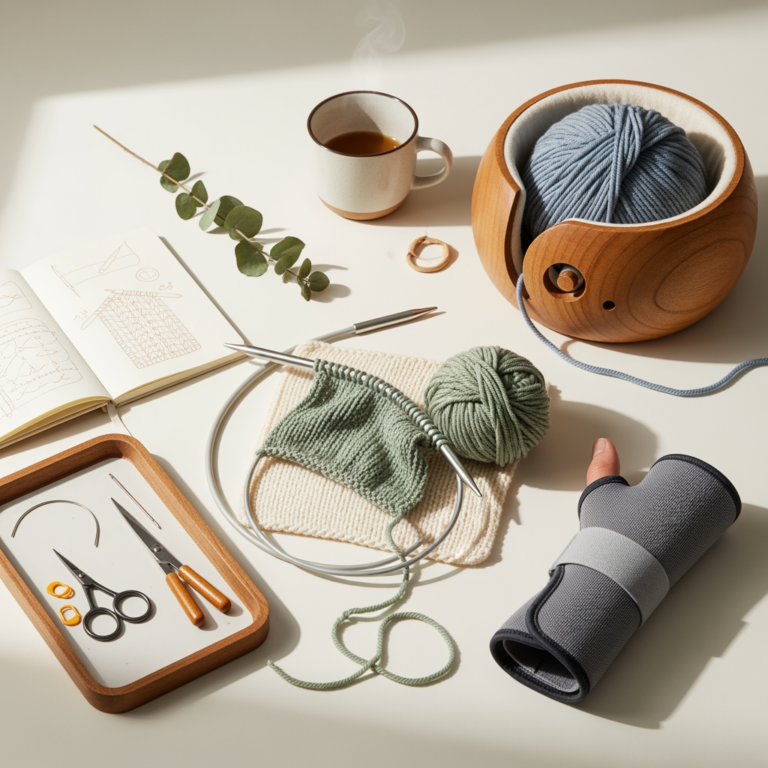
Fumbling with tiny metal jump rings is a common frustration when preparing DIY stitch markers for complex lace projects or heavy-weight sweater patterns. Manually prying these rings open with fingernails or standard pliers often leads to sore fingertips and misshapen wire. Choosing the right tool preserves the structural integrity of the ring, ensuring it won’t snag delicate yarn fibers like mohair or single-ply wool. This guide breaks down the best specialized openers to keep hands comfortable and projects snag-free.
Beadsmith Ring Tool: Best Overall Finger Saver


The Beadsmith ring tool functions as a grooved guide that sits comfortably against the thumb, acting as a sturdy fulcrum. It features multiple slots of varying depths, which accommodate different wire gauges without slipping.
This design is ideal for knitters who suffer from repetitive strain or arthritis. By shifting the leverage from the delicate joints of the fingers to the tool itself, it removes the physical resistance often encountered when opening heavy-gauge copper or silver rings.
For the best results, slide the jump ring into the slot that fits most snugly. Apply light, steady pressure to the pliers holding the other side of the ring. This keeps the circle perfectly round, preventing sharp wire edges from catching on your yarn during a long knitting session.
Wubbers Bent Nose Pliers: Most Ergonomic Grip

Wubbers are widely recognized for their exceptionally padded, non-slip handles that reduce hand fatigue during long crafting sessions. The bent nose design allows for better visibility when working on intricate markers, as it keeps the hand away from the immediate line of sight.
If a project involves dozens of progress keepers for a colorwork chart, the ergonomic benefit of these handles cannot be overstated. The leverage provided by the bent head makes opening tempered metal rings much smoother, requiring less wrist rotation.
The trade-off here is the size of the tool head, which can feel bulky when handling tiny 4mm jump rings. Reserve these for larger rings or when working with high-tension wire that requires a bit more force to manipulate.
Xuron Short Chain Nose Pliers: For Precision
Precision is the primary benefit of the Xuron short chain nose pliers, which feature a tapered profile that excels at delicate work. These pliers are manufactured with a bypass cutter-style spring, providing a smooth, consistent feel that is vital for fine jewelry adjustments.
When knitting with high-twist yarns that are prone to snagging on any slight imperfection, having a perfectly closed jump ring is essential. These pliers allow for the micro-adjustments needed to ensure the two ends of the jump ring meet with absolute flushness.
The short nose provides excellent control, but it lacks the leverage of larger tools. Use these for finer gauges of wire where force is less important than finesse and accuracy.
The Beadalon Jump Ringer: Easiest to Learn
The Jump Ringer is a specialized barrel tool that acts as a secure, hands-free station for jump ring manipulation. It uses a series of slots to hold the ring firmly in place, allowing the knitter to use pliers with both hands for a clean, consistent open and close.
This tool is the most approachable option for beginners who find the coordination of two pairs of pliers intimidating. Because it locks the ring in position, the risk of the ring flying across the room or bending out of shape is significantly reduced.
While it is highly effective, it does require a bit of bench space compared to a simple pair of pliers. It is a stationary tool, so it works best for makers who have a dedicated space for assembling their knitting notions.
Eurotool Plier Set: Best Value for Beginners
Investing in a complete Eurotool set provides a variety of head shapes, including chain, round, and flat nose options. Having the full set at once allows the maker to experiment with which grip and shape works best for different types of wire finishes.
For someone just starting to build their own stash of notions, this set covers every eventuality. Whether you are attaching charms to markers or creating simple ring-and-bead styles, the versatility of having multiple head shapes is unmatched.
Be aware that these are entry-level tools. While they function perfectly well, the grip may not be as soft or the spring action as refined as higher-end, specialized brands. They are a practical starting point before deciding if professional-grade, ergonomic tools are necessary.
Auntie’s Beads Tool: Top Simple & Small Pick
Auntie’s Beads tool is a minimalist, ring-style opener that slides directly onto the finger. It is incredibly compact and requires almost zero learning curve, making it perfect for tucking into a portable knitting bag.
This tool is ideal for knitters who prefer to assemble markers on the go. Since it stays on your finger, you can keep your pliers in one hand and simply use the tool to pop the ring open, streamlining the process significantly.
Because of its simple design, it may not work well with extremely heavy-duty or thick-gauge wire. It is best suited for standard-weight jump rings commonly used for stitch markers that glide smoothly over needles.
How to Properly Open and Close a Jump Ring
The most common mistake is pulling the ends of a jump ring apart laterally, which deforms the circle into an oval. This creates a weak spot and leaves a sharp gap that will inevitably catch on fine wool or lace weight yarns.
Instead, always open a jump ring by using two pairs of pliers to twist the ends in opposite directions along the plane of the circle. Think of it like opening a door on a hinge rather than pulling two magnets apart.
When closing the ring, reverse the motion to bring the ends back together with a slight “click” or overlap. If the ring is slightly out of shape, gently massage it back into a perfect circle with the flat part of your pliers.
Ring Tool vs. Pliers: Which Is Right for You?
Ring tools and finger-mounted openers are best for those who struggle with hand strength or who want to ensure a perfectly circular shape. They are specialized for the task of opening and closing without needing complex motor control.
Pliers are better for those who need versatility for other tasks, such as bending wire, crimping beads, or general repair work. Pliers offer more control over the angle and force, but they require more practice to master the “twist” method.
For the most efficient workflow, keep one pair of pliers and one ring-opening tool at your station. This combination allows for maximum control while ensuring the ring remains perfectly round for snag-free knitting.
What to Look For in a Jump Ring Opening Tool
Look for tools with a comfortable, non-slip grip, as your hands will often be damp or tired after a long day of knitting. A good spring mechanism is also vital, as it reduces the amount of pressure needed to return the tool to an open position.
Check the material of the tool tips; steel is standard, but some include nylon tips to prevent marring soft metals like sterling silver. Avoid tools with sharp, serrated edges on the inside of the jaws, as these will leave teeth marks on your rings.
Prioritize tools that offer a good balance of weight and size. If the tool is too heavy, your hand will tire; if it is too small, you won’t have enough leverage to open stubborn rings without straining your thumb joints.
Why Jump Rings Make Great Knitting Markers
Jump rings are the ultimate stitch marker because they are low-profile and lightweight, meaning they won’t distort your gauge or pull on the stitches. Unlike bulky plastic rings, metal jump rings glide effortlessly across even the most “sticky” or fuzzy fibers like mohair or angora.
Because they are thin, they allow for tighter stitches to be worked right up against the marker without a gap appearing in the fabric. This is especially important for stranded colorwork where you need to keep your floats consistent.
Furthermore, their durability is superior to plastic markers, which can crack or melt over time. A quality metal jump ring will last for years, making them a sustainable and reliable addition to any knitter’s notions kit.
Selecting the right jump ring opener is a small investment that pays off every time a stitch marker slides smoothly across your needles. By prioritizing ergonomic support and the proper “twist-to-open” technique, you protect your hands from fatigue and your project from accidental damage. With the right tool in your kit, you can focus entirely on the rhythm of your stitches rather than the frustration of your notions.