6 Best Craft Sponges For Applying Even Coats To Try
Struggling with streaky paint? Discover the 6 best craft sponges for applying even coats to your projects. Read our expert guide and upgrade your supplies today.
Achieving a professional finish on hand-dyed yarns or painted fiber accessories requires the same precision as maintaining consistent tension in a complex cable pattern. While needles and hooks dictate the structure of the fabric, the tools used to apply dye or sealant define the final aesthetic quality. Choosing the right applicator prevents streaking, pooling, and uneven saturation that can ruin hours of careful work. These six sponges offer the control necessary to elevate handmade projects from amateur experiments to polished, gallery-ready pieces.
Royal & Langnickel Artist Sponges: Best Overall
These sponges represent the gold standard for versatility, much like a set of high-quality nickel-plated needles that perform well across every fiber type. Their structural integrity allows for repeated saturation and compression without the rapid breakdown often seen in cheaper alternatives.
The fine cell structure ensures that liquid dye or paint is distributed uniformly rather than absorbed into the core. This is essential when applying color to delicate wool roving, where uneven application can lead to patchy, undesirable color shifts.
- Superior density: Maintains shape during heavy use.
- Controlled release: Prevents dripping and oversaturation.
- Versatile: Handles everything from thin glazes to thicker acrylic dyes.
For projects requiring consistent color coverage, these are the most reliable option. They minimize the risk of “pooling,” the fiber arts equivalent of accidental dye migration, which can occur when an applicator holds too much excess moisture.
Plaid Stencil Daubers: Best for Stenciling


When adding intricate details to felted pieces or fabric accessories, precision is paramount. Plaid Stencil Daubers function like a tapestry needle used for duplicate stitch; they allow for absolute control over where color is placed without bleeding into adjacent sections.
These daubers feature a flat, firm head that forces the pigment directly into the surface of the fiber. By tapping—rather than dragging—the tool, the artisan creates clean, sharp edges that are impossible to replicate with a traditional brush.
- Flat profile: Ideal for precise, edge-to-edge color placement.
- Firm foam: Provides the resistance needed for consistent pressure.
- Easily managed: The handle length allows for a steady grip, reducing hand fatigue.
This tool is indispensable for repeat patterns or geometric designs. If the goal is a sharp, crisp line on a piece of firm felt or canvas, avoid soft brushes and reach for this dauber instead.
Arteza Foam Sponge Brushes: Best Budget Pick
Economic tools are a staple in any fiber studio, especially when one is working with multiple colors or experimenting with a new technique. These foam brushes provide a surprisingly smooth finish for the price, functioning effectively for base coats or large-scale dyeing sessions.
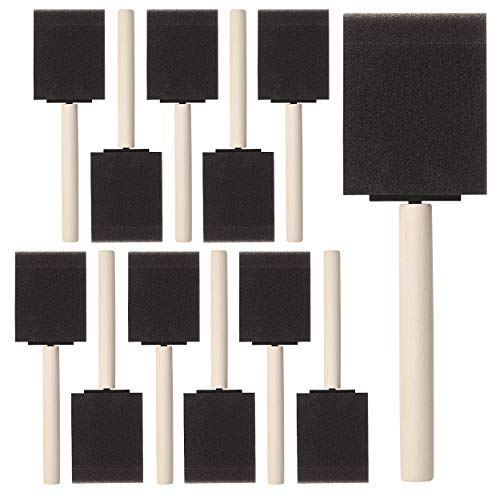
While these brushes lack the long-term durability of professional-grade tools, they are excellent for disposable tasks or one-off projects. They provide a soft, forgiving application that is difficult to overwork, similar to using a flexible bamboo needle for a light, airy yarn.
- Cost-effective: Replaceable without significant financial strain.
- Smooth finish: Foam texture helps eliminate streak marks.
- Lightweight: Minimizes strain during long hours of application.
The primary tradeoff is the tendency of the foam to degrade after a few washings. Treat these as reliable, single-project workhorses rather than heirloom tools.
Natural Sea Wool Sponges: For Organic Textures
When the goal is an ethereal, mottled effect or an organic aesthetic, synthetic tools fall short. Natural sea wool sponges offer an irregular, porous structure that creates depth and visual interest through random, non-repeating marks.
Just as the twist and ply of a yarn create the character of a fabric, the unique shape of a natural sponge dictates the texture of the applied finish. This is the ideal tool for mimicking the appearance of natural stone, worn surfaces, or watercolor-style backgrounds.
- Irregular patterns: Creates unique, non-uniform results.
- High absorbency: Holds large amounts of fluid for expansive projects.
- Soft and pliable: Easily contours to curved or uneven surfaces.
Care must be taken to rinse these thoroughly, as natural fibers can harbor trapped particles. For those aiming for a rustic, bespoke look, these sponges provide a depth of character that manufactured tools simply cannot achieve.
Loew-Cornell Foam Pouncers: For Large Surfaces
Pouncers are designed for rapid coverage, similar to using a bulky yarn with large needles to work up a blanket quickly. Their spherical shape allows the user to apply color in a circular, stippling motion that builds intensity evenly across a large area.
The rounded surface makes it easy to maintain an even distribution of color without the “stop-start” marks often left by rectangular brushes. They are particularly effective when working on non-porous surfaces or applying a final sealant to a finished craft piece.
- Ergonomic handle: Reduces the strain on the wrist.
- Seamless coverage: Prevents streak lines by eliminating sharp corners.
- Consistent pressure: Easier to maintain uniform intensity across a flat plane.
When working on wide surfaces, these tools eliminate the risk of unsightly streaks. They provide a professional, airbrushed look with very little effort, making them an essential part of any finishing kit.
Cosmetic Wedges: For Ultra-Smooth Finishes
Cosmetic sponges are the secret weapon for applying ultra-thin, smooth layers of paint or dye. Because they are designed for delicate skin, they possess an incredibly tight cell structure that leaves virtually no texture behind, much like a smooth, mercerized cotton yarn.
These wedges are the perfect tool for fine-tuning the finish on small accessories. They excel at “pouncing,” or gently dabbing, color onto a surface to achieve a seamless, glass-like gradient.
- Ultra-fine texture: Eliminates brush strokes entirely.
- Disposable convenience: Keeps colors from cross-contaminating.
- Easily cut: Can be trimmed to reach tight corners or tiny details.
The downside is their inability to hold a high volume of liquid, which limits them to small-scale detail work. If a flawless, streak-free surface is the priority, the small size of these wedges is a minor price to pay for the quality of the finish.
How to Pick the Right Sponge for Your Project
Choosing a sponge requires balancing the project’s scale with the desired finish. Just as one chooses a needle material—wood for grip, metal for speed—one must choose a sponge based on its physical properties.
- Small, detailed work: Choose cosmetic wedges or stencil daubers.
- Large, flat surfaces: Opt for foam pouncers or wide foam brushes.
- Texture and depth: Select natural sea wool sponges.
Consider the viscosity of the medium as well. Thinner dyes require a sponge with lower absorbency to prevent flooding, while thicker pigments often need a denser foam to ensure an even transfer.
Technique: Getting a Flawless, Even Finish
The secret to a flawless finish lies in the motion of the hand, not just the quality of the tool. Avoid dragging the sponge across the surface like a paintbrush; instead, use a light, bouncing motion known as “pouncing.”
Start off the edge of the project to remove excess pigment from the sponge before touching the work surface. This prevents “globs” of color from accumulating, which are notoriously difficult to correct once dry.
- Thin coats: Apply multiple thin layers rather than one heavy, saturated coat.
- Overlapping: Always overlap the previous stroke slightly to ensure no gaps remain.
- Drying time: Allow each layer to dry completely; trying to rush this step often results in pilling.
Patience is the knitter’s greatest virtue, and it applies equally here. Building color gradually ensures a smooth, professional result that stands up to close inspection.
Cleaning and Caring For Your Craft Sponges
Proper maintenance extends the life of synthetic applicators significantly. Rinse sponges immediately after use; once pigment dries within the foam cells, the sponge becomes stiff and loses its ability to distribute color evenly.
For synthetic sponges, a mild dish soap and warm water are sufficient. Gently squeeze the sponge—never wring or twist it—as this destroys the internal structure and leads to premature crumbling.
- Drying: Always air-dry sponges in an upright position.
- Storage: Keep in a dust-free container to prevent debris from becoming trapped in the foam.
- Replacement: When a sponge begins to shed particles or show signs of tearing, replace it to avoid marring the project.
Treating these tools with the same care as quality knitting needles ensures they remain reliable for years. A well-maintained sponge is far more effective than a fresh one used carelessly.
Natural vs. Synthetic Sponges: Which is Better?
The debate between natural and synthetic sponges mirrors the discussion around natural fibers versus synthetics in yarn. Natural sponges offer unique, irregular character and a texture that feels organic and handcrafted.
Synthetic sponges, however, provide consistency and control. They are the “superwash wool” of the applicator world—predictable, durable, and easy to clean.
- Natural: Best for artistic, irregular finishes where perfection is secondary to character.
- Synthetic: Best for precise, clean, and repeatable outcomes.
There is no “better” option, only the right tool for the specific design intent. Assess the aesthetic goal of the project before committing to a material, and remember that professional results often involve layering different tools to achieve the desired effect.
By selecting the right sponge and applying it with intention, every project gains a refined finish that reflects the care put into its creation. Consistency, whether in a purl stitch or a painted surface, is the hallmark of a true master.