6 Best Digital Calipers For Exact Measurements
Need precise results? Discover the 6 best digital calipers for exact measurements in our expert guide. Compare top-rated tools and pick the perfect one today.
Achieving professional-grade gauge starts with tools that provide absolute measurement certainty rather than relying on guesswork or worn-out plastic gauges. Whether verifying the diameter of a vintage needle or calculating the precise wraps per inch (WPI) for a hand-spun yarn, a digital caliper is the definitive bridge between theory and a perfectly fitted garment. These precision instruments remove the ambiguity inherent in mass-produced knitting tools, where manufacturing tolerances can often lead to a 0.25mm discrepancy. Investing in an accurate caliper ensures that every swatch reflects the true structural reality of the project.
iGaging Absolute Origin: Best Overall Precision


The iGaging Absolute Origin stands out because it retains the zero-point even after the display is turned off, a massive advantage for repetitive knitting tasks. Many digital tools lose their reference when powered down, forcing a tedious re-calibration process every time a new needle or cable is measured.
For a knitter working on a complex lace shawl where needle diameter is critical for stitch definition, this “Absolute” technology ensures consistent measurements throughout the session. It eliminates the frustration of sliding a gauge back and forth to reset the start point.
The build quality is substantial enough to feel stable in the hand without being bulky. It offers the precision required for high-end fiber work where a tenth of a millimeter changes the drape of an entire sweater.
Neiko 01407A Stainless Steel: Top Budget Model
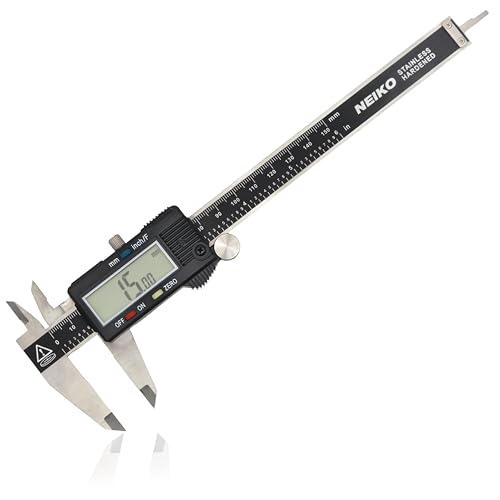
The Neiko 01407A is a robust, entry-level option that proves you do not need to overspend to get reliable results. It is constructed from stainless steel, meaning it will survive the occasional drop into a heavy project bag filled with metal needles and scissors.
This model is ideal for the knitter who wants to verify needle sizes or check the thickness of different yarn plies without the premium price tag. It provides quick, responsive readings that are more than sufficient for standard gauge calculations.
While it lacks the advanced memory functions of professional machinist tools, it handles the daily grind of the knitting room with ease. It remains a practical choice for those who prefer to spend their budget on high-quality wool rather than expensive hardware.
Mitutoyo 500-196-30: The Gold Standard Caliper

Mitutoyo is widely recognized as the industry benchmark for precision measurement, and the 500-196-30 is no exception. Its build quality is peerless, offering smooth, fluid movement that allows for incredibly delicate adjustments when checking the thickness of fine, fingering-weight yarns.
This caliper is an investment intended for a lifetime of use. If the focus is on archiving swatches or conducting rigorous laboratory-style testing of yarn elasticity and diameter, the precision of a Mitutoyo simply cannot be eclipsed by mass-market competitors.
The sensor technology is highly resistant to the environmental factors found in home crafting spaces, such as dust or stray fiber particles. It is the definitive choice for the serious maker who demands absolute, verifiable data for every single stitch.
Vinca DCLA-0605: Most Reliable for Daily Use

The Vinca DCLA-0605 bridges the gap between industrial utility and home craft convenience with impressive consistency. It features a hardened stainless steel frame that is resistant to the natural oils found in spinning fibers and animal-based yarns.
It is particularly useful for checking the consistency of hand-spun singles or verifying the diameter of interchangeable needle tips that have had their labels rubbed off over time. The display is large, clear, and easy to read even in low-light knitting environments.
This tool functions reliably without frequent recalibration, allowing for a seamless transition from one fiber project to the next. It offers a balance of durability and accuracy that makes it a permanent fixture on any serious workbench.
Clockwise Tools DCLR-0605: For Easy-to-Read Results
The Clockwise Tools DCLR-0605 is designed with an extra-large LCD screen, making it the top choice for knitters who need quick, clear visibility. If visual fatigue is a concern after hours of knitting colorwork charts, this caliper reduces the squint factor significantly.
The unit is highly intuitive to operate, with simple buttons that allow for instant switching between metric and imperial systems. This is vital when moving between American patterns that use US needle sizes and international patterns that specify millimeters.
While the exterior is slightly more utilitarian than high-end models, the internal measurements remain highly accurate for everyday knitting applications. It is a user-friendly tool that prioritizes readability without sacrificing the necessary precision.
Kynup Digital Caliper: Great Features for the Price
The Kynup digital caliper comes packed with features that punch well above its price bracket, including a precise fine-adjustment roller. This roller is a game-changer for measuring soft, squishy fibers that might compress if squeezed too hard by a standard manual caliper.
It allows for a gentle, controlled approach to measurement, ensuring that the tool captures the true diameter of the yarn rather than the diameter of a compressed fiber. This is essential for accurate WPI calculations, which are often distorted by heavy-handed measurement techniques.
The stainless steel construction provides a heavy, premium feel that keeps the tool anchored on the table during busy crafting sessions. For the price, it is difficult to find a tool that offers this level of refined, granular control.
What to Look For in a Digital Caliper for Knitting
When selecting a caliper, look for a model with a stainless steel body, as plastic alternatives tend to warp or flex, leading to inaccurate results. Precision is paramount, so ensure the tool has a resolution of at least 0.01mm to capture the subtle variations in yarn weight.
Consider the “Auto-Off” function, as batteries can drain quickly if the tool is left on inside a dark project bag. Also, prioritize models with a locking screw, which allows for holding a specific measurement while you transfer that data to a gauge swatch or pattern note.
Avoid gimmicky tools with excessive, non-knitting-related features. A simple, precise, and sturdy instrument will always serve the fiber artist better than an over-engineered gadget that complicates the creative process.
How to Measure Needle Size and Swatch Gauge
To measure needle size, always place the caliper jaws in the center of the needle shaft, avoiding the tapered tip. For interchangeable needles, verify the diameter exactly where the needle joins the cable to ensure your connector hardware matches correctly.
When measuring yarn for WPI, do not wind the yarn tightly around a ruler; instead, lay it loosely against a flat surface and use the caliper to measure the space between several parallel strands. This prevents the compression of delicate fibers like alpaca or mohair, which can easily throw off your gauge calculations.
Always measure your swatch after blocking, as fiber properties change drastically once wet-finished. Use the caliper to measure 10cm sections to ensure your stitch count remains consistent across the entire fabric surface.
Calipers vs. Needle Gauges: Which Is Best?
Traditional needle gauges are convenient, but they are subject to wear and tear over time, often becoming inaccurate as the holes widen. A digital caliper provides a mathematical truth that a plastic or metal card gauge simply cannot match.
While a needle gauge is excellent for quick identification on the go, a digital caliper is the professional choice for verifying gauge when working with unusual or vintage needles. It eliminates the margin of error present in mass-produced sizing cards.
Ultimately, use a needle gauge for a fast check at the yarn store, but keep a digital caliper on your desk for the actual work of measuring yarn and checking gauge density. Precision is the best defense against a finished sweater that does not fit.
Caliper Care: Keeping Your Tool Accurate for Years
Keep your caliper away from moisture and extreme temperatures, both of which can compromise the sensitive electronic internal components. Always store the tool in its provided case to protect the delicate jaws from being bent or chipped by other heavy knitting tools.
Periodically wipe the jaws with a soft, lint-free cloth to remove any stray fibers or lanolin residue. If the tool starts to give inconsistent readings, it is almost always a sign that the battery is low, so keep a spare pack of high-quality button cell batteries on hand.
Taking these simple steps will ensure that your measurement tool stays as accurate as the day it was unboxed. A well-maintained caliper is the hallmark of a knitter who treats their craft with the seriousness and technical respect it deserves.
Mastering the use of a digital caliper is an essential step in transitioning from a casual hobbyist to a confident, technically proficient maker. By relying on precise data rather than intuition, you can approach any pattern with the security of knowing that your gauge is exact and your sizing is consistent.