6 Best Sewing Needle Threaders For Vision Support
Struggling to thread your needle? Discover the 6 best sewing needle threaders for vision support and simplify your projects today. Shop our top picks right now.
Straining to thread a tapestry needle after a long session of kitchener stitch or weaving in ends is a frustration every fiber artist understands. Diminishing vision or simply the fatigue that settles into the hands after hours of intricate colorwork can turn a simple task into a chore. Fortunately, the right mechanical aid can restore autonomy to your craft. Selecting a needle threader is not just about convenience; it is about keeping the momentum of a project alive when the eyes grow weary.
Clover Desk Needle Threader: Best for At-Home Use


This desktop unit is a stationary powerhouse designed for those who keep a dedicated sewing or knitting station. By resting the needle in a small groove and pressing a button, the mechanism guides the thread through with high precision.
It is particularly effective for those working with tapestry needles used for seaming knitwear. Because it remains on the table, it eliminates the need for steady hand coordination, which is often compromised after a long day of working with fine-gauge wool or bamboo.
However, its footprint is significant compared to handheld alternatives. It is not designed for a project bag, but for the knitter who values a permanent, reliable setup that removes the guesswork from threading.
Dritz Hummingbird Needle Threader: Most Versatile
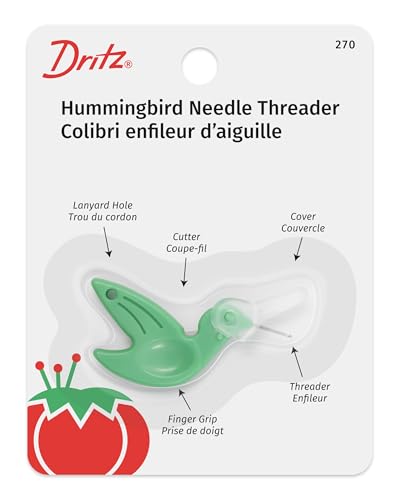
The Hummingbird is a classic for a reason, utilizing a simple wire loop mechanism that accommodates a wide array of eye sizes. This tool is ideal for knitters who frequently switch between chunky weight yarns on large needles and delicate lace-weight finishes.
Its design is compact enough to tuck into any notions pouch, making it a reliable companion for on-the-go knitting groups. The wire loop is gentle on delicate embroidery floss or fine silk threads often used for duplicate stitch or surface embellishment.
While versatile, the thin wire can be fragile if forced through an exceptionally small needle eye. Always ensure the wire passes through cleanly before attempting to pull the thread through to avoid snapping the loop.
Bohin Automatic Needle Threader: Best for Quilters

While marketed for sewing, the Bohin excels in the fiber arts for its ability to handle various needle gauges with consistent mechanical reliability. It uses a push-button system that pushes the thread through the eye, which is a life-saver when using needles with smaller eyes for weaving in tails on thinner, plied yarns.
This device is favored by those who need to maintain speed and efficiency, especially when working on complex projects like intarsia where multiple bobbins of yarn are in constant rotation. It reduces eye strain significantly by removing the need to focus on tiny apertures.
Note that this model works best with standard-length needles. If a project requires extra-long darning needles, the internal guide mechanism might not align correctly with the eye.
LED Light Needle Threader: Best for Low Light

Knitting sessions often happen in the cozy dimness of an evening living room, where standard lighting falls short. A threader equipped with an integrated LED light illuminates the needle eye directly, making the alignment process instantaneous.
This is the ultimate problem solver for those working with dark-colored yarns—like navy or black wool—where the contrast between the yarn and the needle eye is nearly nonexistent. The added visibility helps prevent the frustration of missing the eye repeatedly.
The only trade-off is the need for small button batteries. Always keep a spare set on hand so the light does not fail in the middle of a project-finishing sprint.
Colonial Needle Nifty Notions: Easiest for Travel
If portability is the highest priority, this compact threader is the gold standard. It is small, lightweight, and features a protective cap that keeps the delicate threading wire from snagging on other items in a notions bag, such as stitch markers or small scissors.
It is perfect for the knitter who participates in travel or retreats. Having a reliable, protected tool means that finishing work—like sewing on buttons or grafting ends—can be done anywhere without digging through a disorganized bag.
Despite its small size, the construction is surprisingly robust. It provides a quick, effective solution for standard tapestry needles without the bulk of larger, automatic units.
EZ-In-Fils Needle Threader Set: Top Budget Pick
This set provides multiple threading options at a price point that makes it easy to keep one in every project bag. These are traditional wire-style threaders that rely on a simple hook-and-pull method, which is intuitive and requires no mechanical learning curve.
Because they are inexpensive, losing one in the couch cushions or at a local yarn shop is not a major catastrophe. They are best suited for knitters who want a straightforward, no-frills tool for everyday use.
They lack the longevity of more expensive, specialized units. Treat them as a consumable notion—when the wire inevitably bends or loses its shape after heavy use, it is time to cycle in a fresh one.
How to Choose the Right Needle Threader for You
Selecting the right threader depends on the size of the needles you use most frequently. A tapestry needle with a large, oval eye allows for more leeway, whereas a fine sewing needle requires a precision tool with a very thin wire.
Consider your workspace. If you mostly knit in one spot, a desk model offers the most stability and ease of use. If you are a mobile knitter, prioritize tools with protective covers to ensure the threading wire survives the journey.
Finally, think about your yarn. Heavier, textured yarns like mohair or boucle can be difficult to pull through small eyes; ensure your threader has enough clearance to accommodate the diameter of your fiber without shredding it.
Manual vs. Automatic: Which Threader Is Best?
Manual threaders are simple, reliable, and require no power source or complex moving parts. They are the best choice for beginners who want a low-cost, low-maintenance solution that fits in any notions kit.
Automatic threaders provide a higher level of mechanical support, making them superior for those with dexterity issues or chronic eye fatigue. They take the physical labor out of the process, though they come with a higher price tag and a larger physical footprint.
Assess your specific physical needs. If gripping small wires or threading tiny eyes causes pain or excessive squinting, the investment in an automatic model is well worth the improved comfort and efficiency.
Tips for Threading Tricky Yarns and Floss
Threading highly textured yarns, such as those with decorative metallic threads or halo-heavy mohair, requires a delicate touch. If a yarn is prone to catching, try trimming the very end at a sharp angle to create a smaller, more aerodynamic point.
If the yarn is too thick for the needle eye, avoid forcing it. Using a needle with a larger eye or a specialized yarn needle is always preferable to fighting with the threader, which can damage the fiber and compromise the integrity of the finished knit.
When using metallic or delicate silk floss, use a threader with a smooth, snag-free wire. If the wire has any rough spots or kinks, it will fray the yarn instantly, leading to weak spots in your seaming or embroidery work.
Common Threader Problems and How to Fix Them
The most frequent issue with manual wire threaders is a bent or flattened loop. This is usually the result of pushing too hard; remember that the wire should glide through the eye with minimal resistance.
If an automatic threader stops working, check for trapped lint or broken fiber fragments. A tiny, stray piece of wool or silk can easily jam the internal gears; a puff of compressed air or a quick sweep with a small brush can often restore function.
Never force a needle into a slot it does not fit. If the needle feels stuck, stop immediately and check the alignment, as forcing it can permanently misalign the internal components and ruin the mechanism.
The right needle threader effectively eliminates the final hurdle between a completed project and a beautiful finish. By matching your tool to your project type and physical comfort needs, you ensure that the process remains as relaxing as the knitting itself.