6 Best Desktop Magnifiers For Small Print To Consider
Struggling to read fine print? Discover the 6 best desktop magnifiers for small print to improve your daily reading comfort. Explore our top expert picks today.
Staring at a complex lace chart or struggling to see dark-colored yarn on small-diameter needles can turn a relaxing evening of knitting into a source of immense frustration. Fatigue and eye strain are common culprits behind dropped stitches, uneven tension, and the dreaded “tinking” process when a pattern repeat goes wrong. A high-quality desktop magnifier acts as an essential pair of eyes, ensuring that each yarn-over and decrease is executed with precision. Selecting the right optical aid is just as important as choosing the right needle material or gauge for the project at hand.
Brightech LightView Pro: Best All-Around Choice


The Brightech LightView Pro offers a versatile balance of illumination and optical clarity that suits most knitting setups. Its 2.25x magnification is ideal for general work, providing enough zoom to distinguish between knit and purl stitches on dark mohair without distorting the overall view.
The adjustable swing arm is the standout feature here, allowing the lens to hover exactly where it is needed over a project. This is particularly useful when working on larger items like sweaters, where the knitting must remain on the lap while the magnifier stays anchored to a side table.
Reliability is the bottom line with this model. While it may not offer the extreme zoom of professional-grade tools, its consistent, flicker-free light is perfect for long sessions of colorwork where tracking chart rows is essential.
Carson DeskBrite 200: Top Value Magnifying Lamp
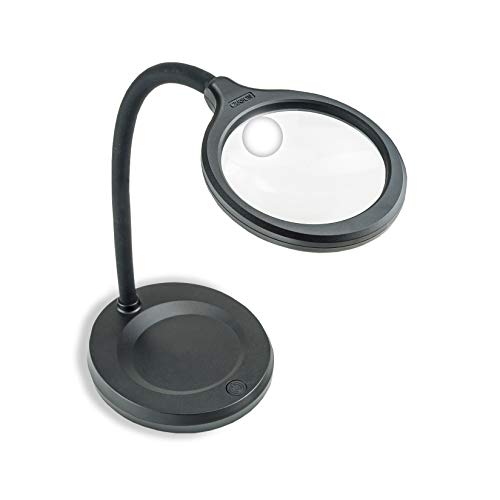
For those who want a functional tool without a significant investment, the Carson DeskBrite 200 is an efficient, no-frills choice. It combines a compact, battery-powered design with a standard magnifying lens, making it an excellent companion for travel knitting or small kits.
Because it is relatively lightweight, it is easy to move from a coffee table to a bedside tray. The magnification level is sufficient for reading standard-sized pattern instructions or checking the structure of a delicate lace border.
Keep in mind that the field of vision is smaller than that of larger floor lamps. This unit is best utilized for close-up inspection of single stitches or small sections rather than scanning an entire row of a bulky cable-knit project.
Fancii XL LED Lamp: Best for Large Pattern Charts
The Fancii XL features a wide, rectangular lens that mimics the natural shape of a printed pattern page. This is a game-changer for knitters working from written instructions, as it allows for a wider field of view without needing to constantly shift the lamp position.
Large-format lenses are superior for tracking long, complex charts across multiple stitches. By covering a larger surface area, this lamp reduces the amount of manual adjustment required during a focused session.
If the main goal is to keep a printed, multi-page chart in focus while working on a project, the Fancii XL offers the most ergonomic experience. It prioritizes surface area over extreme magnification, which is often the better trade-off for reading.
YOCTOSUN Head Magnifier: Best Hands-Free Option
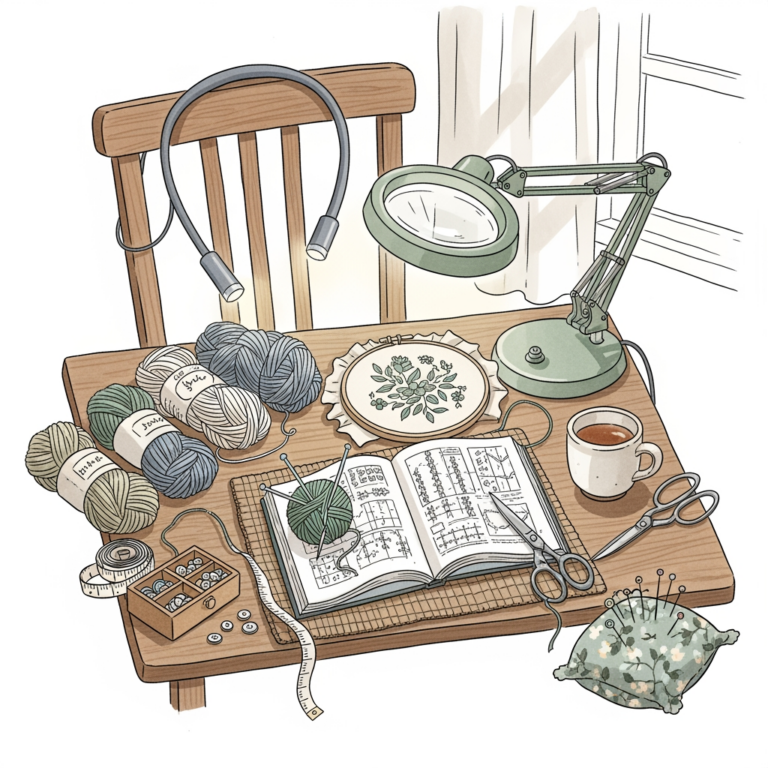
Sometimes, a desk-mounted lamp simply cannot capture the angle needed for intricate maneuvers like kitchener stitch or picking up dropped stitches. The YOCTOSUN head magnifier provides a hands-free alternative that moves exactly where the head turns.
Because it rests on the forehead, the user can lean in close to see exactly what is happening on the needle tips. This level of precision is unrivaled for correcting errors in lace or stranded colorwork where the stitch anatomy is hard to see.
Adjusting to wearing a head-mounted magnifier takes a short learning period. However, for those working with fine lace-weight yarn or dark, plied fibers, the ability to zoom into the action is worth the trade-off in comfort.
Neatfi Bifocals LED Lamp: Most Powerful Lighting

The Neatfi Bifocals LED Lamp is built for the knitter who demands maximum illumination and high-contrast visuals. Its dual-intensity light modes and high-quality glass lens help combat eye fatigue caused by working with “sinking” colors like navy, black, or charcoal.
The “bifocal” component is a smaller, high-magnification inset within the main lens. This allows the knitter to scan their work at a standard zoom while keeping a tiny, high-powered section ready for inspecting tension inconsistencies or complex cable crossings.
Expect a heavier, more stable base with this model, as it is designed for permanent workspace setups. It is an investment piece for the dedicated maker who spends hours daily on complex fiber projects.
iMagniphy Desktop Glass: Simple, No-Frills Pick
The iMagniphy is a classic desk-style magnifier that relies on high-quality optical glass rather than integrated lighting. For knitters who already have a well-lit studio or a dedicated task lamp, this provides a clear, distortion-free view of the needles.
Glass lenses are significantly more resistant to scratching than plastic alternatives, which is a major benefit for tools that see daily use. Its simple base design means it can be placed directly over a pattern or a swatch without taking up valuable table space.
If your primary challenge is lens distortion or surface scratching, the iMagniphy is a reliable, long-term solution. It excels at steady, static magnification for short-term inspection of gauge or stitch density.
How to Choose the Right Magnifier for Your Craft
Selecting a magnifier requires an honest assessment of your specific knitting habits and workspace constraints. Before purchasing, consider whether the primary goal is reading text, tracking a complex colorwork chart, or monitoring the actual structure of the fabric on the needles.
- Field of View: Do you need to see a whole chart row at once, or just a single stitch?
- Light Quality: Is the current room lighting casting shadows over the work?
- Stability: Does the magnifier need to be moved frequently or stay fixed in one place?
- Adjustment: Will a fixed stand work, or is an articulated arm required to follow your hands?
Choose based on your most common project type. If you primarily knit top-down socks on tiny needles, prioritize a high-magnification, hands-free option. If you primarily knit cables or lace from patterns, prioritize a wide, rectangular lens that covers the page.
Understanding Diopter vs. Magnification (X-Rating)
“Diopter” and “X-rating” are often used interchangeably, but they measure different things. The diopter number (e.g., 3D or 5D) refers to the curvature of the lens, while the magnification (the X-number) refers to how much the image is enlarged.
Higher diopters generally result in a thicker, heavier lens with a shorter focal length. This means the magnifier must be held very close to the knitting for the image to stay in focus, which can restrict hand movement.
Avoid the misconception that a higher number is always better. Over-magnification often results in a narrower field of view and increased eye strain; for most knitting, a modest 2x to 3x magnification is the sweet spot for clarity and comfort.
Lamps vs. Stand-Alones: Which Style is for You?
The choice between a magnifying lamp and a standalone glass comes down to environment and project type. Integrated lamps are essential for working with dark fibers where visibility is a constant struggle, as the light source is perfectly positioned to eliminate shadows directly under the lens.
Standalone magnifiers offer greater portability and often feature higher-quality optical glass that won’t degrade over time. They are excellent if you already have a favorite, high-CRI (Color Rendering Index) desk lamp that provides accurate light for color matching.
Evaluate your space carefully. If your setup is cluttered with yarn, patterns, and notions, a clamp-on magnifying lamp that clears the desk surface is a more efficient use of space.
Caring for Your Magnifier Lens for a Clear View
Keeping a lens clean is essential for maintaining the clarity required for fine fiber work. Always use a dedicated microfiber cloth to wipe the lens, as even slight dust or oily residue can create glare or blurring that mimics eye fatigue.
Never use paper towels or tissues to clean a glass lens, as the wood fibers can create micro-scratches over time. If a deep clean is necessary, use a lens-specific spray or a tiny amount of mild dish soap and water, followed by a thorough air dry.
Protect the lens with a cover when it is not in use to prevent accidental scratches or dust buildup. A well-maintained lens will provide years of clear, crisp views, making those intricate cable patterns significantly easier to master.
Investing in a high-quality magnifier is one of the most effective ways to improve the quality of your knitting and extend the longevity of your craft. Whether you opt for a hands-free head magnifier or a professional-grade light station, the right tool will transform how you see your stitches. Match the tool to your specific project needs, keep the glass clean, and watch as those difficult, dark-yarn projects suddenly become effortless to complete.