6 Best Daylight Lamps For Intricate Needlework To Use
Struggling to see your stitches clearly? Discover our 6 best daylight lamps for intricate needlework and improve your precision today. Read the full guide here.
Straining your eyes over a dark, complex lace pattern is the fastest way to turn a relaxing hobby into a frustrating chore. Proper lighting is just as essential as choosing the right needle size for your yarn weight or maintaining consistent tension across your rows. When working with dark-colored fibers or intricate stitch counts, a dedicated craft lamp eliminates the guesswork and fatigue that lead to dropped stitches. Investing in high-quality illumination ensures the nuances of your work remain visible, regardless of the time of day or the ambient light in the room.
OttLite 2-in-1 Magnifier: Best for Versatility


The OttLite 2-in-1 model serves as a chameleon for the dedicated crafter who shifts between different project scales. It functions equally well as a floor lamp for a favorite armchair or a desk lamp for a dedicated workstation.
This flexibility is ideal if the craft space is shared or if a project demands a sudden change in posture. The adjustable neck allows for precise positioning, ensuring the light hits the needles directly rather than reflecting off the surface of the work.
While the magnification is a helpful addition, prioritize the quality of the light spectrum above all else. This unit excels at mimicking natural daylight, which is crucial when color-matching yarn for stranded colorwork.
Brightech Litespan Floor Lamp: Top All-Rounder
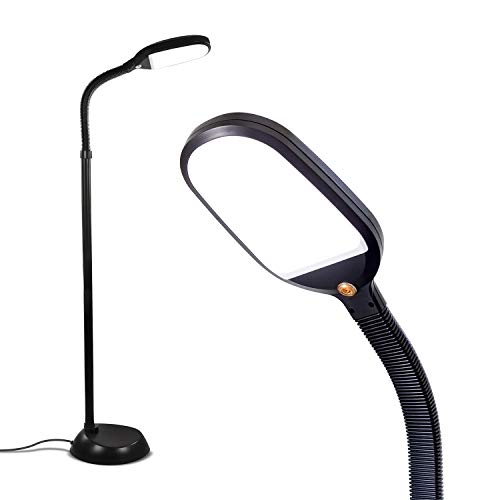
The Brightech Litespan is a reliable workhorse that bridges the gap between professional precision and home convenience. It provides a wide, flicker-free beam that easily covers a large knitting project spread across the lap.
For those working on long, flat pieces like blankets or shawls, the broad reach of this lamp prevents the common issue of light “fall-off” at the edges of the work. The dimmable settings are a significant advantage, allowing for a reduction in intensity during late-night sessions to avoid eye strain.
This lamp is particularly effective for those using dark, high-twist yarns where the ply definition can be difficult to see. It provides the clarity necessary to spot split stitches before they become permanent flaws in the fabric.
Daylight Company Lumi Plus: For Pro-Level Light

Serious fiber artists who prioritize professional-grade optics often gravitate toward the Daylight Company Lumi Plus. This lamp is engineered to minimize shadows, which is essential when reading complex charts or counting cables.
The wide lamp head ensures that the entire knitting area is bathed in consistent, neutral white light. This consistency is vital for maintaining an accurate view of stitch tension, especially when alternating between different types of needle materials like slick nickel or grippy wood.
The build quality is robust, making it a sound long-term investment for those who knit daily. It is a top-tier choice for avoiding the visual fatigue that comes with hours of intensive finishing work, such as grafting or complex seaming.
Verilux SmartLight Full Spectrum: Eye-Care Pick

Verilux specializes in light technology that closely replicates the qualities of natural sunshine. This is a game-changer for knitters who find that harsh, artificial bulbs cause headaches after long periods of focused attention.
The SmartLight utilizes full-spectrum technology to reduce the glare that can bounce off metal needles. When the needle tips shine too brightly, it can obscure the yarn loop itself, making it hard to identify the next stitch.
If the goal is extended marathon knitting sessions without visual exhaustion, this is a premium consideration. The even distribution of light helps keep the eyes relaxed, allowing the focus to remain on the rhythm of the needles rather than the strain of the process.
Neatfi Bifocals Super LED Lamp: Max Magnification

When working with fine-gauge lace or micro-knitting, standard lighting is rarely enough to see every individual fiber clearly. The Neatfi Bifocals lamp features a large lens with a specific section for high-powered magnification.
This is the ultimate tool for troubleshooting, such as picking up a dropped stitch in a delicate mohair or repairing a mistake in a fine-weight wool. The extra-large lens allows for a comfortable field of view without the need to constantly reposition the lamp.
While the magnification is powerful, keep in mind that depth perception can change under heavy lenses. Start with the lower magnification setting until the eyes adjust to the new depth of field while knitting.
Tomons Swing Arm Desk Lamp: Best Budget Choice

Not every project requires a high-end, multi-function lighting system, and the Tomons swing arm lamp proves that simplicity has its merits. Its classic design is highly adjustable, allowing for precise control over where the light is directed.
This lamp is an excellent entry-level choice for knitters who need a focused beam directly over their needle tips. It works best when paired with a high-quality daylight LED bulb, which the user can upgrade or replace as needed.
It is a sensible, space-saving solution for small apartments or cramped craft nooks. While it lacks the advanced features of premium lamps, its mechanical adjustability remains a major asset for finding the perfect angle for intricate needlework.
How to Choose the Right Craft Lamp For Your Space
Selecting the right lamp requires an honest assessment of the physical knitting environment. Consider the height of the chair, the proximity to a wall outlet, and how much desk or floor space is available.
For those who move between the living room and a dedicated craft room, a floor lamp with a sturdy, weighted base is superior to a desk-mounted option. Always check the range of motion the lamp offers, as the ability to swing the light head low over the work is more important than the overall height of the unit.
Finally, consider the heat output of the light source. Knitting involves handling yarn for hours; a hot lamp bulb near the fibers can cause subtle changes in the texture of natural animal fibers like wool or alpaca.
Lumens, Kelvin, and CRI: What Do They Mean for You?
Understanding these three technical terms takes the guesswork out of bulb shopping and lamp selection. Lumens refer to the brightness, and for knitting, a range of 800 to 1,200 is generally ideal for avoiding dark shadows.
Kelvin measures the color temperature of the light. Look for a rating between 5,000K and 6,500K to achieve a “daylight” effect that prevents yellowing or color distortion of the yarn.
The Color Rendering Index (CRI) is perhaps the most important metric for colorwork enthusiasts. A CRI of 90 or higher ensures that the colors of the yarn appear as they would in natural daylight, preventing the common frustration of realizing a color mismatch after a project is finished.
Do You Really Need a Magnifier on Your Craft Lamp?
Magnification is not mandatory for every knitter, but it is indispensable for specific, high-detail tasks. If the work involves fine silk, intricate beaded knitting, or very small needle sizes (under 2.5mm), a magnifier provides a significant advantage.
However, be aware that magnification can make the hand movements feel different. It takes time for the brain and eyes to calibrate to the enlarged scale of the stitches.
If a magnifier is chosen, prioritize a lamp with a large lens diameter. A wider lens allows for better depth perception and reduces the need for the knitter to constantly move their head to stay within the focal point.
Floor, Desk, or Clip-On: Which Lamp Type Is Best?
The choice of lamp style depends entirely on where the knitting happens. Floor lamps offer the most flexibility, as they do not rely on existing furniture and can be moved easily to accommodate different seating arrangements.
Desk lamps are excellent for those who have a dedicated crafting surface where they keep charts, project bags, and notions within arm’s reach. They provide a stable, consistent light source that rarely needs adjusting once the initial setup is complete.
Clip-on lamps are the most portable, making them a favorite for knitters who travel or visit local stitch-and-bitch groups. While they save space, they often have limited arm reach and light spread compared to their heavier counterparts, making them better suited for smaller projects like socks or hats.
Proper lighting acts as a silent partner to your needles, preserving your vision and highlighting the beauty of your stitches. By selecting a tool that matches your specific knitting habits and environment, you ensure that every row is worked with precision and ease. A well-lit workspace is not just a convenience; it is a fundamental part of the craft, protecting the eyes that allow you to create for years to come.