6 Best Metal Deburring Tools For Finishing Wire Edges
Find the best metal deburring tools to achieve professional finishes on wire edges. Read our expert review to choose the right equipment for your workshop today.
Working with wire in fiber arts—whether for custom shawl pins, beaded stitch markers, or structural elements in knitted accessories—requires a clean finish. A jagged wire end is not just a nuisance; it acts like a miniature hook, catching on delicate silk, mohair, or hand-dyed wool during the knitting process. Properly deburring wire ensures that the hardware remains as smooth as the most polished bamboo needle. Investing in the right tool saves hours of frustration and prevents ruined yarn fibers.
The Beadsmith Wire Rounder: Best for Jewelry


This tool is specifically designed to eliminate the sharp edges left behind after cutting wire with standard pliers. It acts as a small, specialized file that creates a perfectly rounded tip, which is vital when creating handmade stitch markers or toggle closures.
For those crafting delicate jewelry-knit hybrids, a rounded end prevents the metal from snagging fine yarn plies. It is an essential step for any wire-based project that interacts directly with your knitting needles or fabric.
The primary limitation remains its focus on smaller gauges. It is not intended for heavy-duty structural wire, but for finishing the tips of wire used in beadwork, it is unmatched.
Dremel 3000: Best for High-Volume Crafters
When production speed becomes a factor—such as when creating dozens of custom stitch markers for a knitting group—manual filing becomes tedious. The Dremel 3000 offers a motorized solution that handles repetitive tasks with ease.
Equipped with the right grinding bit, this tool can smooth rough edges on various metals in seconds. It provides the consistency required for batch work, ensuring every single marker has the exact same finish.
However, power tools require a steady hand to avoid over-grinding the wire. Always secure the metal firmly before starting, as the high RPM can easily mar the surface if the tool slips.
TEKTON Needle File Set: Best Budget Option
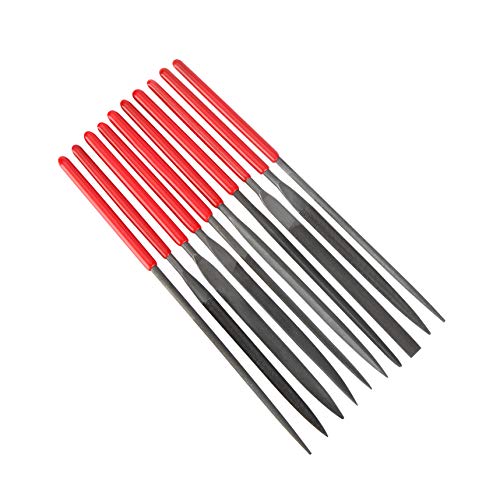
Precision is often about having the right shape for the job, and this file set provides an assortment of profiles. Needle files are indispensable for reaching into tight corners or smoothing wire that has been bent into intricate shapes.
These files allow for tactile feedback, meaning you can feel exactly when the burr is removed. This level of control is perfect for beginners who want to master the art of finishing wire without the risk of over-grinding associated with power tools.
They are an affordable, long-lasting investment for any craft kit. While they require manual effort, they provide the most accurate results for custom wire bending projects.
Noga Hand Deburring Tool: Best for Heavy Gauge
Structural wire used for knitting looms or large-scale fiber art displays often requires a more aggressive approach. The Noga tool uses a swivel blade design to shave away thick burrs from cut ends efficiently.
Unlike standard files, the swivel head follows the contour of the wire perfectly. This prevents flat spots on the end of the wire and maintains a natural, clean profile on larger diameter materials.
This tool is strictly for finishing larger gauge wires. Using it on thin jewelry wire will likely remove too much material, so reserve it for structural support hardware.
Vintaj 1.8mm Cup Burr: For Precision Finishing
The cup burr is a specialized tool that encapsulates the end of the wire as it spins, creating a perfectly smooth, rounded end every time. It is the gold standard for finishing ear wires or jump rings that come into contact with the skin or delicate fibers.
Because it works by cupping the end, it is safer than traditional files and less prone to slipping. It is highly recommended for knitters who prioritize professional-grade results on their handmade accessories.
It is a small, specialized investment, but it eliminates the guesswork. Once you have a perfectly rounded end, you will never go back to sharp, cut edges.
General Tools Pin Vise: For Manual Control
A pin vise provides a sturdy grip for small files or specialized bits, allowing for microscopic adjustments. It is particularly useful when working on extremely thin wire that might bend under the pressure of a standard file.
This tool is all about leverage and stability. It is the perfect choice for fine-tuning the finish on wire ends that must pass through tight, intricate knitting patterns or small-hole beads.
Think of the pin vise as an extension of your own hand. It provides the stability needed for high-stakes finishing work where a single slip could ruin a finished piece.
How to Choose the Right Tool for Your Project
Choosing a deburring tool depends entirely on the gauge of the wire and the volume of work. For delicate beadwork, stick to the Beadsmith or Cup Burr, as these are designed for fine, jewelry-grade wire.
If the goal is structural integrity for larger fiber art projects, turn to the Noga tool. The mechanical advantage of a swivel blade is necessary for heavy metals that standard files cannot handle.
Finally, consider the budget and frequency of use. If you only finish wire occasionally, a simple needle file set is the most versatile and cost-effective entry point.
Safety First: Tips for Using Deburring Tools
Metal dust is an inevitable byproduct of filing, and it should never be inhaled. Always work in a well-ventilated area and consider wearing a basic dust mask when using power tools to grind metal.
Protect your eyes with safety glasses at all times. Small metal shavings can easily fly off during the deburring process, and eye protection is non-negotiable for any crafter.
Keep your work surface clean. Use a magnetic tray to catch filings, which prevents sharp, microscopic metal bits from migrating into your yarn stash or fabric.
Technique: How to Perfectly Smooth Wire Ends
Begin by cutting your wire with the appropriate cutters, then use a coarse file to remove the initial “shelf” or jagged edge. Transition to a finer grit file or a cup burr to refine the shape.
The goal is to move from a flat, sharp cut to a smooth, dome-like finish. Rotate the wire or the tool frequently to ensure the end remains symmetrical rather than lopsided.
Finish the process by rubbing the end against a scrap piece of leather or heavy denim. This final polish removes any microscopic burrs that remain after the filing process.
Manual vs. Power Tools: Which Is Right for You?
Manual tools offer superior control and tactile feedback, making them ideal for delicate, one-off projects. There is very little risk of accidentally shortening your wire too much, and they are quiet enough to use while watching a movie.
Power tools are efficient but demand focus and practice to master. Use them when you have a high volume of wire to finish, or when dealing with harder metals that would exhaust the hand if filed manually.
Ultimately, the best tool is one that leaves the wire end smooth enough to glide through fiber without catching. Test the finished end against a strand of scrap wool; if it doesn’t snag, the finish is perfect.
Properly deburring your wire isn’t just about professional aesthetics; it is about protecting the integrity of your hard-knitted work. By choosing the right tool and mastering the finishing technique, you ensure that your hardware is as soft and snag-free as the yarn itself. Happy making.