6 Best Crimp Tubes For Professional Jewelry Security
Discover the 6 best crimp tubes for professional jewelry security to ensure your designs last. Upgrade your supplies and shop our top expert recommendations today.
Securing a finished piece of jewelry requires the same attention to detail as weaving in ends on a delicate lace shawl. Just as a poorly finished bind-off can undo hours of intricate knitting, a failed crimp will lead to lost beads and broken designs. Choosing the right hardware is the difference between a heirloom-quality necklace and one that falls apart at the first sign of wear. Mastering these small but vital findings ensures the longevity of every project.
Beadalon Crimp Tubes: The Industry Standard Pick


Beadalon tubes are the reliable workhorse of the jewelry world, functioning much like a standard stainless steel knitting needle that consistently hits gauge. These tubes are crafted with consistent wall thickness, which allows for a uniform fold when compressed.
Uniformity matters because a lopsided crimp is a structural weakness, much like an uneven tension in a row of stockinette stitch. When the metal wall is consistent, it flows predictably around the beading wire during the crimping process.
For most general beading projects, these tubes provide the best balance of strength and affordability. They are the baseline for success; if the basics work well, there is rarely a need to complicate the process with exotic materials.
Soft Flex Crimp Tubes: Best for Flexible Wires
Soft Flex crimp tubes are engineered specifically to accommodate the nuances of flexible, multi-strand beading wire. Because flexible wires often feature a nylon coating, they require a crimp that grips without slicing through the protective layer.
These tubes are generally thicker than standard hardware, providing extra surface area to grab the wire strands firmly. Think of this like choosing a slightly blunter needle tip when working with slippery silk yarn; the goal is to provide enough friction to prevent slipping without damaging the delicate structure of the fiber.
If the project involves heavy gemstone beads or long, dangling designs, these tubes are the preferred choice. The added wall thickness ensures the connection remains rigid even under the constant pull of gravity.
Beadalon Scrimp Findings: Ultimate Security Choice
Scrimp findings represent a shift in approach, functioning more like a mechanical knot than a traditional crushed tube. Instead of using a crimping tool to flatten a tube, these findings utilize a small internal set screw to lock the wire in place.
This is the ultimate solution for those who struggle with the pressure sensitivity of standard crimping pliers. Just as some knitters prefer interchangeable needle cables with mechanical locking keys to prevent unscrewing, the Scrimp provides a positive, tactile lock that removes the guesswork from the connection.
While they are bulkier than traditional tubes, they offer unmatched security for high-value designs. They are worth the investment when the cost of the materials justifies the need for absolute, fail-safe permanence.
Artistic Wire Crimp Tubes: Best for Color Variety
Artistic Wire crimp tubes excel in projects where the findings must match the color palette of the beads. Just as choosing a yarn color that perfectly matches a button makes a sweater look professional, selecting a crimp that blends in keeps the focus on the design.
These tubes come in an array of metallic finishes that mimic copper, brass, and darkened gunmetal. Using a bright silver crimp on a dark, earthy necklace can look jarring, much like using a stark white thread on a navy blue heirloom quilt.
However, be mindful that plated metals can sometimes be slightly harder than precious metals, requiring a bit more caution during compression. Always use a gentle, steady hand to avoid cracking the plating during the final squeeze.
BeadSmith Sterling Silver Crimps: For Fine Metal
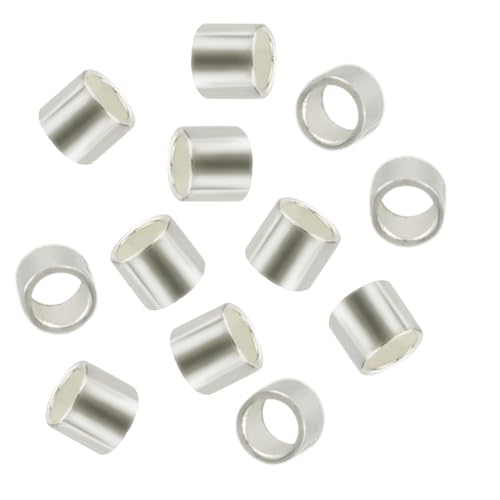
BeadSmith sterling silver crimps are the premium choice for fine jewelry that requires a precious metal finish. Silver has a unique malleability that allows it to wrap around wire with incredible intimacy, creating a bond that is both secure and aesthetically seamless.
Working with sterling is similar to working with premium natural fibers like cashmere or alpaca; it requires more respect than a synthetic alternative. Because the metal is softer, it compresses more easily, meaning there is a lower risk of fracturing the wire if the tool is applied correctly.
These are best reserved for necklaces and bracelets where the crimp is visible and part of the overall design aesthetic. If the price point is a concern, keep them for the projects that truly deserve the investment of high-end materials.
Tierracast Crimp Beads: Top Decorative Option
Tierracast crimp beads are designed to be seen rather than hidden. Unlike industrial tubes that look purely functional, these are often textured or shaped to act as tiny accent beads at the ends of a strand.
If the jewelry design calls for a polished, finished look, these beads bridge the gap between a hardware component and a design element. This is akin to choosing a decorative, hand-carved toggle button for a cardigan instead of a plastic sew-on fastener.
Because they are decorative, their walls are often thicker than standard crimp tubes. Ensure the crimping pliers are properly sized to handle the increased mass of the bead to avoid a wobbly or incomplete crimp.
Choosing the Right Crimp Size for Your Wire
Selecting the correct size is the most common point of failure for beginners, mirroring the mistake of choosing a needle size that is too large for the weight of the yarn. A crimp that is too large will leave gaps, allowing the wire to slide back and forth, which leads to eventual snapping from friction.
Follow these general guidelines for a secure fit: * 0.010″ – 0.012″ wire: Use a 1mm or 1.5mm crimp tube. * 0.015″ – 0.019″ wire: Use a 2mm crimp tube. * 0.021″ – 0.024″ wire: Use a 2.5mm or 3mm crimp tube.
Always aim for a snug fit where the wire strands sit side-by-side within the tube without being forced. If the wire doesn’t fit comfortably, do not force it; move up to the next size to ensure the structural integrity of the loop.
Crimp Tubes vs. Beads: Which One Do You Need?
Crimp tubes are long, cylindrical metal findings designed for folding and flattening. Crimp beads, by contrast, are spherical or slightly flattened, which makes them less ideal for creating a strong, “locked” bond because they lack the surface area to fold correctly.
Think of the difference between a cable-knit sweater and a plain stockinette one; the tube is the engineered, functional choice for structure, while the bead is the decorative option. Tubes provide a much larger contact surface, making them objectively more secure for heavy-duty applications.
If the goal is security for a necklace that will be worn daily, always default to a tube. Reserve round crimp beads for lightweight projects or where the crimp is intended to be a subtle, decorative transition.
The Secret to a Perfect, Secure Crimp Every Time
The most common mistake is over-compressing the metal until it is paper-thin, which creates sharp, jagged edges that eventually cut the wire. Like tensioning a cast-on edge, the goal is firmness without over-working the material.
Begin by placing the tube in the back notch of the crimping pliers to create a curved “C” shape. Then, rotate the tube ninety degrees and place it in the front notch to fold it neatly into a square or rounded bundle.
If the crimp looks distorted or the wire looks pinched, start over with a fresh piece of wire and a new tube. A weak crimp is a permanent liability, and attempting to fix a poorly crimped connection is like trying to steam-block an incorrectly knitted stitch—it simply cannot be corrected once the integrity is compromised.
Essential Tools for Professional Crimping Results
The only tool required for this task is a pair of dedicated crimping pliers, which feature specialized notches designed to fold the metal correctly. Using standard flat-nose pliers is the equivalent of using scissors to cut yarn—it is possible, but the results will never be as clean or reliable as using the proper tool.
Invest in a quality pair of pliers that fits comfortably in the hand, as hand fatigue can lead to sloppy technique. A good pair of pliers acts as an extension of the maker’s intent, providing the leverage needed to lock the wire in place without the struggle.
Keep the tool clean and clear of debris to ensure a smooth, mar-free finish on the metal. Proper tools, paired with the right hardware, turn a technical frustration into a seamless part of the creative process.
Mastering the use of crimp tubes elevates any jewelry project from a hobbyist experiment to a professional-grade accessory. By selecting the right size, using the proper pliers, and treating each connection with the care it deserves, every piece is guaranteed to last for years of enjoyment.