6 Best Closet Hooks For Hanging Accessories To Organize
Maximize your storage space with these 6 best closet hooks for hanging accessories. Follow our expert guide to organize your wardrobe and shop your favorites.
A well-organized workspace is as vital to a knitter as the right needle for the yarn weight. When handmade shawls, stash bags, and finished projects are haphazardly piled, delicate fibers lose their shape and risk unwanted snags. Proper storage ensures that months of work stay in pristine condition. These six organizational tools turn a chaotic closet into a functional fiber studio.
Spectrum Vintage Rack: Best for Heavy Bags


Heavy canvas project bags filled with wool-heavy sweaters or circular needle sets require substantial support. A lightweight hook will often buckle under the weight of a multi-skein project.
The Spectrum Vintage Rack offers the structural integrity needed to prevent sagging. Because the hooks are integrated into a sturdy metal frame, the weight is distributed evenly across the wall or door surface.
Consider this option for storing bags containing heavy worsted or aran-weight wools. When you load a bag with three or four 100-gram hanks, the strain on a single adhesive hook can lead to structural failure, dropping your hard work to the floor.
Command Large Utility Hooks: Best Damage-Free
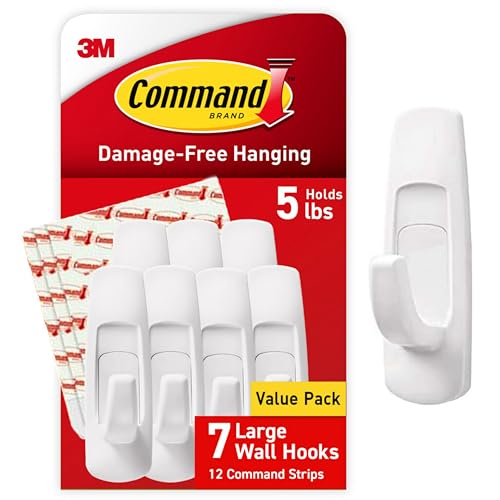
Rental spaces or vintage closets with delicate finishes often forbid drilling holes. Adhesive hooks allow for modular organization without compromising the integrity of woodwork or paint.
These hooks are ideal for lightweight accessories like finished lace scarves or light fingering-weight cowls. When applying these, ensure the surface is thoroughly cleaned; any lingering dust will cause the adhesive to lose its bond over time.
Be mindful of the weight limit specified on the packaging. While these are convenient, they are not designed to support the concentrated weight of heavy project bags. Use them for your lighter, finished accessories to prevent them from hitting the ground during a long storage period.
Youcopia StoraBag: Best for Scarves & Shawls
Scarves and shawls deserve storage that respects their intricate lace work and delicate fiber structures. Stacking them on a shelf often leads to crushing, which ruins the loft of the yarn.
The StoraBag system utilizes a series of clips that hold items securely without tight compression. This is particularly helpful for mohair-blend shawls, which benefit from hanging vertically rather than being squashed in a storage bin.
Avoid using sharp, thin hooks for delicate lace projects. The tension of the entire piece hanging from a single point can cause distortion in the stitch pattern, especially in blocked lacework. Wide, flat-ended clips preserve the fiber geometry better than narrow metal hooks.
The Door-ganizer Rack: Best for Small Closets
Small closets often suffer from wasted vertical space on the back of the door. Utilizing this area keeps your tools accessible while freeing up shelf space for yarn storage.
This rack offers a tiered structure that accommodates various accessory lengths. If you have a collection of long, rectangular scarves and shorter cowl projects, this system allows for visual organization by length.
Look for a configuration that allows for repositionable hooks. This gives you the flexibility to adjust the vertical spacing based on whether the accessory is a bulky, cabled item or a lightweight, delicate scarf.
Liberty Pylon Hook: Most Stylish Single Hook
Sometimes a single, well-placed hook is all that is needed to display a particularly beautiful, hand-dyed shawl or a prized project bag. Design matters when the storage solution itself contributes to the room’s aesthetic.
The Liberty Pylon Hook provides a clean, modern look that won’t distract from the texture of your knitting. Its rounded profile is far superior to cheap, stamped-metal hooks that may have burrs or sharp edges.
If you choose a metal hook, ensure the finish is smooth. Even a microscopic flaw on the metal can catch a loose strand of fiber, causing a snag that may unravel a section of your work.
IKEA SUNNERSTA S-Hooks: Best Budget Option
S-hooks are the most versatile tools for a knitter’s closet. They can be hung from existing wire shelving or a repurposed curtain rod, creating an adjustable storage rail.
These are particularly useful for grouping project bags by yarn fiber or project phase. Use one hook for your ‘in-progress’ bags and another for ‘finished object’ accessories awaiting their final wash and block.
Because they are inexpensive, you can purchase a large quantity to standardize your storage. Keep the hooks uniform to ensure your closet maintains a cohesive look, which helps in quickly identifying your tools and accessories at a glance.
How to Pick the Right Hook for Your Accessories
Choosing the right hook depends on the weight and fragility of your yarn. A heavy, felted bag requires a heavy-duty anchor, while a silk-blend lace shawl needs a smooth, wide hook.
Consider the following factors when selecting your storage: * Material Compatibility: Metal, wood, and plastic each interact differently with yarn. * Surface Texture: Always check for seams or burrs that could pull at fibers. * Width of Support: Wider hooks reduce the tension on a single spot, preventing permanent sagging or distortion of the fabric.
Never overlook the “hang time.” If a piece is going to stay on the hook for months, a wider hook is non-negotiable to maintain the structural integrity of your stitch pattern.
Wall-Mounted vs. Adhesive: What to Consider
Wall-mounted hooks provide a permanent, high-weight solution that is best for heavy-duty storage like full stash-totes. They require tools but offer peace of mind that a heavy load won’t crash down.
Adhesive hooks excel in flexibility and temporary setups. They are perfect for lightweight, finished accessories or managing a rotating collection of current projects.
Evaluate your closet construction before choosing. If you have wire racks, a hook that clips onto the wire might be more effective than either a wall-mount or an adhesive option.
Don’t Ignore Hook Weight Capacity: A Guide
Every hook has a limit, and overloading them is a recipe for damaged goods. A heavy project bag might weigh two or three pounds, which exceeds the rating of many standard adhesive hooks.
Always look for the maximum weight capacity rating on the packaging. If you are uncertain about the weight of your project, use a kitchen scale to weigh your bag before hanging it.
When in doubt, use two hooks instead of one to distribute the weight. Doubling up ensures that the pressure is divided, minimizing the risk of the project falling and the hook breaking.
Preventing Snags on Your Precious Handknits
Knits, especially those made of delicate protein fibers like alpaca or merino, are magnets for snagging. The contact point between the hook and the yarn is the most common place for damage to occur.
To protect your work, follow these rules: * File down rough edges: Use an emery board to smooth out any sharp metal or plastic edges on the hook. * Use padding: Wrap a small piece of soft fabric or leather around the hook to create a protective barrier. * Check the position: Ensure the hook does not distort the garment by placing the weight on a seam rather than the delicate body of the knit.
A little preventative maintenance on your hooks goes a long way in preserving the longevity of your projects. Taking the time to smooth your surfaces now will save you from having to perform emergency repairs on your favorite handknits later.
Effective closet organization is not merely about storage; it is about preserving the longevity and beauty of your finished projects. By selecting the right hooks and paying attention to fiber-specific needs, you ensure your handknits remain as pristine as the day they were cast off.