7 Best Sewing Storage Drawers For Bulky Findings
Organize your craft room with these 7 best sewing storage drawers for bulky findings. Explore our top picks to declutter your space and boost your productivity.
Every dedicated knitter eventually reaches the point where a single notions bag simply cannot contain the chaos of a growing stash. Bulky findings—such as oversized pom-pom makers, heavy-duty circular needle cases, multiple swift and ball winder attachments, and stacks of blocking mats—require robust storage solutions that provide structure and accessibility. Selecting the right drawer unit prevents the frustration of buried tools, ensuring that time spent searching for a cable needle or a stitch gauge is time spent actually knitting. The following guide breaks down the most effective storage systems tailored to the unique physical requirements of fiber arts equipment.
Akro-Mils 10144 Cabinet: Best for Large Items


The Akro-Mils 10144 cabinet features deep, generous bins that are ideal for housing larger tools that do not fit into standard notions boxes. While many storage solutions cater to small buttons or tiny stitch markers, this unit handles bulky items like interchangeable needle sets, crochet hook rolls, and oversized tension rings with ease.
The industrial-grade plastic construction provides a rugged home for heavy metal tools or large, wooden weaving shuttles. Because the bins are deep, they prevent items from sliding out when pulled quickly, which is essential when the workshop is cluttered with yarn scraps and active projects.
The primary trade-off is the lack of internal dividers within the larger compartments, which can lead to tangling if small notions are stored loosely. It is best used for grouping specific project tools rather than miscellaneous sorting.
IRIS USA 6-Case Scrapbook Cart: Most Versatile
Versatility in a sewing or knitting station often comes down to the ability to transport specific tools to a different workspace. This cart includes six removable, latching cases, making it perfect for dedicated project bins.
When working on a multi-month project, such as an intricate stranded colorwork blanket, having all relevant items—scissors, tapestry needles, specific yarn bobbins, and pattern markers—in one portable case is a lifesaver. Once the project is complete, the case can be stored back in the tower, keeping the workstation clean.
The cart’s height allows it to slide under many desks, making it a space-saving powerhouse. However, the latching mechanism requires consistent care, as the thin plastic hinges can fatigue over years of daily use.
Adeptus 6-Drawer Rolling Cart: Best Wooden Pick
For knitters who prefer natural materials in their studio, the Adeptus 6-Drawer Rolling Cart offers a sturdier, more aesthetic alternative to ubiquitous plastic towers. Wood provides a solid frame that does not wobble under the weight of heavy yarn balls or metal tool collections.
The drawers slide smoothly and offer enough depth to store bulky items like bulky-weight skeins that need to be kept away from dust. Unlike plastic, wood does not generate static electricity, which is a major advantage when storing delicate wool or silk blends that might otherwise attract lint.
While the assembly is more involved than plastic counterparts, the trade-off is superior long-term durability. It is an excellent choice for a permanent studio setup where furniture-grade quality is preferred over modular convenience.
mDesign Stackable Bins: Best for Visibility
Visibility is the enemy of the “I know I have that needle size somewhere” dilemma. mDesign stackable bins offer clear construction, allowing the contents to be identified at a glance without the need for constant labeling.
These bins are particularly effective for storing circular needles still in their original packaging, as the flat, wide footprint prevents the packaging from bending or folding. If the storage area is dimly lit, the transparency helps track inventory levels, such as when running low on point protectors or cable needles.
The main limitation is that plastic bins can crack if overfilled with heavy metal tools or dense wooden equipment. Use these for lighter, bulkier notions to ensure the long-term integrity of the containers.
Sterilite 3-Drawer Unit: Top Budget-Friendly Choice
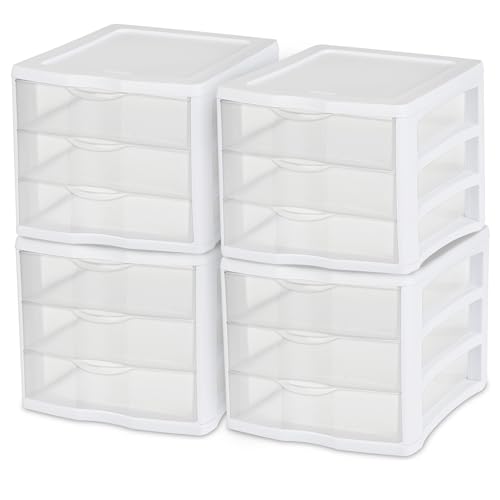
The Sterilite 3-Drawer Unit is a workhorse in the craft world, providing a simple, no-nonsense storage solution. It is ideal for knitters just starting to build their toolkit who need to organize disparate items without a significant financial investment.
The drawers are spacious enough to hold large blocks of foam for blocking, spare needle cases, and even bags of fiber fill for plushie projects. The units are lightweight, making them easy to reposition as a workstation evolves.
The trade-off for the budget price is the potential for the drawers to bow under heavy weight. Avoid storing heavy iron-based tools in the center of the drawer, and distribute weight toward the corners where the frame provides more structural support.
Seville Classics 10-Drawer Cart: Heavy-Duty Pick
When the goal is absolute organization for a massive stash of tools and accessories, the Seville Classics 10-Drawer Cart is the industry standard. The drawers are made of metal mesh, which allows for airflow—a critical feature if you are storing items near areas that might become humid.
The metal construction holds up exceptionally well against sharp objects, such as metal crochet hooks or needle gauges that might scratch or puncture plastic drawers. It is a robust solution for a professional knitter or someone with a large, diverse collection of tools.
Keep in mind that the mesh drawers can catch on yarn fibers if they are stored loose. Use a fabric liner or small trays inside the mesh to protect delicate yarns or finished swatches from snagging on the wire.
Really Useful Box 8-Drawer Tower: Best Compact
Compact storage is essential for knitters working in shared spaces or small apartments. The Really Useful Box tower provides a vertical, slim footprint that maximizes square footage while keeping tools neatly ordered.
The strength of this unit lies in its high-quality, impact-resistant plastic. It is built to last and can handle the weight of dense items like metal circular needles or heavy-duty scissors without warping or collapsing.
The drawers are smaller than those found in larger carts, making them perfect for grouping by function—such as one drawer for tapestry needles, one for measuring tapes, and one for stitch markers. It is the most efficient choice for those who value precise organization over mass storage volume.
What to Look for in a Sewing Storage Drawer Unit
When choosing a unit, evaluate the weight of the items being stored first. Metal tools, such as heavy-duty needle sets, require reinforced drawer glides to ensure smooth operation over time.
Consider the environment of the knitting space as well. If the area is prone to temperature fluctuations or high humidity, metal mesh or high-quality plastics are preferable to wood, which may warp, or cheaper plastics, which may become brittle.
Assess mobility requirements. If the storage needs to move from a sofa to a desk, look for locking casters. If it is a permanent fixture, a static, stackable unit is often more stable and cost-effective.
How to Organize Your Drawers for Quick Access
Organization is only as effective as the system behind it. Start by grouping tools by frequency of use: place daily-use items, like your primary tape measure and row counter, in the top drawer for easy access.
Use internal dividers to keep bulky findings from shifting. You can create custom dividers using foam core or heavy cardstock, which keeps items like stitch holders and point protectors separated and easy to identify.
Label every drawer clearly, even if the contents seem obvious. A well-labeled system reduces the mental friction of starting a new project, allowing you to focus on the pattern and yarn rather than searching for lost tools.
Plastic vs. Wood: Which Drawer Material is Best?
Plastic is lightweight, affordable, and easy to clean, making it the standard choice for most knitters. However, it can attract dust through static and lacks the aesthetic appeal of a more permanent furniture piece.
Wood offers superior stability and protection for high-end wooden needles or delicate fiber tools. It is also an investment that ages well, but it comes with a higher price point and a heavier physical footprint.
Ultimately, the choice depends on the longevity of the workspace. For a growing, changing collection, plastic offers the modularity needed to pivot. For a dedicated, long-term studio, wood provides the structural reliability that justifies the initial cost.
Finding the perfect storage solution is an investment in your craft as significant as the yarn or needles you choose for your projects. By selecting a system that aligns with your specific volume of tools and the physical constraints of your workspace, you clear the path for more focused, enjoyable knitting. Whether opting for the rugged utility of metal carts or the compact efficiency of plastic towers, the goal remains the same: to keep your essential findings accessible and your creative space orderly. With the right foundation in place, you can spend less time managing your equipment and more time perfecting your craft.