6 Best Tackle Boxes For Tiny Sewing Notions To Organize
Struggling to manage your craft supplies? Discover the 6 best tackle boxes for tiny sewing notions to organize your workspace efficiently. Shop our top picks now!
Every fiber artist understands the frustration of hunting for a specific tapestry needle or a locking stitch marker while in the middle of a complex lace chart. Small notions have a way of migrating to the bottom of project bags, often getting tangled in yarn overs or snagging delicate silk blends. A proper organizational system transforms the chaotic clutter of loose metal and plastic bits into a streamlined workshop. Selecting the right tackle box ensures these essential tools stay pristine, accessible, and ready for the next cast-on.
Plano ProLatch StowAway 3600: Best Overall Pick


The Plano ProLatch StowAway 3600 represents the industry standard for a reason. Its modular design allows for near-infinite customization, making it ideal for storing everything from small wooden stitch markers to longer cable needles.
The transparent plastic allows for an instant visual inventory before starting a project. If the current WIP involves multiple needle sizes or varying types of cable needles, this box provides enough compartments to keep everything segregated without cross-contamination.
The primary tradeoff is the thickness of the dividers, which are sturdy but take up internal space. For those who prioritize a versatile, robust container that survives being tossed into a heavy project bag, this is the definitive choice.
Creative Options Grab N’ Go: Most Portable System
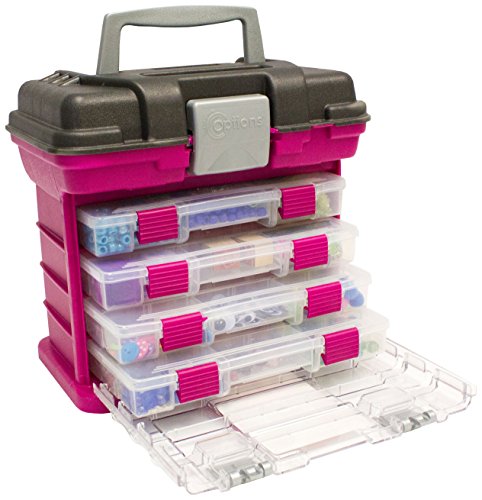
Portability is vital for the traveling knitter who needs a curated kit for workshops or retreats. The Grab N’ Go system is designed for vertical storage, fitting neatly into small spaces where a flat tackle box might be cumbersome.
This system is particularly effective for keeping disparate items—like measuring tapes, scissors, and point protectors—separated yet connected. It eliminates the need to dig through a single deep bag, as the modular trays keep small items accessible.
However, the smaller footprint means it cannot accommodate larger tools like circular needle cases. It is best viewed as a supplement to a larger home storage system, rather than a total replacement.
ArtBin Essentials 3003AG: Best for Small Spaces

Compact and shallow, the ArtBin Essentials 3003AG is a masterclass in space efficiency. It fits perfectly into project bags alongside a single skein of hand-dyed wool or a set of bamboo DPNs without adding unnecessary bulk.
Because the compartments are relatively shallow, items do not have space to tumble or mix during transit. This is an excellent feature for knitters who use fine-gauge metal stitch markers that are prone to jumping over low dividers.
The tight seal is a significant advantage, but it can be difficult for those with arthritis or limited grip strength to open. Ensure the latch style aligns with your personal comfort level before investing.
Akro-Mils 10124 Case: Most Durable Organizer

The Akro-Mils 10124 is a cabinet-style organizer that belongs on a dedicated knitting station rather than in a travel bag. Its rigid frame and pull-out drawers are designed to handle years of wear and tear in a craft room environment.
If you maintain a large collection of spare needles, specialized crochet hooks, and various gauges of stitch holders, this unit offers unparalleled structural integrity. It prevents the bending and warping that can occur in cheaper, flexible plastics over time.
While it lacks portability, it provides a permanent home for your entire collection. It is the best choice for the dedicated maker who has moved past starter kits and needs a professional-grade archival system.
Life-New 36-Grid Box: Best Budget Multi-Pack
The Life-New 36-grid box offers a practical solution for those with a massive volume of tiny notions, such as beads for knitting or various styles of row counters. It is an affordable way to standardize storage across multiple projects.
The grids are generally smaller than those in fishing-focused boxes, making them better suited for tiny hardware like toggle buttons or needle gauges. Because they come in a multi-pack, you can assign one box specifically to “sock knitting notions” and another to “sweater finishing supplies.”
The plastic is thinner than premium options, meaning the hinges may eventually fatigue if opened and closed daily. Treat this as an entry-level storage solution or a way to archive items you do not use on a weekly basis.
Fiskars Large Storage Case: For Bulky Notions
Bulky items like needle gauges, large plastic stitch holders, and fringe trimmers often struggle to fit in standard tackle boxes. The Fiskars storage case provides the extra depth and width required for these larger, non-standard knitting tools.
The interior layout is often more generous, which is beneficial for knitters who prefer to keep their original packaging or instruction booklets for tools like smart counters. It prevents the need to force items into compartments that are too small, which can bend metal tools.
While it excels at holding larger gear, it lacks the fine-tuned granularity for tiny beads or micro-stitch markers. Use this for your “macro” notions and keep a smaller container for the “micro” ones.
Fixed vs. Adjustable Dividers: Which is Best?
Fixed dividers offer superior security because items cannot slide underneath them if the box is tilted or dropped. This is essential for very small findings like micro-beads or locking safety-pin markers.
Adjustable dividers, by contrast, offer the flexibility to change your layout as your collection evolves. If you switch from knitting chunky blankets to delicate lace shawls, you may find your need for needle space changes, making adjustability a major asset.
The tradeoff is the occasional “gap” at the bottom of adjustable dividers where thin items can migrate to adjacent cells. If you choose an adjustable box, prioritize ones with a tight fit that leaves no space between the divider and the floor of the box.
What to Look for in a Secure Latching System
A latching system is the only thing standing between a well-organized kit and a floor covered in spilled stitch markers. Seek out double-locking mechanisms that require intentional force to open, as single-latch boxes can be accidentally triggered in a crowded bag.
“ProLatch” or heavy-duty snap designs are generally more reliable than friction-fit lids, which loosen over time. Consider how the latch operates when your hands are tired after a long evening of purling; avoid anything that is too sharp or requires excessive force.
Always check for a lip or recessed design that protects the latch from being snagged by loose yarn strands. A protruding latch can easily catch on a loose end of yarn, leading to a accidental spill.
How to Organize Your Box for Maximum Efficiency
Efficiency begins with proximity: place the notions you use every time you pick up a project—like row counters and stitch markers—in the most accessible compartments. Less frequently used items, such as darning needles for weaving in ends or tapestry needles for grafting, can go toward the back or in secondary rows.
Consider grouping by task rather than by type. Create a “Finishing” section with your blunt-tip needles and crochet hooks for picking up dropped stitches, separate from a “Progress” section with your row counters and marker rings.
Labeling the outside of the box is an underrated trick for those with multiple projects. A small piece of masking tape indicating the gauge or the project title can save precious time when you are juggling several works-in-progress simultaneously.
Beyond Buttons: What Else Can You Store in It?
Tackle boxes are essentially small, modular storage units perfect for anything that threatens to disappear into the depths of a knitting bag. They are excellent for keeping track of fine gauge knitting needles, cable needles, and even specialized notions like point protectors or needle sizers.
Beyond metal and plastic, consider storing items that preserve your finished pieces, such as small vials of wool wash or pins for blocking. You can even house delicate embroidery floss or ribbons for finishing work, keeping them dust-free and untangled.
Think of your tackle box as a customizable cockpit for your craft. Whether you are storing tiny pearl buttons for a cardigan or spare rubber bands for keeping yarn cakes tidy, these boxes offer the structure necessary to keep your focus entirely on the rhythm of your needles.
A well-organized tackle box is more than just a storage container; it is an investment in your peace of mind and the longevity of your tools. By carefully selecting a system that suits the size and frequency of your specific knitting needs, you remove the unnecessary barriers between you and your creativity. Take the time to audit your current notion collection, choose the organizer that best fits your storage style, and enjoy the satisfaction of a workspace that supports your craft as much as you do.