6 Best Knitting Pattern Clips For Hands-Free Sewing
Struggling to manage your yarn? Discover the 6 best knitting pattern clips for hands-free sewing and keep your focus on your craft. Shop our top picks today.
Maintaining focus on a complex chart while managing multiple yarn strands often leads to lost place-markers and mid-row mistakes. Hands-free clipping tools transform the workspace by securing patterns and stitches exactly where they belong. Selecting the right accessory is as important as choosing the correct needle material for a specific fiber. The following guide explores the most effective clips and keepers designed to streamline the knitting process.
Clover Wonder Clips: The All-Purpose Favorite
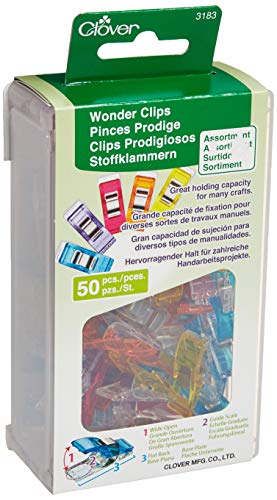

Clover Wonder Clips are a staple in both sewing and knitting rooms for their firm, reliable grip on varied fabric thicknesses. Unlike traditional pins, these clips do not pierce delicate fibers, making them ideal for holding folded hems or securing double-knitted edges before seaming.
The flat base allows the clip to sit securely on a table without wobbling, providing a stable anchor for a pattern sheet. They are particularly useful when blocking large, heavy pieces that require multiple attachment points to ensure symmetry.
While they are excellent for holding edges, they lack the fine-tuned tension needed for extremely delicate lace. Keep them away from high-stretch synthetic blends where heavy clips might leave a temporary indentation in the fabric.
Cocoknits Maker’s Keep: Ultimate Magnetic Wristband

The Maker’s Keep functions as a wearable, magnetic landing pad that keeps essential metal tools within immediate reach. By housing stitch markers and needles on a silicone snap bracelet, it eliminates the need to constantly set down knitting to rummage through a project bag.
This tool shines when working on complex cables or stranded colorwork, where rapid switching between different needle sizes or stitch markers is frequent. It effectively minimizes downtime, keeping the hands focused on maintaining consistent tension across the row.
However, the magnetic field is strong, so avoid placing it directly against digital devices or sensitive electronics. It is a highly efficient solution for the knitter who frequently misplaces small notions during intricate sessions.
Knitter’s Pride Chart Keeper: For Complex Patterns

A chart keeper is essential when tackling intricate lace or multi-color patterns that require constant reference. This tool uses a rigid board and magnetic strips to highlight a single row of a pattern, effectively “locking” the place so the eye never loses focus.
Using a magnetic edge to track rows prevents the common error of skipping a line in an complex chart. It is far superior to digital alternatives, as it eliminates screen glare and allows for quick, tactile adjustments while the needles are in hand.
Be aware that these boards can be bulky for travel-knitting. They are best reserved for stationary projects at home where desk space is ample and pattern complexity demands high visibility.
Fons & Porter Klipit: Best for Bulky Projects
The Fons & Porter Klipit offers a sturdy grip designed to handle thick, heavy-duty projects with ease. When working with jumbo-weight wools or layered fabric structures, these clips provide the necessary clamping force to keep pieces aligned.
These are the go-to choice for managing the weight of large blankets or heavy rugs during the assembly phase. They prevent the pieces from shifting under their own weight, which is critical when matching intricate patterns or aligned seams.
Because of their strong spring, they are not appropriate for fine alpaca or silk blends, as the tension can distort the fibers. Use them only when the structural integrity of the project outweighs the need for delicate handling.
Grabbit Magnetic Pincushion: A Seamstress’s Secret

The Grabbit Magnetic Pincushion is perhaps the most underrated tool for keeping track of metal stitch markers and tapestry needles. Its powerful, wide-radius magnetic surface allows needles to be dropped onto it from almost any angle without precision placement.
For a knitter constantly switching between different needle sizes or organizing various cable needles, it acts as a central hub. It simplifies the cleanup process, as the powerful magnet can even be used to sweep a workspace for lost pins or markers.
Avoid storing heirloom knitting needles directly on top of the magnet for long periods, as it can occasionally interfere with the finish of certain plated metals. Treat it as a temporary staging area rather than a long-term storage solution.
Dritz See-Thru Ruler: The Clear Choice for Accuracy
A clear, see-thru ruler is a non-negotiable tool for verifying gauge and measuring seam allowances. When sewing knitted components together, the ability to see through the ruler ensures that stitches are perfectly aligned before the needle passes through.
Using a transparent ruler allows for exact calculations when blocking, ensuring that two sleeves or front panels are identical in width and length. It removes the guesswork that often leads to asymmetrical garments.
Always check for heat-resistance if using the ruler in conjunction with steam blocking, as some plastics may warp. A high-quality, shatterproof version is a lifetime investment for any dedicated maker.
How to Choose the Right Clip For Your Project Type
Selecting the right accessory depends heavily on the weight of the fiber and the delicacy of the construction. Lightweight, fuzzy fibers like mohair snag easily, so favor magnetic keepers over spring-loaded clips to protect the halo of the yarn.
- For heavy, structured wools: Use spring-loaded clamps that provide high tension.
- For delicate lace and silk: Use soft, magnetic fasteners or lightweight pins that do not compress the fiber.
- For complex charts: Use a magnetic board to prevent line-tracking errors.
Always consider the potential for “crushing” the yarn. If the clip leaves a mark after thirty seconds of use, it is too tight for that specific project.
Magnetic vs. Spring Clips: What’s the Difference?
Magnetic clips are designed for organization and retention, acting as static anchors for small parts. They excel at keeping track of metal accessories but offer little in the way of structural holding power for heavy fabric pieces.
Spring clips are functional, mechanical devices designed to apply consistent pressure to fabric layers. They are essential for structural alignment but can damage delicate fibers if left clamped for too long.
The distinction lies in the application: magnetic tools are for inventory management, while spring tools are for structural assembly. Most knitters benefit from having a set of both in their kit.
Using Pattern Keepers for Intricate Lacework
Intricate lacework, particularly projects with large repeats, often requires the use of multiple markers and pattern keepers. When tracking a lace repeat, place the pattern keeper horizontally to isolate only the current row of the chart.
If the pattern involves both knit and purl stitches on the wrong side, highlight the chart rows with distinct colors to avoid confusion. This reduces the cognitive load of the project, allowing the knitter to focus on maintaining the correct yarn-over placement.
Remember that lace is highly prone to distortion. Never clip a pattern keeper directly to the lace fabric itself, as the tension can stretch the yarn-overs and ruin the delicate openwork structure.
Tips for Seaming Knits Without Stretching Them
The most critical aspect of seaming is maintaining the same tension as the knitted fabric itself. Avoid pulling the yarn too tightly, as this creates a ridge that pulls at the fabric and compromises the silhouette of the garment.
Always use a tapestry needle that is appropriate for the weight of your yarn to avoid splitting the plies. If seaming a superwash wool, be extra cautious, as these fibers are notoriously slippery and prone to growing during the seaming process.
- Use pins or clips: Hold pieces together at critical junction points like armholes and shoulders.
- Match stitch-for-stitch: Use the mattress stitch technique to create a clean, invisible seam.
- Ease the pieces: Distribute any slight differences in length evenly across the seam rather than bunching at the end.
Success in fiber arts is found at the intersection of quality tools and careful technique. By integrating these clips and keepers into the workflow, the knitting experience becomes more organized, precise, and enjoyable. Take the time to evaluate the specific needs of the current project before settling on a method, and watch how these small adjustments lead to significantly more professional results.