6 Best Magnifying Bookmarks For Detail Work
Struggling with small print? Explore our top 6 magnifying bookmarks for detail work and improve your reading experience today. Find your perfect tool now.
Staring at a complex lace chart or trying to track a delicate row of brioche stitches under dim lighting is a recipe for eye strain and dropped stitches. High-quality magnification tools provide the clarity needed to keep gauge consistent and patterns accurate during long sessions of intricate work. These accessories turn frustrating, squint-heavy tasks into fluid, enjoyable knitting experiences. Choosing the right tool depends on whether the primary goal is portability, steady illumination, or a clear view of an entire complex row.
Carson PageGlow LED Bookmark: Best for Travel


The Carson PageGlow excels when knitting on the move, such as during commutes or flights where overhead lighting is often insufficient. It combines a slim profile with a focused beam, ensuring the chart stays illuminated without disturbing seatmates.
Because of its lightweight design, this bookmark clips effortlessly onto a pattern binder or a small notebook. It is an ideal companion for sock knitters working with dark, tonal yarns that tend to hide stitch definition in low-light environments.
The tradeoff here is the smaller lens surface area compared to larger desktop magnifiers. It serves as a precision tool for pinpointing specific stitches rather than scanning an entire page of intricate cable instructions.
Mighty Bright Lighted Bookmark: For Low Light
Consistent light is the difference between catching a cabling error in real-time and finding it three inches later. The Mighty Bright offers a reliable light source that clips directly to the page, illuminating the specific section of a chart being worked.
This bookmark is particularly useful when working with high-twist, dark-colored wools where stitch definition is naturally muted. Having a dedicated light source right at the point of focus significantly reduces eye fatigue during long evening knitting sessions.
While the illumination is excellent, ensure the batteries are kept fresh to maintain peak brightness. For those working on complex colorwork, the clarity provided by this light helps distinguish between similar-toned yarns.
KnitPro Magma Chart Keeper: The Knitter’s Choice

The Magma Chart Keeper is designed specifically for the realities of the craft, featuring a magnetic board that holds the pattern flat and a magnetic strip that acts as a row marker. The integrated magnification strip is a game-changer for tracking stitches across dense, row-by-row instructions.
By keeping the pattern physically anchored, it prevents the common issue of losing one’s place during complicated lace repeats. The magnetic strip is strong enough to hold heavy pattern pages securely, even when bumped on a crowded knitting table.
This tool is the gold standard for anyone who frequently tackles large-scale projects like heirloom shawls or sweaters with multiple size-dependent charts. It removes the guesswork and mental load, allowing focus to remain entirely on the needlework.
MagniPros 3X Page Magnifier: Top Budget Pick

For those needing a broader view, the MagniPros offers a large, rectangular lens that covers a significant portion of a chart at once. This is excellent for knitters who prefer to see an entire sequence of chart repeats without constantly shifting the tool.
The 3X magnification is usually sufficient for standard pattern text and clear charting symbols. It is a cost-effective solution for anyone who wants a simple, no-frills tool to keep by their side in a project bag.
Be aware that larger, non-rigid lenses can sometimes cause slight distortion at the extreme edges. It works best when held at a steady, consistent distance from the page rather than relying on a clip-on mechanism.
CO-Z Hands-Free Magnifier: Best for Versatility
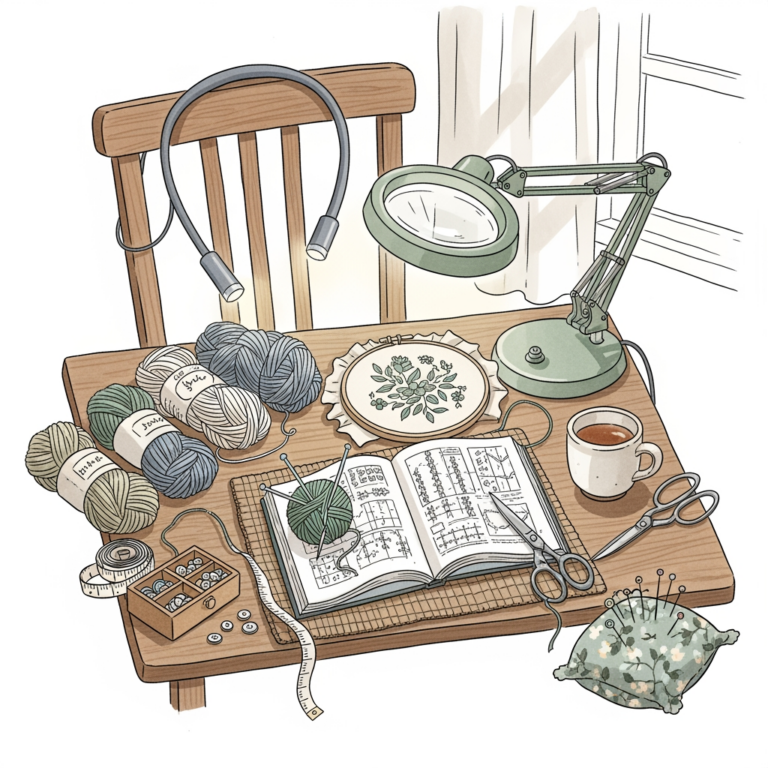
A hands-free magnifier is essential when both hands must be dedicated to the needles and yarn. The CO-Z model features a neck strap or a stable base, allowing for a steady, hands-free view of a pattern while knitting complex textures.
This is highly recommended for knitters working with intricate, multi-layered patterns that require constant reference to stitch keys. It is also an excellent option for those who knit with larger-gauge needles and want to keep a close eye on stitch regularity.
While the convenience is unmatched, it does require a bit of desk or lap space to position properly. Ensure the angle is adjusted to prevent glare from nearby lamps or ceiling fixtures.
iMagniphy Page Magnifier: Best Large View Area
Large-format magnification is superior when reading long, complex written patterns alongside detailed symbol charts. The iMagniphy provides an expansive, crystal-clear viewing window that minimizes the need to move the tool across the page.
Because of its superior lens quality, the image remains sharp across the entire field of vision. This clarity is vital when working with fine-weight yarns like lace-weight mohair, where spotting a missed yarn-over is critical to the project’s success.
It is a heavier tool, so it is best suited for a stationary knitting station rather than being packed into a daily project bag. Use it on a flat surface to maintain the focal distance required for the best results.
How to Choose the Right Magnification Strength
Magnification strength is measured in ‘X’ values, with 2X to 3X being the standard for knitting patterns. A higher number is not always better, as it significantly reduces the field of view and requires holding the tool much closer to the page.
- 2X – 2.5X: Ideal for reading standard text and viewing large charts.
- 3X: The “sweet spot” for checking stitch details and small symbols.
- 4X or higher: Recommended only for extremely fine print or identifying structural issues in tiny, tight stitches.
If you find yourself having to move the magnifier constantly, the magnification is likely too high for your needs. Always prioritize a wider field of view to ensure the rhythm of the knitting flow is not interrupted by constant adjustments.
Key Features: Lights, Lines, and Reading Aids
Beyond the lens itself, the best tools include integrated lighting and physical tracking aids. LED lighting is essential for modern knitters who work with dark yarns, as it reveals the underlying structure of the stitch that natural light might miss.
Lines or magnetic bars help track progress through a pattern, acting as a visual anchor that prevents the eyes from skipping a row. When selecting a tool, look for a combination of these features to streamline the project management process.
Effective tools should feel like an extension of the workflow, not an obstacle to it. Test the weight and balance to ensure that using the magnifier does not cause wrist or hand fatigue during long projects.
Using Magnifiers with Knitting & Cross Stitch
Magnifiers serve as a vital bridge between the pattern and the hands, especially for projects involving precision. In cross stitch, where the grid count is paramount, a high-clarity lens allows for precise identification of the canvas holes.
In knitting, use a magnifier to monitor tension consistency, especially when transitioning between different needle materials like bamboo and nickel-plated metal. These tools reveal the subtle variations in gauge that occur when switching between different yarn fibers or needle textures.
If you are struggling to maintain a consistent gauge with slippery synthetic fibers, magnification can help spot where a stitch might have been elongated or pulled too tight. Use them as a diagnostic tool to improve technique over time.
Do You Really Need a Lighted Magnifier?
A lighted magnifier is rarely a luxury; it is a fundamental tool for maintaining accuracy in fiber arts. For anyone working with dark-colored yarns or intricate patterns in low-light conditions, the difference is night and day.
The additional light eliminates shadows cast by the hands and needles, ensuring that every stitch is clearly visible. This reduces the time spent “tinking” back errors and increases the overall speed and enjoyment of the knitting process.
If you find yourself squinting or moving toward a window, it is time to invest in a lighted solution. It is a small investment that pays dividends in both the quality of your finished items and the health of your eyes.
Investing in a quality magnifier is one of the most effective ways to elevate the technical standard of your knitting. By choosing a tool that aligns with your specific project needs—whether it is a simple lighted bookmark for travel or a robust, hands-free station for complex lace—you ensure that every stitch is placed with confidence and precision. Happy knitting, and may your rows always remain true.