7 Best Walking Foot Guides For Consistent Spacing
Achieve perfect, even seams with our top 7 walking foot guides for consistent spacing. Discover the best tools for your next sewing project and buy yours today.
Achieving perfectly straight, evenly spaced quilting lines is the difference between a project that looks handcrafted and one that looks truly professional. Even the most carefully blocked knit-backed quilt or heavy-weight tapestry can become distorted under the needle if the fabric layers shift during the quilting process. A reliable walking foot guide serves as a mechanical extension of the hands, ensuring consistency across every inch of a quilt sandwich. These seven tools provide the mechanical stability needed to maintain rhythm and precision throughout long quilting sessions.
Husqvarna Viking Dual Feed Foot: The Pro’s Pick


The Husqvarna Viking Dual Feed foot is engineered for machines that require an integrated approach to fabric movement. It acts as a secondary set of feed dogs, gripping the top layer of fabric to match the speed of the machine’s internal feed mechanism.
This prevents the “creeping” often seen when quilting thick cotton or batting-heavy projects. It is an investment, but for those working on complex, multi-layered heirloom quilts, the precision offered is unmatched.
Expect the highest level of registration between layers, even when dealing with bulky fibers or varying tension. If the goal is professional-grade finish on a queen-sized quilt, this foot eliminates the need for excessive pinning or basting.
Brother SA132 Quilting Guide: Most Versatile

The Brother SA132 Quilting Guide excels because of its simplicity and wide-ranging compatibility. It attaches directly to the walking foot, allowing for rapid adjustments of the spacing width without the need for specialized tools.
This versatility makes it ideal for quilters who alternate between narrow, decorative topstitching and wider, structural straight-line quilting. It holds its position firmly, ensuring that the guide arm does not drift during long, straight passes.
Consistency here is achieved through a rigid design that resists the vibrations of the machine. It is the practical choice for those who need a reliable tool that works across multiple quilting patterns without a steep learning curve.
Janome Even Feed Foot Guide: Quilter’s Favorite
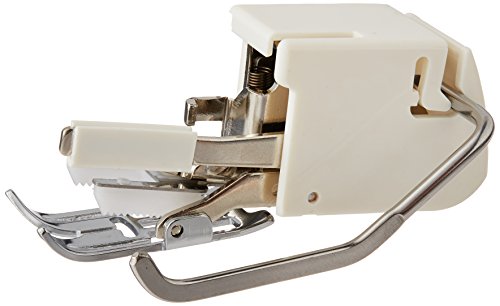
Janome’s even feed system is renowned for its ability to handle delicate, slippery fabrics as well as thick, layered quilts. The guide attachment is designed specifically to work in harmony with the machine’s unique pulse of fabric advancement.
Many quilters prefer this system because it is remarkably easy to install and adjust on the fly. When working with wool batting or high-loft synthetics, the pressure remains consistent, preventing the skipped stitches that plague inferior feet.
Precision depends on the guide’s ability to lock into the specific groove provided on the foot. It remains steady throughout the length of the project, allowing for perfectly parallel lines that stay true from edge to edge.
Madam Sew Adjustable Guide Foot: Ultimate Control
The Madam Sew Adjustable Guide Foot provides granular control for those who prefer custom spacing. Unlike fixed-width guides, this model offers a sliding mechanism that can be set to any increment desired by the user.
This is particularly useful when replicating specific quilting motifs or matching the width of unique binding tape. The guide is built to hold its setting securely, even during high-speed stitching on dense fabric structures.
The tradeoff for this level of adjustment is a slightly larger profile on the machine bed. Ensure that the workspace remains clear to allow the guide to move freely without bumping into bulky, rolled-up sections of the quilt.
Baby Lock Walking Foot with Guides: Premium Option
Baby Lock’s walking foot system is a premium option designed for those who view their sewing machine as a high-performance studio tool. It offers an exceptionally smooth movement that reduces fabric puckering, which is vital when working with delicate silk or lightweight backing fabrics.
The included guide is robust, featuring a clear, easy-to-read scale for setting widths. It is built to withstand the rigors of heavy daily use, making it a favorite for those who produce quilts at a higher volume.
While the cost is higher than universal options, the build quality and mechanical tolerances justify the price for serious crafters. It offers superior visibility, allowing for a clear line of sight to the needle during the entire quilting process.
EverSewn Walking Foot with Guide: Best for Value
EverSewn provides a functional, no-frills walking foot that delivers consistent performance at a lower price point. It is an excellent choice for beginners who are just starting to explore straight-line quilting or for those who need a spare set for a travel machine.
The guide is straightforward, utilizing a screw-in mechanism that holds firmly to the side of the foot. While it may lack the high-end finishes of premium models, it performs the primary task of maintaining stitch spacing with complete reliability.
For the price, the durability is excellent, provided the guide arm is treated with care. It represents a sensible entry point for anyone wanting to improve their quilting technique without committing to a premium investment.
Universal Screw-In Seam Guide: Budget-Friendly
The Universal Screw-In Seam Guide is the ultimate tool for those who prioritize a simple, functional approach. It attaches to the bed of the machine rather than the foot, providing a physical rail for the fabric edge to ride against.
This setup is ideal for those who prefer to keep their foot assembly light and unobtrusive. It is incredibly effective for edge-stitching or quilting parallel lines where the fabric edge remains parallel to the needle.
Because it attaches to the machine bed, it is less impacted by the vibrations of the walking foot itself. It is a fundamental tool that every quilter should have in their drawer, regardless of the complexity of their primary walking foot.
How to Choose a Guide for Your Sewing Machine
Choosing the right guide begins with confirming the shank height and feed system of your machine. A low-shank machine requires a different foot geometry than a high-shank or slant-shank model, regardless of the guide’s performance.
Consider the thickness of the projects usually undertaken. For thick, multi-layer quilts, prioritize a walking foot with a high “lift” capacity to accommodate the bulk under the foot.
Look for a guide that offers enough extension for the desired spacing range. Some guides are limited to two inches, while others can reach significantly further; choose based on the aesthetic of the quilting patterns typically chosen.
Installing & Using a Walking Foot Seam Guide
Always ensure the power is off before removing the standard presser foot and installing the walking foot. Align the walking foot lever over the needle clamp screw, as this interaction drives the feeding mechanism.
Attach the guide to the designated port or screw hole on the side of the foot. Once secured, use a test scrap—preferably the same batting and fabric combo as the quilt—to calibrate the exact width before starting the main project.
Slide the fabric into position so the previous line of stitching aligns with the guide. Maintain a slow, steady speed; the walking foot is designed to do the work, so avoid pulling or pushing the fabric, which can compromise the feed timing.
Pro Tips for Perfectly Spaced Quilting Lines
Start by quilting from the center of the quilt outward to manage the bulk of the fabric. This prevents the edges from becoming overwhelmed and helps keep the layers from shifting during the process.
Use masking tape or a specialized quilting marker to mark the very first line of stitching. This line acts as the foundation for the guide; if the first line is slightly off-center, every subsequent line will be consistently crooked.
Finally, keep the machine bed clear of any trailing fabric weight. Support the weight of the quilt on a table to the left of the machine to ensure the walking foot is not struggling against the pull of gravity.
Achieving uniform spacing in quilting is a skill built through patience and the right mechanical support. By pairing a quality walking foot guide with consistent technique, even the most ambitious projects become achievable with a professional, balanced look.