
6 Best Bent Nose Tweezers For Intricate Assembly
Upgrade your precision work with our top 6 best bent nose tweezers for intricate assembly. Explore our expert-tested picks and improve your project accuracy now.
Precision is the difference between a seamless graft on a silk lace shawl and a snagged fiber that ruins a week’s worth of work. When managing delicate mohair or untangling a complex cable cross, the standard fingers often lack the dexterity required for the job. Bent nose tweezers provide the specific ergonomic angle needed to reach into tight stitch structures without distorting the fabric. These tools turn frustrating manual corrections into effortless adjustments, making them an essential addition to any dedicated knitting toolkit.
Xuron 450 TweezerNose Pliers: Best for Durability
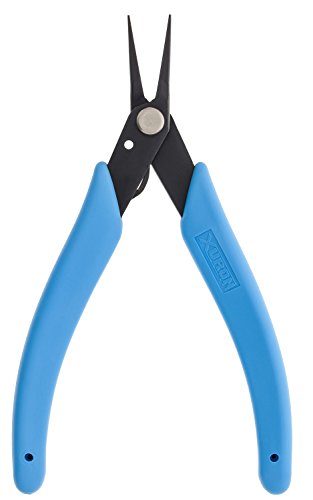

These tools bridge the gap between heavy-duty pliers and fine-point tweezers, offering a robust construction that stands up to constant use. The steel is tempered for long-term resilience, ensuring the tips do not lose their alignment even after years of picking at dense, worsted-weight stitches.
Unlike cheaper stamped-metal options, these feature a soft-touch grip that reduces hand fatigue during long sessions of weaving in ends. For those working with heavy wool or thicker cotton cords, the durability of these pliers ensures they will not bend or snap under tension.
The bottom line: Choose these if you prefer a tool that feels substantial in the hand and handles thicker yarn fibers without compromising on control.
Beadsmith Fine Tip Bent Tweezers: Precision Pick

Fine tip bent tweezers excel when the task involves individual strand manipulation, such as fixing a dropped stitch in a delicate fingering-weight project. The acute angle of the tip allows for deep penetration into the stitch column without stretching the neighboring loops.
These are particularly useful when working with high-twist yarns, which can easily split if handled with blunt tools. By isolating a single ply of a yarn strand, you can accurately re-knit a stitch that has unraveled deep within the fabric.
The bottom line: This is the go-to choice for intricate lace or sock knitting where visual clarity and surgical precision are required.
Hakko CHP-7-SA Stainless Steel Tweezers: Best Grip

The Hakko CHP-7-SA is engineered with an anti-magnetic stainless steel finish that provides a surprisingly tactile, non-slip grip. When working with slippery fibers like bamboo or rayon, the surface texture of these tweezers prevents the yarn from sliding out of the grasp.
The tension of the metal is calibrated to hold a firm grip without requiring excessive finger pressure, which is vital for preventing hand cramping. The angled tip allows for a natural wrist position, mimicking the motion used when holding a crochet hook for a dropped stitch rescue.
The bottom line: These offer the most reliable hold on slick, cellulose-based fibers that otherwise fight back against standard metal tools.
Aven 17542 Bent Nose Tweezers: Most Ergonomic
The design of the Aven 17542 prioritizes the physical comfort of the maker, featuring an offset angle that perfectly aligns with the line of sight. By reducing the need to twist the wrist, these tweezers prevent the strain often associated with tedious mending work.
If you spend hours performing grafting or Kitchener stitch adjustments, the ergonomic benefit of these tweezers becomes apparent almost immediately. They allow for a relaxed hand posture, preventing the stiffness that often follows intensive fiber repair.
The bottom line: Invest in these if comfort is the primary factor, especially during long repair sessions for large-scale projects.
Craftopia Pro Tweezers Set: Best Value Pack
For those just starting to build their knitting kit, this set provides a variety of tip shapes that cover almost every conceivable repair scenario. Having a selection of angles and point thicknesses allows you to experiment with what works best for your specific knitting style.
While these may lack the specialized tempering of professional-grade tools, they are more than adequate for most hobbyists. It is a cost-effective way to keep a pair in your project bag, one in your notion case, and one on your crafting table.
The bottom line: Ideal for beginners or those who want multiple options without committing to a single high-end purchase.
Dumont 3-Style Bent Tip Tweezers: The Pro’s Choice
Dumont tweezers are widely considered the gold standard for high-stakes fiber work due to their legendary alignment and superior steel quality. The tips meet with microscopic accuracy, allowing you to grip even the most fragile, single-ply lace yarn without breaking it.
These tools are built for professionals who cannot afford a mistake when fixing a complex heirloom garment. Every movement is transmitted precisely to the tip, providing a level of feedback that cheaper alternatives simply cannot replicate.
The bottom line: This is a luxury investment for the dedicated maker who views tool quality as a permanent extension of their technique.
How to Choose Your Perfect Pair of Craft Tweezers
Selecting the right tweezers requires looking at the yarn weight and the nature of the project. A thick, textured wool yarn might require a broader, sturdier tip, while a fine silk or mohair project demands a thin, needle-like point.
Consider the tension of the tweezers themselves; if the spring is too tight, you will fatigue your hands quickly. Conversely, if the tension is too loose, you will lack the control needed to navigate dense, stranded colorwork or complex intarsia transitions.
- Tip shape: Always check for an angle that aligns with your natural wrist rotation.
- Finish: Choose non-glare, matte finishes to prevent eye strain under bright task lighting.
- Material: Ensure the metal is corrosion-resistant, as hand oils can eventually damage lower-quality finishes.
Why Bent Nose Tweezers Are a Knitter’s Best Friend
Knitting involves a high volume of repetitive, tiny mechanical actions that often result in minor errors. Bent nose tweezers function as a third hand, allowing you to hold a working yarn or a loose loop in place while you re-insert your knitting needle.
They are indispensable for weaving in yarn tails, especially when the end is too short for a standard tapestry needle to manage. Using these tools to pull a tail through the back of a stitch provides a clean, professional finish that hides the transition point effectively.
Keeping Your Precision Tweezers in Top Condition
Tweezers are precision instruments and should be stored in a protective case to prevent tip damage. If the tips become misaligned, the tool loses its ability to grip, rendering it essentially useless for fine work.
Clean the tips regularly with a soft cloth and a drop of isopropyl alcohol to remove lint, lanolin, and dust. Keeping the surfaces clean ensures the grip remains firm and prevents fibers from snagging on residual debris trapped in the metal texture.
Stainless Steel vs. Titanium: Which Tweezer is Best?
Stainless steel is the classic choice for knitting tweezers, offering a perfect balance of durability, corrosion resistance, and affordability. It is sturdy enough for general repairs and easy to maintain with standard household cleaning supplies.
Titanium is lighter and virtually indestructible, which is ideal if you carry your notions case everywhere you travel. However, titanium is often more expensive and does not offer a significant functional advantage over high-grade stainless steel for routine fiber tasks.
- Stainless Steel: Best for general daily use and longevity.
- Titanium: Best for portable kits and those who prefer a lightweight tool.
The right pair of tweezers is an investment in the longevity of your hand-knitted work. By selecting a tool that matches your specific fiber preferences, you eliminate the stress of complex repairs and ensure your projects maintain their professional finish for years to come.