6 Best Stackable Modular Drawers For Embroidery Thread
Organize your craft space with the 6 best stackable modular drawers for embroidery thread. Shop our top picks to keep your collection tangle-free and accessible.
Embroidery thread collections often grow from a few solitary skeins into a vibrant, overwhelming library of fibers. Managing this inventory requires more than just a cardboard box; it demands a system that protects delicate strands from dust, light, and tangles. A well-organized storage solution transforms a chaotic craft room into a streamlined workspace where inspiration is never hampered by searching for the right colorway. Choosing the right drawers ensures that every stitch, whether on a fine lace project or a complex embroidery design, starts with clean and accessible materials.
Akro-Mils 10164: Best for Large Thread Collections


The Akro-Mils 10164 cabinet is a heavy-duty industrial staple that has found a permanent home in many fiber arts studios. Its numerous small, transparent drawers provide the granular control needed to categorize threads by manufacturer, color family, or fiber weight.
For the serious embroiderer, this system eliminates the frustration of digging through jumbled piles. Each drawer can be labeled clearly, allowing for rapid retrieval when color-matching thread to a specific hand-dyed yarn project or intricate heirloom embroidery.
While the plastic construction is durable, these units are best suited for stationary placement on a workbench. They offer unparalleled capacity, but they lack the aesthetic charm of wooden cabinets, making them a purely functional choice for high-volume storage.
IRIS USA Cart: Best Mobile Embroidery Workstation

Mobility is a vital consideration when the workspace shifts between the living room sofa and a dedicated studio desk. The IRIS USA rolling cart offers deep, stackable drawers that accommodate not just thread, but also larger tools like hoops, shears, and reference books.
Rolling storage allows the entire thread collection to move in tandem with a project. If a long-term embroidery piece requires frequent access to a specific palette of colors, simply roll the cart to the preferred seating area to maintain a steady workflow.
These carts are ideal for those who value versatility, yet they occupy a larger footprint than static tabletop units. Ensure the floor space is cleared to prevent the wheels from snagging on rug edges or loose yarn ends.
Creative Options Organizer: Most Compact Design

The Creative Options line excels in environments where shelf real estate is at a premium. These compact units are designed specifically for the meticulous crafter who needs a modular solution that stacks neatly without dominating the room.
These organizers are particularly effective for storing specialty threads, such as metallic filaments or delicate silk, which require separation from standard cotton floss. Their small size makes them perfect for tucking into corners or stacking inside closets.
Though they are small, they are limited by their vertical storage capacity. They are excellent for curated collections, but they may prove frustrating for someone managing vast amounts of thread who requires quick, frequent access to every color at once.
ArtBin Super Satchel: Best for Grab-and-Go Kits

ArtBin Super Satchels offer a unique approach by combining storage with portability in a rugged, secure format. These cases are designed to be moved, making them the superior choice for traveling to craft retreats or local needlework guild meetings.
The interior compartments are often adjustable, allowing for the customization of space based on thread spool size. Because the cases seal tightly, they provide an extra layer of defense against dust and humidity, which can degrade sensitive natural fibers over time.
While they are excellent for transport, they do not function well as a permanent, high-access repository. Relying on them for daily use can become tedious as the latches and stacking mechanics are designed for occasional transit rather than constant opening and closing.
Deflecto Caddy System: Most Customizable Setup
The Deflecto Caddy System stands out for its modularity, allowing the user to stack or wall-mount components based on current needs. This is the go-to solution for those whose thread collection is fluid and frequently expanding.
Customization is the primary advantage here; one can mix drawer sizes to accommodate both tiny bobbins and bulky skeins of wool embroidery thread. This flexibility ensures that no space is wasted and every tool has a designated home.
The tradeoff for this modularity is the need for careful assembly and planning. It is easy to end up with an unstable tower if the base is not properly balanced, so prioritize a sturdy, flat surface for this system.
Sterilite 3-Drawer Unit: Top Budget-Friendly Pick
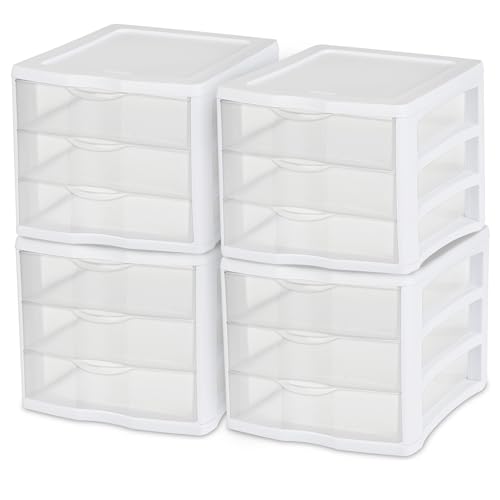
Sterilite drawers are the most accessible storage solution for beginners just starting to build their thread inventory. They are lightweight, inexpensive, and widely available, making them the pragmatic choice for those investing their budget into higher-quality fibers rather than hardware.
These units provide ample depth for large quantities of thread, particularly if storing whole skeins rather than individual bobbins. They are perfect for grouping supplies by project type, such as keeping linen threads separate from cotton embroidery floss.
Because the plastic is relatively thin, they are not designed for extreme heavy-duty use or frequent stacking of heavy items. Use these to organize light, categorized bins rather than as structural support for other heavy crafting equipment.
How to Pick Your Perfect Thread Drawer System
The decision-making process should begin with an honest assessment of the current inventory size and the frequency of use. If the thread is used daily, visibility and ease of access take precedence over compact, hidden storage.
Consider the environmental conditions of the workspace, specifically humidity and sunlight. Natural fibers, especially silk and fine cotton, can weaken or fade when exposed to direct light or fluctuating moisture, so opaque drawers are often a better investment than clear ones.
- Assess volume: Are you storing a few dozen skeins or hundreds of bobbins?
- Determine mobility: Does the system need to stay in one room or travel?
- Measure depth: Will you store thread in its original packaging or wound on cards?
Always prioritize a system that allows for growth. Adding one drawer at a time is far more sustainable than purchasing a massive cabinet that remains half-empty or a tiny one that becomes cluttered within months.
Organizing Your Drawers: Bobbins vs. Skeins
Deciding whether to wind thread onto bobbins or keep it in original skeins is a fundamental organizational choice. Bobbins save significant space and prevent tangles, but they require a time investment to wind—a chore that can be meditative for some and tedious for others.
Keeping thread in original skeins preserves the labels, which contain vital information like dye lot numbers and color codes. For complex embroidery projects where matching a specific batch is necessary for consistent coverage, keeping the label attached is non-negotiable.
- Bobbins: Ideal for small amounts of thread and long-term, tangle-free storage.
- Skeins: Best for keeping records of color codes and managing larger quantities of thread for big projects.
- Hybrid approach: Use bobbins for active working colors and store bulk skeins in labeled bags within larger drawers.
Regardless of the method, ensure that the thread remains upright or flat. Avoid piling heavy items on top of delicate silk floss, as the weight can crush the fibers and introduce permanent kinks.
Keeping Your Embroidery Thread Safe and Clean
Thread is a magnet for dust and oil, both of which can transfer to embroidery fabric during the stitching process. Use airtight or well-sealed drawers to prevent dust accumulation, which acts as an abrasive over time.
Avoid storing thread in areas with high humidity, such as basements or near kitchen sinks. Moisture encourages mold growth on organic fibers like cotton and wool, which can ruin a carefully planned project before a single stitch is made.
If the storage unit is near a window, use opaque containers to prevent ultraviolet light from fading vibrant colors. Even subtle fading can be noticeable when the time comes to pull a spare length of thread for a finishing touch.
Tips for Maximizing Your Drawer Storage Space
Vertical space is the most underutilized asset in a small studio. Utilize drawer dividers to keep spools from rolling around; these can be as simple as stiff cardboard or purpose-built plastic inserts that keep every color in a dedicated lane.
Grouping threads by color gradient rather than by brand often makes it easier to find the perfect shade for a project. This visual approach allows for intuitive color selection, which is often more helpful than sorting by manufacturer code alone.
Finally, keep a master inventory list attached to the side of the drawer unit. Updating this list as colors are used up prevents the frustration of starting a design only to realize the essential highlight color is depleted.
Proper storage is the foundation of every successful fiber project. By selecting a system that balances access with protection, your embroidery thread collection becomes a lasting asset rather than a source of stress.