6 Best Pattern Tracing Light Boxes For Accuracy
Find the 6 best pattern tracing light boxes for professional accuracy. Shop our top-rated picks to improve your precision and streamline your creative workflow.
Precision in pattern tracing is the silent partner to every successful knitting project, especially when translating intricate lace charts or complex stranded colorwork onto a working canvas. A high-quality light box serves as the bridge between a dense, multi-page pattern and the tangible reality of your needles and yarn. By illuminating the subtle details of a graph, you ensure that every stitch count remains accurate and every design element aligns perfectly. Investing in the right tool saves hours of frustrating frogging—the process of unraveling knitted work—caused by simple reading errors.
Cricut BrightPad Go: Best Cordless Option


Portability is a primary concern for knitters who move between the living room sofa, the local yarn shop knitting circle, and the occasional retreat. The BrightPad Go eliminates the frustration of searching for an outlet, allowing for a clutter-free workspace that is essential when handling delicate mohair or long, unwieldy cables.
Its battery-operated design is particularly beneficial when you need to stabilize a pattern while sitting in a chair without nearby power access. Because it offers high-contrast illumination, it excels at making complex cable charts pop, ensuring you don’t miss a single “knit 1, yarn over” instruction in a dense lace repeat.
The trade-off for this convenience is the need for consistent charging cycles. If you tend to knit for hours on end, ensure the device is topped off before starting a marathon session to avoid a mid-row power failure.
Artograph LightPad Pro: Pro-Level Brightness

Advanced colorwork often requires discerning subtle tonal shifts in a pattern, which is where the Artograph LightPad Pro shines. This model provides the high-intensity, color-calibrated light needed to differentiate between similar hues on a printed chart.
This level of brightness is a game-changer when working with dark-colored yarns, where pattern visibility can easily drop under standard room lighting. The edge-to-edge illumination prevents “hot spots,” ensuring that your eyes don’t fatigue even after hours of referencing your gauge and stitch count.
While the price point is higher, the investment is justified for those who spend significant time mapping out custom designs or drafting complex intarsia pieces. It is a tool built for durability and long-term use in a busy studio environment.
LitEnergy A4 Light Box: The Top Budget Pick

Accessibility is vital, and the LitEnergy A4 provides a straightforward, effective solution for hobbyists who need a reliable workspace without an extravagant price tag. It is an excellent entry-level choice for beginners just starting to experiment with tracing their own patterns or enlarging small, difficult-to-read charts.
Its slim profile makes it easy to tuck into a project bag or slip beneath a pile of knitting manuals when not in use. While it may lack the bells and whistles of professional-grade pads, the consistent LED light is perfectly adequate for reading standard 12-point font charts and simple geometric colorwork.
Keep in mind that the light intensity is fixed; it does not offer the granular adjustments found in more expensive models. It works best for standard projects where you aren’t fighting with extremely high-contrast or low-light visibility issues.
Daylight Wafer 2: For Flawless Illumination

The Daylight Wafer 2 is engineered with a focus on color accuracy and even distribution, which is critical for designers who need to see their work exactly as it will appear in the final garment. The dimmable feature allows you to adjust the light output based on the ambient room conditions, preventing glare on the surface of your patterns.
This light box is exceptionally thin and lightweight, making it a dream for those who maintain a minimalist workspace. It is particularly useful for mapping out complicated lace repeats where seeing the negative space of a chart is just as important as seeing the knit symbols themselves.
Though the footprint is wider than some compact models, the quality of the light is among the best in its class. It minimizes eye strain during long, late-night knitting sessions, keeping your focus firmly on the pattern rather than the tools.
US Art Supply A3 Box: Ideal for Large Projects
When working on large-scale projects like a queen-sized afghan or a complex sweater pattern with multiple sizes spread across a single page, surface area is everything. The US Art Supply A3 provides the generous space needed to spread out full-sized schematics without constant shifting and repositioning.
Having a large, uninterrupted surface prevents the loss of flow that occurs when you have to repeatedly fold or flip a master pattern. It is an essential asset for knitters who frequently cross-reference sizing tables while simultaneously tracking stitch repeats.
Be aware that an A3 size requires a more dedicated workspace than the compact A4 versions. Clear a permanent spot on your crafting table to ensure you get the most out of this broader illuminated field.
Huion L4S Light Pad: The Best Ultra-Thin Model
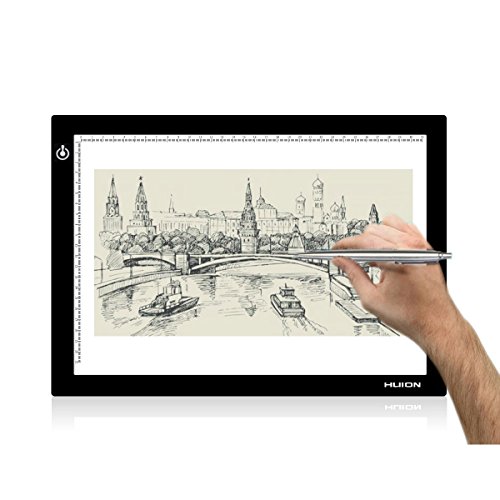
The Huion L4S combines an ultra-slim design with a surprisingly responsive touch interface. Its thinness makes it feel almost like a natural extension of the desk surface, which is a major benefit when you are trying to keep a heavy knitting manual from sliding around.
Its lightweight build doesn’t sacrifice stability, thanks to a base that stays firmly in place during use. The even distribution of light across the pad is excellent for beginners who need a reliable, no-fuss tool that “just works” right out of the box.
Because it is so thin, handle the edges with care when moving it between your knitting basket and your workstation. While portable, the screen surface requires a gentle touch to avoid scratches, so avoid placing heavy ceramic mugs or metal stitch markers directly on the glass.
How to Choose the Right Tracing Light Box
Selecting the ideal tool requires an honest assessment of your workspace and your most common projects. If you are a mobile knitter who prefers to work in various rooms, prioritize a cordless option like the BrightPad Go. If your work is stationary and involves complex, high-detail charts, a larger, corded model with adjustable brightness will offer better long-term value.
Always consider the weight of your project materials. If you are working with thick, heavy charts or cardstock patterns, you need a pad with a sturdy frame that won’t flex under pressure. Look for pads that have non-slip rubber feet to keep your workspace stable as you move your needles and yarn around the surface.
Ultimately, the choice comes down to the trade-off between portability and intensity. Balance the physical space you have available against the complexity of the patterns you typically follow, and select a unit that feels intuitive to use rather than one that requires constant fiddling.
Understanding Brightness and Light Quality
Brightness isn’t just about intensity; it’s about the ability to see the difference between symbols on a page without causing glare. Dimmable lights are superior because they allow you to match the box output to your current room environment, which changes throughout the day.
High-quality LEDs should provide a consistent, flicker-free light source. Flickering is not only annoying, but it can lead to premature eye fatigue—a common complaint for knitters who spend hours counting stitches late into the evening. Aim for “cool” or “neutral” white light temperatures, as these provide the highest contrast against standard black-and-white printed patterns.
If you find yourself constantly squinting at your pattern, it is time to check your light box settings. If the light is too bright, it will wash out the symbols; if it is too dim, you will miss small markers like decreases or yarn-overs. Adjusting the output until the lines are crisp is the secret to accurate, error-free knitting.
Corded vs. Cordless: What’s Best for You?
The decision between corded and cordless often dictates your entire knitting setup. Cordless models provide total freedom of movement, allowing you to knit in a favorite chair or even outdoors, provided the battery is maintained. This is ideal for those who treat knitting as a meditative, relaxed activity.
Corded models, conversely, offer a “plug it in and forget about it” reliability. You never have to worry about a battery dying in the middle of an important lace transition. They are the standard for dedicated “knitting stations” where you keep your patterns, needles, and yarn in a permanent, organized setup.
Evaluate your habits carefully before purchasing. If you often find yourself moving from your desk to the couch, a cordless model will significantly reduce the irritation of dealing with dangling cables. If you value consistency and hate charging devices, a corded unit is the superior, maintenance-free choice.
Light Box Sizing: A3 vs. A4 Explained
The choice between A4 and A3 size is a question of project scope versus physical footprint. A4 is the standard size for most office documents and pattern booklets; it is compact, travel-friendly, and perfect for standard sweater patterns or small accessory charts.
A3 offers double the surface area, which is vital when you are working with full-sized garment schematics or large, multipage lace blankets. Trying to piece together a large chart on a small light box is a recipe for errors, as you will likely miss the connections where the pattern repeats meet at the edges of the light pad.
If you have the desk space, an A3 light box provides significantly more versatility. However, if your knitting space is shared or cramped, the A4 is a perfectly capable tool that handles 90 percent of the patterns most knitters encounter.
By matching the right light box to your specific knitting needs, you transform your pattern-reading experience from a chore into a seamless part of your craft. Whether you prioritize portability or surface area, these tools are investments in accuracy and enjoyment. Choose the model that fits your workspace and your typical project scale to ensure every stitch count is as intended, every single time.