6 Best Leather Sewing Awls For Thick Material Work
Struggling to pierce tough hides? Discover the 6 best leather sewing awls for thick material work and upgrade your crafting toolkit. Shop our top picks today.
Working with thick, heavy materials requires a shift in mindset similar to moving from delicate lace weight mohair to rugged, worsted-spun wool. Just as a project’s structure dictates the choice of needle material and size, leatherwork demands tools capable of piercing through dense layers without buckling. Sewing thick materials requires tools that offer both leverage and precision to ensure every stitch is as secure as a well-tensioned cable. Selecting the right awl is the foundation for creating durable items that hold their shape for years, much like choosing the correct yarn for a sweater ensures it survives decades of wear.
Speedy Stitcher Sewing Awl: Best All-in-One


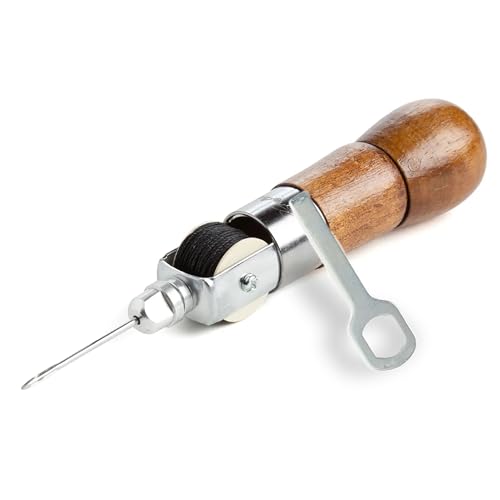
The Speedy Stitcher is the industry standard for those who need a portable, self-contained solution. It functions much like a mechanical sewing machine housed within a handheld wooden handle, making it ideal for field repairs on bags or heavy canvas equipment.
Think of this tool like a circular needle set—it keeps everything you need in one place. The spool of thread is contained directly inside the handle, which simplifies the process of managing tension. It excels when the user needs to stitch through thick webbing or multiple layers of leather where a traditional needle would simply snap.
However, the size of the needle is fixed and relatively large, which may be too coarse for fine leatherwork. It is best suited for utility projects rather than delicate accessories.
C.S. Osborne Stitching Awl: The Pro-Grade Pick

For those committed to the craft, C.S. Osborne tools offer the kind of reliability that comes with long-standing manufacturing traditions. These awls are built to last, featuring blades that hold their edge through rigorous use.
A pro-grade awl is akin to using high-quality nickel-plated needles; the surface is smooth, the taper is precise, and the feel in the hand is balanced. This tool allows for much more control than a mechanical stitcher, providing the sensitivity needed for intricate patterns.
The primary trade-off is that the blade and the handle must be purchased or assembled to fit specific needs. This setup is recommended for those who have moved past the introductory phase and want to refine their stitching technique.
Tandy Leather Awl Set: Top Choice for Beginners
The Tandy Leather Awl set provides a gentle entry point for those just beginning to explore leathercraft. It offers a variety of blades, which allows the user to experiment with different stitch widths and hole shapes.
Beginners often struggle with inconsistent hole spacing, much like a knitter struggling to maintain an even gauge. Having a set with multiple interchangeable heads allows for experimentation without the high cost of a professional-grade individual tool.
Keep in mind that these sets are designed for learning rather than heavy-duty production. They are perfect for small wallets or simple projects but may show wear quickly if used daily on industrial-grade hides.
Aiskaer Awl Tool Kit: Best Budget-Friendly Set

Aiskaer kits are designed for the hobbyist who wants a variety of options without a significant financial investment. These sets usually include several styles of awls, ranging from diamond-point to round-point, covering most common project requirements.
If you are just beginning to build a leatherworking toolkit, this set functions as a “starter kit” similar to a basic collection of bamboo circular needles. It covers the essential bases, allowing the user to understand which blade shape works best for their specific grip.
The steel quality is utilitarian, meaning it may require more frequent honing than more expensive alternatives. It is a smart purchase for those who prefer to “buy once to learn” before committing to heirloom-quality tools.
Barry King Diamond Awl: Ultimate Pro Stitching

A Barry King diamond awl is the equivalent of artisan-made, hand-turned wooden needles; it is an investment in ergonomics and performance. These tools are precision-ground to slide through leather with minimal resistance, creating perfectly shaped diamond holes that allow for a cleaner stitch line.
The diamond shape is critical for professional-looking work, as it leaves a slanted entry hole that allows the thread to sit at an angle. This mimics the look of a traditional saddle stitch, which is the gold standard for strength and aesthetics.
Because this tool is so sharp, it demands a high level of caution and technique. It is the ideal upgrade for someone who has mastered the basics and wants to produce professional-grade goods.
General Tools Scratch Awl: Simple and Versatile
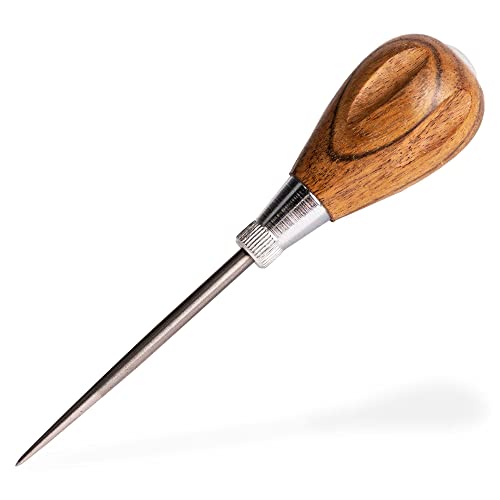
A scratch awl is less about sewing and more about marking, piercing, and guiding. Its simple design makes it an indispensable tool for marking stitch lines or clearing holes before threading a needle.
Think of this tool as the equivalent of a locking stitch marker or a tapestry needle—it isn’t the primary tool, but the project would be significantly harder without it. It is particularly useful for measuring distances and ensuring that layers of thick material remain aligned before the permanent piercing happens.
Do not attempt to use a scratch awl to pull thread through thick leather; that is not its design. Use it to map out your work, and then follow up with a dedicated stitching awl for the actual assembly.
How to Choose the Right Sewing Awl for Your Job
Selecting the right tool depends entirely on the thickness of the material and the desired aesthetic of the stitch. A thicker, diamond-tipped awl is essential for heavy-duty leather, while a finer, round-tipped awl is better for thinner, more delicate hides.
Consider the “stitch density” of the project. If you are aiming for a high SPI (stitches per inch), you need a sharper, more refined blade.
- Thickness: Heavier leather requires a wider, sharper blade.
- Material: Softer leathers may require a finer point to prevent tearing.
- Ergonomics: Ensure the handle fits your grip comfortably to prevent fatigue during long stitching sessions.
Stitching Awl vs. Scratch Awl: Key Differences
It is a common error to conflate the two, but they serve entirely different functions. A stitching awl is designed with an eye or a specific geometry to facilitate the passage of thread, whereas a scratch awl is a pointed rod for marking or punching holes.
Using a scratch awl for stitching will often lead to damaged thread or uneven tension. Conversely, using a heavy-duty stitching awl for light marking will create holes that are far too large for the project’s aesthetics.
Use the scratch awl to establish your path, then rely on the stitching awl to execute the join. This two-step process ensures a clean, professional finish.
Mastering the Lock Stitch With Your Sewing Awl
The lock stitch is to leatherwork what the kitchener stitch is to socks—it is the secure, professional way to join two edges. By using two needles or a single awl-and-needle combination, the threads are intertwined within the material, preventing the entire seam from unraveling if a single loop breaks.
Achieving a consistent lock stitch requires finding your “tension rhythm,” similar to maintaining an even tension when knitting stranded colorwork. If the tension is too loose, the seam will be weak; if it is too tight, you risk tearing the leather.
Practice on scrap pieces of leather of the same weight as your final project. Focus on keeping the awl at a consistent angle throughout the entire length of the seam.
Tips for Maintaining and Sharpening Your Awls
An awl is only as good as its edge. Dull tools require more physical force, which increases the likelihood of slipping and potentially ruining the leather or causing injury.
Periodically hone your awls using a fine-grit sharpening stone. Keep the factory angle consistent; if you change the angle, the tool will lose its ability to pierce effectively.
- Clean: Wipe off oils and debris after every project.
- Hone: Use a leather strop with polishing compound to maintain a razor-sharp edge.
- Store: Keep blades protected in a block or sheath to prevent them from dulling against other tools.
Just as a knitter’s hands find their rhythm with a well-maintained set of needles, the right leather awl will become a natural extension of the craft over time. By balancing the choice of tool with the demands of the material, every project becomes an exercise in precision and durability. Experimenting with different styles and keeping tools properly honed will ensure that every seam is as strong as it is beautiful.