6 Best Replacement Mats For Heavy Duty Craft Projects
Upgrade your workspace with the 6 best replacement mats for heavy-duty craft projects. Read our expert guide to find the perfect durable surface for your needs.
A stable, reliable cutting surface is just as essential to a project’s success as choosing the right needle material for a specific fiber. Whether prepping fabric for a quilted project bag or trimming patterns for hand-knitted garment construction, a quality mat prevents damage to work surfaces and extends the life of cutting blades. Precision in preparation mirrors the precision required for maintaining consistent gauge in lace or colorwork. Selecting the right mat minimizes frustration, ensuring that tools stay sharp and the workspace remains efficient.
OLFA RM-SG Self-Healing Rotary Mat: Best Overall


The OLFA RM-SG is the industry standard for a reason. Its unique self-healing polymer surface allows rotary cutter blades to sink into the mat, closing the gap behind the blade immediately to provide a smooth, continuous surface.
This mat excels for those who frequently cut heavy-weight fabrics or backing for complex fiber projects. Because it stands up to repeated, high-pressure passes from a rotary blade, it maintains its integrity far longer than generic alternatives.
The double-sided design, featuring a solid color on one side and grid lines on the other, offers versatility. Use the grid for precise measuring during fabric prep and the solid side for clean, undisturbed cutting.
Fiskars Self-Healing Cutting Mat: Best for Fabric

Fiskars mats are engineered with a focus on fabric-specific tasks, making them the go-to choice for quilters and garment makers. The grid markings are exceptionally clear, which is vital when you need to align fabric grainlines perfectly before making a cut.
The surface has just the right amount of “grip” to prevent fabric from shifting during the cutting process. This is particularly useful when dealing with slippery fibers like silk or loosely woven linens that might otherwise slide under the blade.
While these mats are robust, avoid using them with heavy-duty utility knives. Stick to rotary cutters for the best results, as the surface is specifically formulated to accommodate the rolling action of a blade without excessive wear.
Dahle Vantage Self-Healing Mat: Most Durable
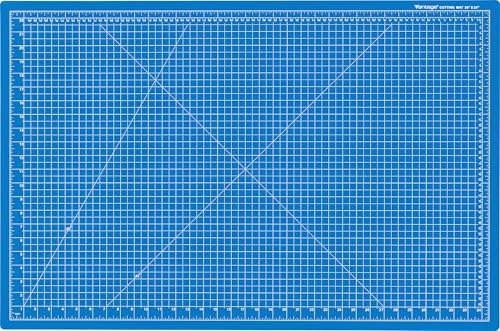
Durability is the primary selling point for the Dahle Vantage, which utilizes a five-layer construction designed for high-volume use. If you are a prolific maker who spends hours every week trimming materials, this mat will resist deep gouges that can snag a blade.
The surface is slightly firmer than other options, providing a stable platform for precision work. This firmness prevents the blade from skipping, which is critical when you are cutting complex templates or multiple layers of fabric.
It features a non-slip backing that keeps it securely in place on a table. For makers who move between different stations or need a reliable base for heavy-duty cutting, this structural stability is an invaluable asset.
US Art Supply Large Self Healing Mat: Budget Pick

Budget-friendly options often sacrifice thickness, but the US Art Supply mat provides a surprising amount of quality for the price. It offers a standard self-healing surface that performs adequately for light-to-medium craft projects.
This mat is an ideal entry point for makers just starting to build their toolkit. It provides necessary protection for the desk without the high investment required for professional-grade gear.
However, be mindful of heat sensitivity. Never place a hot iron or a blocking board near this mat, as the material can warp easily under high temperatures. Keep it flat at all times to ensure its longevity.
Cricut Self-Healing Mat: For Die-Cut Machine Users
The Cricut self-healing mat is specifically tailored for those who integrate digital cutting machines with manual craft work. Its surface is optimized to work in tandem with the tools found in a modern, automated studio.
Even if you do not own a die-cutting machine, this mat is excellent for manual trimming. It is thin, lightweight, and easy to store, making it a perfect choice for small studio spaces where gear must be packed away after every session.
Because it is thinner than industrial mats, it is not recommended for heavy-duty crafting with thick knives. Stick to light-duty rotary cutters or precision craft blades for the best performance and surface longevity.
Alvin Professional Self-Healing Mat: Pro Choice
The Alvin Professional series is built for those who demand long-term consistency in their measurements. These mats are thicker than standard versions, which adds a significant layer of cushioning that protects both the blade and the underlying table.
The grid markings are printed with high-contrast inks, ensuring they remain visible even after years of use. This is crucial for precise alignment when working on structured projects that require absolute accuracy.
This mat is an investment piece for the dedicated maker. When cared for properly, it resists warping and retains its healing properties through thousands of cuts, providing a professional-grade foundation for any workshop.
How to Choose the Right Size Mat for Your Space
Selecting the right mat size is a balance between your available workspace and the scale of your projects. A mat that is too small forces you to reposition materials frequently, which increases the chance of cutting errors.
Measure your table surface first. Ensure that you have at least two inches of clearance on all sides of the mat so that your rotary cutter does not run off the edge and damage your furniture.
For most garment or large craft projects, an 18″ x 24″ mat is the functional minimum. If your space allows, a larger 24″ x 36″ mat provides the freedom to work with large fabric panels without folding or bunching, keeping your cuts square and accurate.
What Does “Self-Healing” Really Mean for a Mat?
“Self-healing” is a marketing term that describes a high-density, multi-layer vinyl or polymer construction. The material is designed to be soft enough for a sharp blade to penetrate but resilient enough to pull itself back together after the blade passes through.
No mat truly “heals” like skin. Instead, the material compresses and closes the gap, which prevents the blade from getting caught in previous cut marks. This action also keeps the blade sharper for longer by avoiding contact with hard substrates.
Over time, these mats will eventually show wear. When they reach the end of their lifespan, the cuts will stay open and the surface will become uneven. Regular rotation of the cutting area, rather than using the same center spot, will extend the life of the surface significantly.
Tips to Keep Your Cutting Mat Flat and Lasting
Storage is the single most important factor in the lifespan of a cutting mat. Always store the mat lying perfectly flat. Folding, rolling, or leaning it against a wall will cause permanent warping, making it impossible to achieve an accurate cut.
Avoid extreme temperature changes. Never store your mat near a radiator, in a sunny window, or in a hot car. Heat causes the plastic compounds to expand and buckle, which is an irreversible form of damage.
Clean the mat periodically with mild soap and a soft cloth to remove dust and fabric fibers. These particles can get lodged in the “healed” cuts and eventually dull your blades prematurely.
Rotary Cutters vs. Craft Knives: What Mat to Use
Rotary cutters and craft knives exert force differently on a mat. A rotary cutter uses a rolling, slicing motion that works in harmony with the self-healing properties of a mat. Always use a rotary cutter with a dedicated self-healing mat to protect the blade’s edge.
Craft knives, such as a hobby blade or utility knife, use a dragging motion that is more likely to create deep, permanent gouges. While a self-healing mat can handle the occasional knife cut, excessive use will destroy the surface much faster than a rotary cutter will.
If you must use a heavy craft knife, consider a glass or metal cutting board if the project involves deep scoring or repetitive heavy-duty cuts. For general fiber and fabric prep, stick to the rotary cutter and a self-healing mat to keep both your tools and your workspace in pristine condition.
Choosing the right cutting mat is an essential step in professionalizing a workspace and protecting the investment made in high-quality tools. By matching the mat’s durability and surface features to the specific demands of your craft, you ensure that every project begins with precision and care. Proper maintenance and storage will guarantee that your chosen mat remains a reliable partner for many years of creation.