6 Best Mixing Spatulas For Consistent Texture
Achieve perfect, consistent texture in your kitchen with our top 6 picks for the best mixing spatulas. Read our expert review and upgrade your baking tools today.
Achieving professional-grade saturation in hand-dyed yarn requires more than just high-quality pigments; it demands precision in mixing. Inconsistent dye baths often lead to “breaking,” where pigments separate unexpectedly, or uneven color distribution that ruins the intended tonal effect. By using the right mixing spatula, fibers absorb dye evenly from the start, ensuring your final skeins are perfectly uniform. This guide explores the essential tools for maintaining that critical consistency throughout the dyeing process.
GIR Ultimate Spatula: The Dye Studio Workhorse


The GIR Ultimate Spatula is widely regarded as the gold standard for heavy-duty studio use. Its single-piece, BPA-free silicone construction eliminates the crevices where dye residue typically hides, preventing cross-contamination between batches.
Because it is molded over a rigid fiberglass core, it provides the structural integrity needed to break up stubborn clumps of powdered dye. If you are mixing concentrated pigments for a gradient set, this tool ensures every granule is fully incorporated into the liquid.
The trade-off for this durability is a slightly heavier weight compared to standard kitchen spatulas. However, the ergonomic grip provides excellent control, which is vital when you are meticulously measuring dye stock for complex colorways.
OXO Good Grips Silicone Spatula: Best Budget Pick
The OXO Good Grips Silicone Spatula balances affordability with the essential heat resistance required for studio work. While it lacks the single-piece construction of premium models, its silicone head is soft enough to scrape the sides of mixing containers effectively.
This model is a stellar choice for beginners who are just starting to experiment with immersion dyeing. It handles basic acid dye preparations with ease, allowing for smooth, swirl-free mixtures that prevent streaks in your yarn.
Be aware that the junction between the head and handle can accumulate pigment over time. Regular, thorough cleaning is necessary to ensure that hidden dye particles do not bleed into subsequent, potentially lighter-colored batches.
Di Oro Seamless Series Spatula: For Smooth Pastes
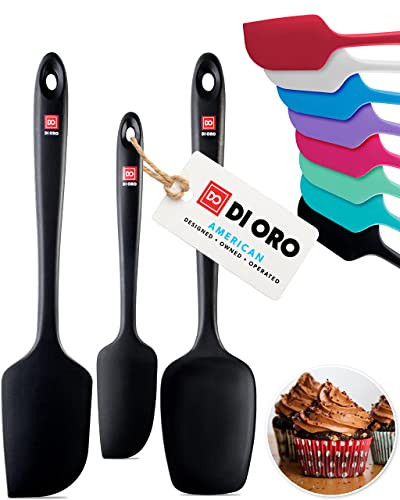
The Di Oro Seamless Series is designed with a specific focus on hygiene and ease of movement. Its seamless design makes it an ideal choice for crafters who switch frequently between different dye stocks and cannot afford the risk of lingering color.
The edges of this spatula are particularly effective at dragging through viscous dye pastes. When preparing thick stock solutions, the flex-core technology allows the head to conform to the curvature of your mixing vessel, leaving zero wasted pigment behind.
This tool shines when you are working with delicate color palettes where precision is paramount. By ensuring a perfectly smooth mix, it minimizes the risk of concentrated dye spots appearing during the final yarn saturation process.
Le Creuset Revolution Spatula: Premium Durability
Le Creuset tools are engineered for extreme conditions, making them a long-term investment for the serious fiber artist. The blade is stiff enough to handle thick mordant pastes while remaining gentle enough to avoid scratching delicate enamel or plastic mixing bowls.
The professional-grade silicone is non-porous and resists staining, which is a major advantage when working with highly potent, deeply saturated pigments. Even after extended exposure to acidic dye baths, the material maintains its integrity and color-neutral state.
While the price point is higher, the longevity of this spatula often outweighs the initial cost. For those who dye yarn in high volumes, the comfort of the wooden handle and the durability of the head make for a superior user experience.
Norpro Mini Spatula Set: Ideal for Small Batches
Mini spatulas are often overlooked, yet they are indispensable when mixing dyes for small test skeins or samples. When you are testing a new colorway, mixing in a large container with a standard tool leads to unnecessary waste and potential inaccuracy.
These compact tools allow for precise stirring in small glass beakers or jars. They reach into corners that wider spatulas simply cannot access, ensuring that even a tiny volume of dye is perfectly homogenous before it touches your fiber.
Because they are small, they are also incredibly easy to clean and sanitize between color changes. Keep a set in your studio for those moments when you are tweaking subtle hues or working with limited-edition luxury fibers.
U-Taste High Heat Spatula: For Heated Dye Baths
When using the stovetop method or working with large, heated dye pots, heat resistance is non-negotiable. The U-Taste High Heat Spatula is designed to withstand temperatures that would cause cheaper plastics to melt or warp.
The rigidity of the handle is particularly useful when stirring large pots filled with water and heavy yarn skeins. It provides the leverage needed to ensure even dye penetration throughout the fiber without requiring excessive physical exertion.
If you are a fan of using heat-set techniques for superwash wool, this spatula will be your primary studio assistant. Its performance remains consistent even when submerged in near-boiling dye baths for extended periods.
What to Look For in a Dye-Mixing Spatula
Selecting a spatula is about matching the tool to your specific dye process. A good mixing spatula should be heat-resistant, non-porous, and rigid enough to incorporate powders without snapping under pressure.
- Heat Resistance: Always look for tools rated for at least 450°F if you intend to use them in heated dye pots.
- Seamless Design: One-piece tools are the best defense against stubborn, cross-contaminating dye buildup.
- Size: Have both a large spatula for bulk dyeing and a mini version for sample testing on hand.
- Material Strength: Avoid flimsy plastic; look for a metal or fiberglass core encased in food-grade silicone.
Prioritize tools that are easy to clean, as residue is the enemy of color accuracy. If a spatula shows signs of staining or degradation, it is time for a replacement to protect your future yarn projects.
Silicone vs. Metal: Which Spatula is Best?
Silicone is the preferred material for most fiber artists due to its flexibility and non-scratch properties. It cleans easily, does not react with acidic dye components, and conforms to the shape of various mixing containers.
Metal spoons or spatulas are technically more durable but pose a risk to the interior finish of your mixing equipment. Furthermore, certain metallic surfaces can theoretically react with specific chemical mordants, potentially altering the intended color outcome.
For the vast majority of dyeing applications, silicone is the superior choice. It offers the perfect middle ground between the rigidity required for mixing and the flexibility required for scraping every drop of color from your bowl.
Keeping Tools Clean to Avoid Dye Contamination
Dye contamination occurs when microscopic pigments trapped in the pores or crevices of a tool leach into a new batch. To prevent this, always soak your spatulas in a mild bleach solution or specialized studio cleaner immediately after use.
Check the edges of your spatulas regularly for signs of wear, such as tiny nicks or cracks in the silicone. These small imperfections are breeding grounds for dye particles that water cannot reach, eventually leading to mysterious color bleeds.
If a tool has been used with a particularly potent color, such as a deep navy or black, consider dedicating it exclusively to those hues. This simple organizational step significantly reduces the stress of cleaning and protects your lighter, more delicate colorways.
Spatula Shape: Does It Really Matter for Mixing?
Spatula shape directly influences how efficiently you can incorporate pigments into your dye stock. A square-edged spatula is excellent for scraping the flat bottom of a container, ensuring no dry powder remains trapped in the corners.
Rounded or curved edges are better suited for circular vessels, allowing for a smooth stirring motion that encourages uniform mixing. If you frequently switch between different containers, a spatula with one rounded side and one straight edge offers the most versatility.
Ultimately, the shape should match your vessel to minimize wasted dye and time. By choosing a spatula that fits the geometry of your mixing routine, you ensure that the consistency you achieve in the beaker carries through to the finished, dyed yarn.
Choosing the right mixing spatula is a small but critical step in the journey of creating consistent, professional-quality hand-dyed yarn. By prioritizing material quality, hygiene, and the right geometry for your specific dye vessels, you eliminate unnecessary variables in your craft. Invest in tools that handle your pigment mixing with precision, and your results will reflect that attention to detail. With these tools in your studio, you are well-equipped to maintain color integrity from the first mix to the final rinse.