
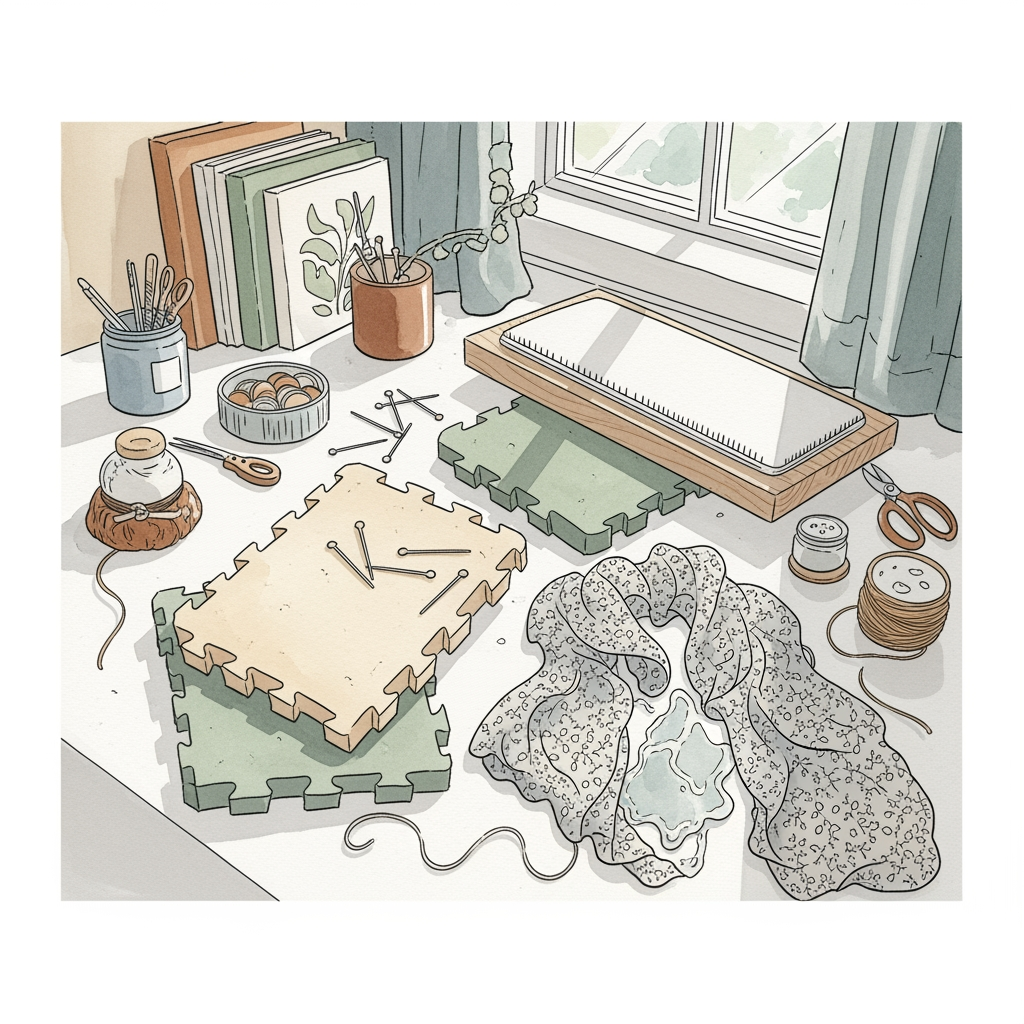
6 Best Blocking Grids For Symmetrical Patterns
Master symmetrical patterns with these 6 essential blocking grids. Learn how to achieve precise alignment and professional finishes for your textile projects.
Achieving perfect symmetry in lace or complex geometric colorwork is impossible without a reliable foundation. Blocking mats aren’t just foam squares; they are the architectural blueprints for your finished garment. Choosing the right grid ensures your hard-earned stitches settle into their intended shape with professional precision. This guide breaks down the best tools to help you transform a crumpled swatch into a masterpiece.
KnitIQ Blocking Mats: Best Overall for Precision
When you have spent weeks on a complex, symmetrical lace shawl, you need a surface that doesn’t lie to you. KnitIQ mats are the gold standard because they feature a printed grid system that is consistently accurate across every tile.
Many generic mats have patterns that drift or fade, leading to skewed blocking. These mats offer a crisp, reliable visual guide that allows you to count squares and ensure your edges are perfectly perpendicular.
The density of the foam is also a major factor here. It is firm enough to hold T-pins securely without them wobbling, yet soft enough that you aren’t fighting the material to insert your pins. If you value professional-grade results, these are the mats that won’t let you down.
Knitter’s Pride Lace Blocking Mats: Best Value
If you are a prolific knitter who needs to block multiple projects at once, you need a large surface area without breaking the bank. Knitter’s Pride mats provide a generous amount of coverage at a price point that makes stocking up easy.
The tiles interlock smoothly, creating a seamless surface that prevents your delicate lace from snagging on gaps. While they might be slightly less dense than premium options, they hold pins well for standard blocking tasks.
These are ideal for the knitter who frequently works on larger items like blankets or heavy cowls. You get the utility of a professional grid system without the premium price tag.
Cocoknits Blocking Mats: Best Eco-Friendly Pick


Not every knitter wants to work on standard EVA foam, which can have a strong chemical smell and a heavy environmental footprint. Cocoknits offers a unique solution by using natural, sustainable materials that feel better under your hands.
These mats are designed with a neutral, sophisticated aesthetic that looks great in your home studio. They are particularly well-suited for knitters who are sensitive to the off-gassing often found in cheaper foam products.
The trade-off is that they are generally firmer and require a specific pinning technique to ensure the pins stay anchored. If you prioritize sustainability and a clean workspace, these are worth the investment.
Boye Interlocking Foam Mats: Best Budget Option

Sometimes you just need a functional surface for basic blocking and don’t want to overthink the purchase. Boye mats are the classic, no-frills choice found in almost every local craft store across the country.
They get the job done for simple scarves or basic blocked sweaters. While the grid lines may not be as precise as high-end alternatives, they are more than sufficient for general shaping and steam blocking.
Don’t expect them to last a lifetime, but for the beginner or the occasional knitter, they represent a solid entry point. They are easy to store and replace if they eventually wear down from heavy use.
Exquiss Extra Thick Blocking Mats: Best Stability
If you work with heavy-weight fibers like wool-alpaca blends or bulky cables, you know that standard, thin mats can warp or fail to hold deep tension. Exquiss mats offer extra thickness, which provides superior stability when you need to really stretch your fabric.
The increased depth of the foam allows for deeper pin penetration. This means your pins stay vertical even when you are applying significant tension to stubborn, non-superwash wools.
This is a game-changer for heavy garments that require aggressive blocking to open up the stitch definition. While they take up more storage space, the stability they offer is unmatched for heavier projects.
Clover Blocking Mats: Best for Small Projects
For the sock knitter or the maker who focuses on small accessories, a giant wall of mats is often overkill. Clover provides smaller, highly portable tiles that are perfect for targeted blocking.
These are excellent for blocking individual lace motifs, swatches, or delicate baby items. Their compact size means you can set them up on a small side table rather than clearing off a massive dining room table.
They are precision-engineered with the quality you expect from a brand that understands needlework. If your workspace is limited, these small-format mats are a lifesaver.
Why Symmetrical Patterns Require Precise Blocking
Symmetry is fragile; one loose stitch or a slightly uneven tension point can ruin the visual balance of a pattern. When you block a symmetrical piece, you are essentially "training" the yarn to hold a specific geometry.
Without a grid, you are guessing at the proportions of your work. A grid allows you to measure from the center point outward, ensuring that the left side of your shawl is an exact mirror of the right.
This is particularly critical for intricate lace where the "openness" of the pattern is defined by the tension of the blocking wires or pins. A consistent grid is the only way to guarantee that your final result matches the designer’s intent.
How to Choose the Best Grid Size for Your Lace
Grid size is not just a preference; it is a tool for measurement. If you are working on fine-gauge lace, a smaller grid increment is essential for measuring subtle increases and decreases.
- 1-inch grids: Best for bulky items or standard garments where general shaping is the goal.
- 0.5-inch grids: Ideal for lace, cables, and small-gauge projects where every quarter-inch matters.
Always consider the scale of your project before purchasing. If you are knitting delicate lace on 2.0mm needles, a large grid will leave you guessing; a finer grid provides the resolution you need to see your progress clearly.
Essential Tips for Perfect Blocking Alignment
Start by finding the center of your project and pinning it to the center of your grid mat. This ensures that any adjustments you make to the edges are balanced equally across the entire piece.
Always use rust-proof pins to avoid staining your yarn, especially if you are using light-colored, natural fibers like silk or cotton. When pinning, go in at an angle rather than straight down; this creates more tension and prevents the pin from popping out of the foam.
- Measure twice, pin once: Use a measuring tape to verify the distance from the center to the edge.
- Don’t over-stretch: Let the fiber tell you how far it wants to go; forcing it can distort the stitch pattern permanently.
- Check the corners: Ensure your right angles are truly square by lining them up with the grid lines.
Maintenance Guide for Your Blocking Grid Mats
Your mats will last much longer if you treat them as part of your toolkit rather than disposable foam. After every blocking session, wipe them down with a damp cloth to remove any excess water or fiber residue.
Store them in a cool, dry place away from direct sunlight, which can cause the foam to become brittle over time. If your mats interlock, try to keep them connected in a flat stack to prevent the edges from warping or curling.
Avoid using harsh chemicals or abrasive cleaners, as these can degrade the surface and make the grid lines fade. With simple care, a good set of mats will remain a reliable partner for your knitting projects for many years.
Investing in a high-quality blocking grid is one of the most significant upgrades you can make to your knitting practice. It bridges the gap between a handmade object and a professional-looking garment. Choose the mat that fits your project scale, keep your pins rust-proof, and always trust the grid. Your future self will thank you when you unpin that perfectly symmetrical shawl.
