6 Best Digital Calipers For Yarn Thickness Tested
We tested six digital calipers to measure yarn thickness accurately. Discover our top picks for precision and ease of use in your next fiber craft project.
Every knitter knows the frustration of starting a project only to realize the yarn doesn’t match the pattern’s suggested weight. While labels provide a general category, they often fail to capture the subtle variations in twist and fiber density that dictate your final gauge. Using a digital caliper allows you to move beyond guesswork and quantify exactly what you are working with. Here are six tools that can help you achieve professional-level consistency in your fiber arts projects.
Mitutoyo 500-196-30: The Gold Standard Precision


When you handle high-end fibers like hand-dyed silk or fine cashmere, you want a tool that doesn’t second-guess your measurements. The Mitutoyo is the industry benchmark for a reason, offering an absolute scale that keeps your zero-point even after the unit powers down.
In a studio setting, this level of precision is invaluable for calculating the exact diameter of luxury plied yarns. If you are designing your own patterns or spinning your own fiber, this tool eliminates the margin of error that cheaper sensors often introduce.
It is an investment piece, certainly, but for the serious designer, it is the last caliper you will ever need to buy. Its build quality ensures that even after years of being tossed into a project bag, the jaws remain perfectly aligned.
iGaging IP54 Digital Caliper: Best Value Pick

Most knitters don’t need aerospace-grade instruments, they just need something that won’t fail when they are checking their stash. The iGaging IP54 strikes a fantastic balance, offering splash and dust resistance that is perfect for a busy craft room.
The IP54 rating is particularly helpful if you tend to keep your tools near your dyeing station or humid yarn storage. It provides a clear, large display that is easy to read even when your eyes are tired from a long night of lace knitting.
While it lacks the absolute scale of more expensive models, it is more than accurate enough for standard worsted or fingering weight yarns. It is the reliable "workhorse" tool that belongs on every knitter’s workbench.
Neiko 01407A Electronic Caliper: Durable Choice
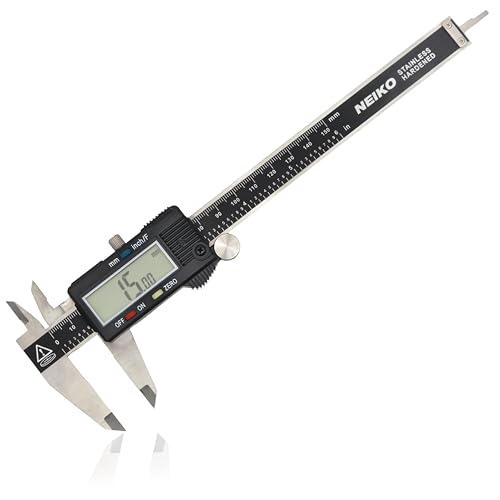
If you are the type of knitter who keeps a tool kit in your knitting bag for emergencies, the Neiko 01407A is built to handle the travel. Its stainless steel construction feels substantial in the hand and resists the accidental dings that happen during travel.
I appreciate how smoothly the thumb roller operates on this model, allowing for a steady, controlled closing force. This is vital when measuring delicate, lofty wools that compress easily; you want to touch the fiber without squashing the loft.
It is a straightforward, no-nonsense tool that does exactly what it promises without unnecessary bells and whistles. It’s a solid, durable choice for the knitter who values utility over aesthetics.
Hornady Digital Caliper: Great for Yarn Texture

Originally designed for reloading, the Hornady caliper is surprisingly adept at measuring the texture of novelty or hand-spun yarns. Because it is built for high-precision mechanical work, its jaws are exceptionally thin, allowing you to isolate specific sections of a textured yarn.
When you are working with slub or boucle yarns, measuring the "average" thickness can be deceptive. The thin jaws of this tool allow you to measure the thin spots and the thick spots separately, helping you understand how the yarn will behave in a finished fabric.
Be mindful that its sensitivity can be a double-edged sword; it will pick up every tiny variation in your spin. Use it to get a "snapshot" of your yarn’s character rather than just a single number.
Vinca DCLA-0605 Digital Tool: Accuracy Leader

The Vinca DCLA-0605 is renowned for its high-resolution display, which provides measurements in fractions and decimals. For a knitter who is constantly converting between metric and imperial systems, this saves a significant amount of mental math.
This tool is particularly helpful when you are trying to match a discontinued yarn to a modern substitute. By measuring the diameter of the original yarn to the thousandth of an inch, you can find a replacement that will yield the same drape and structure.
It is an incredibly accurate device that rewards careful, steady handling. If you are a stickler for gauge and want to ensure your swatches match the pattern exactly, this is your best ally.
Adoric Digital Caliper: Best Budget Option

If you are just beginning to experiment with measuring your yarn, you don’t need to break the bank. The Adoric is a simple, user-friendly digital caliper that is perfect for learning the ropes of yarn sizing.
It is lightweight and easy to carry, making it a great addition to a basic knitting kit. While it may not have the long-term durability of the Mitutoyo, it is more than sufficient for checking WPI (Wraps Per Inch) and basic diameter measurements.
For a beginner or a casual knitter, this tool provides the "aha!" moment of seeing just how much your yarn varies in thickness. It is an affordable entry point into the technical side of knitting.
Why Knitters Need Calipers for Yarn Weight
Yarn labels are often misleading because they rely on broad categories like "DK" or "Worsted," which can vary wildly between brands. A caliper allows you to see the actual diameter of the fiber, which is a much more reliable indicator of how the yarn will interact with your needles.
- Consistency: Ensure your yarn matches the pattern gauge before you cast on.
- Substitution: Find accurate modern replacements for vintage or discontinued yarns.
- Spinning: Monitor your singles to ensure a consistent weight throughout your bobbin.
By quantifying your yarn, you take the guesswork out of your projects. You will spend less time swatching and more time knitting with confidence.
How to Measure Yarn Diameter Without Tension
The biggest mistake knitters make when using a caliper is applying too much pressure to the jaws. Yarn is a compressible material, and if you squeeze it, you will get a measurement that is significantly smaller than the yarn’s actual loft.
- The Light Touch: Close the jaws until they just barely graze the yarn fibers.
- Multiple Samples: Take at least five measurements along a length of yarn to find an average.
- Avoid Stretching: Ensure the yarn is lying flat and is not under any tension while measuring.
Treat the yarn like a living thing. If you compress the air out of the twist, you aren’t measuring the yarn—you’re measuring the density of the fiber itself.
Understanding WPI and Caliper Measurements
WPI (Wraps Per Inch) is a classic, low-tech way to determine yarn weight, but it is subjective based on how tightly you wrap the yarn around the tool. A digital caliper provides an objective measurement that removes the "human factor" from the equation.
While WPI is great for a quick estimate, a caliper gives you a precise numerical value that you can track over time. If you find that a WPI of 12 corresponds to a diameter of 2.5mm for your favorite wool, you have created a personal standard that you can rely on for every future project.
Use the caliper to calibrate your WPI tool. Once you know the exact diameter of your "standard" yarns, you can eyeball other yarns with much higher accuracy.
Essential Tips for Consistent Yarn Sizing
Consistency is the secret to a professional-looking garment. When measuring, always try to work in a well-lit area and keep your tool on a flat, stable surface to prevent accidental movement.
- Clean the Jaws: Dust or fiber bits trapped in the jaws will throw off your reading.
- Zero Before Use: Always ensure the caliper reads 0.00 when the jaws are fully closed.
- Record Your Data: Keep a small notebook with your yarn measurements and the resulting gauge swatches.
Remember that fiber content changes everything; a cotton yarn will measure very differently than a lofty, woolen-spun alpaca, even if they are both "DK" weight. Always measure the specific yarn you are using for the project, not just a generic sample.
Mastering the technical side of your craft doesn’t make it any less artistic; it simply gives you the freedom to execute your vision with precision. A digital caliper is a small, humble tool that can save you hours of wasted effort and provide deep insights into your favorite materials. Start measuring your stash today, and watch how much more predictable and enjoyable your knitting process becomes.