7 Best Gauge Rulers For Calculating Stitch Density
Master your knitting precision with our top 7 gauge rulers. Learn how these essential tools help you calculate stitch density for perfectly sized garments.
Achieving the perfect fit in a hand-knit garment begins long before you pick up your needles. While many knitters view gauge as a tedious chore, it is actually the bridge between a dream project and a wearable reality. Mastering your stitch density ensures that your hard work doesn’t end up as a sweater that’s either two sizes too big or stiff as a board. These seven tools are the industry standards for keeping your tension consistent and your measurements precise.
Cocoknits Maker’s Keep Gauge Ruler: Best Overall


This tool is a masterclass in thoughtful design, combining a sturdy gauge ruler with a magnetic snap-back base. If you are prone to losing your stitch markers in the couch cushions, this tool keeps them tethered right where you need them.
The ruler itself features a clear, centered window that makes counting stitches over four inches incredibly intuitive. It eliminates the "eyeballing" errors that often happen when you try to align a standard office ruler with your knitting.
Because it is made of a durable, bio-composite material, it feels substantial in the hand without being heavy. It is the best choice for the knitter who wants a permanent, reliable companion for every project in their queue.
ChiaoGoo Needle Gauge and Ruler: Most Durable
When you need a tool that can survive the bottom of a project bag, the ChiaoGoo stainless steel gauge is the gold standard. It doesn’t bend, snap, or warp, even if it gets buried under a heavy stash of wool.
The etched markings are permanent, meaning you won’t have to worry about the numbers rubbing off after a few years of heavy use. It provides both metric and US needle sizing, which is essential if you frequently switch between imported and domestic needle brands.
The trade-off here is the weight; it is significantly heavier than plastic alternatives. However, for the knitter who values longevity and precision over portability, this is an investment that will last a lifetime.
Susan Bates Knit Chek Tool: The Classic Choice
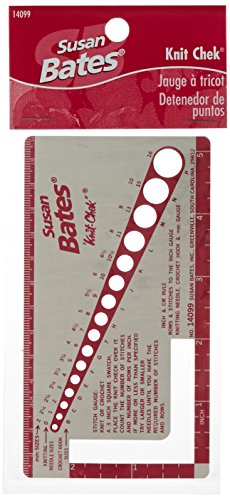
The Knit Chek is a staple in almost every knitting bag for a reason: it is simple, effective, and incredibly affordable. This small, lightweight tool combines a needle gauge and a stitch counter in one compact plastic frame.
It is particularly useful for beginners who are still learning to identify needle sizes by eye. The cutouts for measuring needle diameter are accurate and easy to navigate, even in low-light conditions.
While the plastic can eventually become brittle with age, its price point makes it an easy item to replace. It is the perfect "keep-one-in-every-bag" tool for knitters who move between projects frequently.
Clover Knitting Needle Gauge: Best for Beginners
Clover’s gauge is designed with high-contrast, easy-to-read numbers that remove the guesswork from measuring. For a new knitter, the most frustrating part of gauge is simply seeing the tiny increments; this tool makes those numbers pop.
The material is a smooth, flexible plastic that won’t snag your delicate mohair or hand-dyed silk yarns. It is gentle on your materials, ensuring that you don’t accidentally split a ply while checking your work.
It is an excellent educational tool, as it clearly lays out the relationship between needle size and stitch density. If you are just starting your journey, this is the most user-friendly entry point into the world of gauge management.
Katrinkles Wooden Gauge Ruler: Best Ergonomics

Katrinkles brings a tactile, artisanal feel to the technical process of measuring. Made from sustainable wood, these rulers offer a warm, grippy surface that feels much more natural to handle than cold metal or slick plastic.
The laser-cut edges are precise, allowing you to get right up against your fabric for an accurate count. They are also incredibly lightweight, making them ideal for knitters who struggle with hand fatigue or joint pain.
Because they are made of wood, they are susceptible to moisture and should be kept away from damp blocking mats. They are the top pick for knitters who prioritize aesthetics and comfort during their crafting sessions.
Boye Aluminum Knitting Gauge: Top Budget Pick
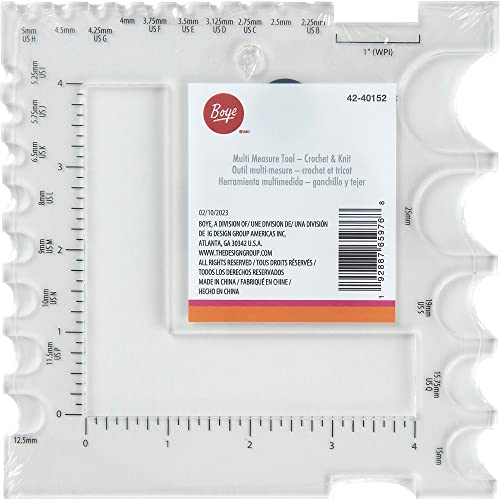
The Boye aluminum gauge is a no-nonsense, utilitarian tool that gets the job done without any bells or whistles. It is thin, flat, and slides easily into the pocket of a knitting case or between the pages of a pattern book.
While it lacks the modern design features of newer tools, its simplicity is its greatest strength. It is essentially indestructible under normal use and provides a reliable, standard measurement for both needles and stitches.
If you are a minimalist knitter who doesn’t want to carry extra bulk, this is your best option. It proves that you don’t need expensive gadgets to achieve professional-level accuracy.
Knitter’s Pride Mindful Gauge: Best Precision

The Mindful collection is designed with a focus on meditative, accurate practice, and this gauge reflects that philosophy. It is exceptionally well-calibrated, offering precise measurements that cater to the needs of advanced, detail-oriented knitters.
The finish is smooth and professional, designed to sit flat against your swatch without slipping. It is particularly useful for complex projects like lace or cables, where even a half-stitch difference can ruin the final drape of the garment.
It is a premium tool for those who treat their knitting as a precise science. If you are tackling high-stakes projects with expensive yarn, this gauge provides the peace of mind you need.
Why Accurate Gauge Is Critical for Your Project
Gauge is the mathematical foundation of your sweater, hat, or socks. If your stitch density is off, the physical dimensions of your finished item will deviate from the pattern’s intended size, often leading to a garment that doesn’t fit correctly.
Many beginners assume that if they use the needles recommended on the yarn label, their gauge will be correct. This is a common misconception; your personal tension, the specific fiber content, and even your mood can change how you knit.
Always remember that yarn behaves differently based on its ply and twist. A superwash wool will grow significantly after washing, while a plant fiber like linen or cotton may shrink or remain rigid.
How to Properly Use a Ruler for Stitch Density
To measure correctly, you must first block your swatch exactly as you intend to block your finished garment. A swatch measured while it is still "fresh" off the needles will rarely match the final density of a washed and dried piece.
Lay your ruler flat against the center of the swatch, avoiding the edges where the tension is often distorted. Count the number of stitches within a four-inch span, noting any half-stitches as you go.
If your count is higher than the pattern calls for, you have too many stitches per inch, meaning your fabric is too tight. If your count is lower, your fabric is too loose and you should consider going down a needle size.
Essential Tips for Measuring Swatches Correctly
- Always swatch in the round if your project is worked in the round, as many knitters have different tensions for knit and purl stitches.
- Use a dark background behind your swatch to make the individual stitches stand out more clearly.
- Measure multiple areas of the swatch to ensure your tension is consistent across the entire piece.
- Don’t stretch the fabric while measuring; let it lay in its natural, relaxed state to get a true reading of the drape.
Investing in a reliable gauge ruler is one of the most impactful decisions you can make for your knitting practice. By removing the uncertainty of stitch density, you gain the freedom to focus on the joy of the craft rather than the anxiety of a poor fit. Choose a tool that fits your personal style and keep it close, because every great garment begins with a perfectly measured swatch.