
6 Best Rivet Setters For Bag Hardware To Try
Upgrade your leathercraft with the 6 best rivet setters for bag hardware. Discover our top-rated tool recommendations and elevate your professional finish today.
Adding professional-grade hardware to a hand-knitted bag or a hand-woven tote elevates a project from a simple craft to a polished accessory. While stitches and gauge are the foundation, the structural integrity of the finish depends on how securely the hardware is fastened. Choosing the right rivet setter ensures that leather straps, magnetic closures, and bag feet stay firmly in place without damaging delicate fabrics. Selecting the proper tool bridges the gap between a fragile handmade item and a durable, functional piece of gear.
Tandy Deluxe Rivet Setter: Best Overall Kit


The Tandy Deluxe Rivet Setter provides the most reliable foundation for those who regularly incorporate leather components into their textile projects. It comes with a modular base and interchangeable heads, which accommodate various sizes of rivets commonly used in bag construction.
Unlike basic, one-size-fits-all tools, this kit offers precision that prevents the metal from deforming or scratching during installation. When working with heavy-duty fabrics like canvas or dense wool felt, having a set that won’t slip is vital for maintaining a clean, professional aesthetic.
This is the standard choice for makers who prioritize consistency across multiple projects. If the goal is a look that mirrors high-end boutique accessories, this kit provides the control necessary to achieve it.
Dritz Double Cap Rivet Tool: Best for Beginners
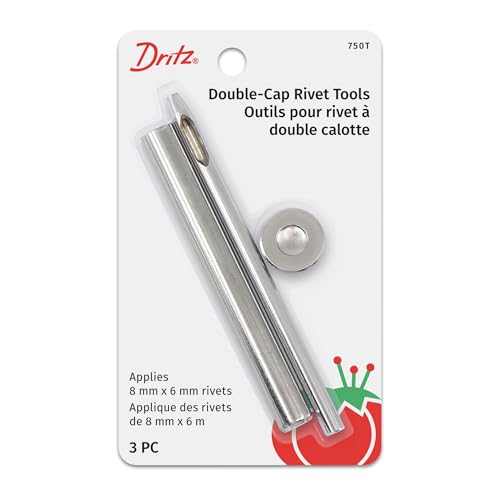
For the knitter just starting to add hardware to finished projects, the Dritz tool offers simplicity without the need for a steep learning curve. It is a straightforward, hammer-and-anvil style system that is incredibly easy to manage on a tabletop.
This tool is perfectly suited for occasional use, such as attaching a faux-leather strap to a project bag or securing a magnetic snap to a closure flap. It requires very little physical force, making it accessible for makers who may find heavy-duty presses intimidating.
Keep in mind that this tool is limited in its compatibility; it works best with the specific rivet sizes designed for the Dritz brand. For a beginner focused on finishing one or two projects, this is the most cost-effective entry point.
KAM Snaps Hand Press: Best for High Volume

If the craft room functions more like a small production studio, the KAM Snaps Hand Press is the gold standard for efficiency. This bench-mounted tool utilizes leverage rather than brute force, allowing for hundreds of attachments without hand fatigue.
This press is a game-changer when working with multi-layered projects, such as thick bag linings interfaced with stabilizer or heavy cotton duck. Because it uses a specialized die system, the alignment is always perfect, effectively eliminating the risk of ruined hardware.
While the initial investment is higher, the time saved in setting rivets is substantial. It is the ideal upgrade for anyone transitioning from gift-making to selling finished items at markets.
We R Crop-A-Dile: Most Versatile Hand Tool

The Crop-A-Dile is a beloved multi-purpose tool that functions as both a hole punch and a setter. It is arguably the most versatile item for makers who swap between different types of grommets, eyelets, and snaps frequently.
The depth gauge allows for precise placement from the edge of the fabric, which is critical when working with heavy-duty interfacing or reinforced bag corners. It is quiet, portable, and requires no hammering, making it the perfect tool for late-night crafting when noise is a concern.
While it is exceptionally convenient, it is slightly less powerful than a dedicated bench press for extra-thick leather. It excels at adding eyelets for drawstring closures or securing smaller rivets in light-to-medium weight textiles.
General Tools Snap Kit: Best Heavy-Duty Value
General Tools offers a robust, no-nonsense kit that feels more like hardware-store equipment than hobby supplies. This set is intended for those who need a durable, long-lasting solution for heavier bags that see daily, rigorous use.
The metallic construction of these setters ensures they do not warp under the impact of a mallet. If a project involves thick webbing or multiple layers of heavy denim, this kit provides the durability required to hammer hardware through those dense fibers without the tool bending.
The trade-off is the learning curve; it requires a bit of practice to ensure the rivets are perfectly centered. It is the best option for makers who value longevity and function over fancy aesthetics.
Arbor Press with Dies: The Professional Upgrade
The arbor press is the ultimate tool for the perfectionist who demands commercial-grade results every time. By utilizing a rack-and-pinion mechanism, this press offers unparalleled force and steady, vertical pressure that snap-action tools cannot match.
For those crafting luxury bags with high-end leather hardware or oversized rivets, the arbor press ensures the metal compression is perfectly symmetrical. This prevents the “canted” or tilted rivet heads that can make a handmade bag look amateurish.
This is an investment piece for a lifetime of crafting. While it requires dedicated space on a workbench, the consistency it provides is unmatched for professional-level results.
How to Choose the Right Rivet Setter for You
The choice depends primarily on the volume of work and the thickness of the materials. A maker creating one bag a year requires a simple, handheld setter, whereas someone producing inventory needs a press.
Consider the material weight of the projects. If the hardware is going through four layers of canvas and a stiff interfacing, a handheld mallet-based tool may struggle to provide the necessary crush force.
Finally, evaluate the hardware requirements. Not all setters accept all brands of rivets, so investigate whether the tool is “open system” or proprietary before committing to a purchase.
Manual Setters vs. Hand Presses: A Comparison
Manual setters are handheld tubes that require a mallet or hammer to set the rivet. They are compact, inexpensive, and excellent for occasional use, but they can be unpredictable for those who lack a steady hand.
Hand presses, by contrast, use mechanical leverage to press the rivet into place. They offer significantly higher control and are much easier on the hands, which is a major factor for crafters who deal with repetitive strain.
Manual sets are fine for small-scale hobbyists who value portability and storage space. Hand presses are the superior choice for anyone prioritizing precision, reduced physical effort, and batch efficiency.
A Quick Guide to Different Types of Bag Rivets
- Double Cap Rivets: These feature finished caps on both sides, making them perfect for bag straps where both sides of the hardware are visible.
- Single Cap Rivets: These have a finished front and a plain back; they are best for internal attachments hidden by a lining.
- Tubular Rivets: These provide the strongest hold for heavy-duty applications like satchel straps or base feet.
- Rapid Rivets: These are the most common for light hobby work, featuring a simple snap-together design for quick assembly.
Pro Tip: Getting a Perfect Rivet Set Every Time
Always use a sacrificial scrap of the exact fabric being used in the project to test the rivet before applying it to the final product. Even experienced makers can misjudge the thickness of a seam, which changes how much metal remains for the setter to clinch.
Ensure the hole is punched slightly smaller than the rivet stem; a tight fit prevents the rivet from wobbling during the setting process. If the rivet still feels loose after setting, check that the anvil surface is perfectly level with the head of the rivet.
Finally, if using a hammer, strike straight down rather than at an angle to ensure even pressure distribution. A single, firm, deliberate blow is almost always superior to several light, hesitant taps.
With the right tool in the kit, adding professional hardware becomes as natural as picking up the needles for a new cast-on. Whether choosing a simple setter or investing in a heavy-duty press, the goal remains the same: a secure, clean, and durable finish.