

6 Best Digital Food Thermometers For Checking Internal Cake Temps
Stop guessing if your cakes are done. Discover our top 6 digital food thermometers for checking internal cake temps with precision. Shop our expert picks today.
Just as a well-calibrated set of interchangeable needles ensures consistent gauge across a complex sweater project, a high-quality thermometer is the difference between a perfectly set cake and a sad, sunken disaster. Baking, much like colorwork, relies on precision and chemistry rather than guesswork. Relying solely on the “toothpick test” is as unreliable as relying on the “eye test” for tension; it lacks the data needed for a perfect result. Investing in a digital thermometer removes the uncertainty, allowing for consistent bakes that hold up just as well as a perfectly blocked garment.
ThermoWorks ThermoPop 2: Best Overall Value


The ThermoPop 2 balances performance and price with the same reliability as a set of stainless steel needles that will last a lifetime. It features a rotating display that adapts to the angle of the probe, making it easy to read regardless of how the oven rack is positioned.
This model excels for bakers who want pro-grade accuracy without the steep investment of a high-end lab instrument. It is fast enough to minimize heat loss when checking a delicate sponge cake, ensuring the internal structure remains stable.
It is a sensible choice for those who view baking as a regular craft rather than an occasional hobby. While it lacks some of the bells and whistles of more expensive units, its build quality is rugged enough to withstand a busy kitchen environment.
Lavatools Javelin PRO Duo: Fastest Readings

Speed is critical when working with recipes that are sensitive to temperature fluctuations, much like keeping a consistent tension while working with slippery silk or bamboo yarns. The Javelin PRO Duo provides near-instant results, meaning the oven door stays open for the absolute minimum amount of time.
The large, backlit display is a boon for those working in dim kitchen lighting. Its magnetic backing is a thoughtful touch, allowing it to stay stored on the side of the oven rather than getting lost in a chaotic drawer of notions and tools.
While this unit is highly efficient, the probe is slightly thicker than premium alternatives. It may leave a slightly larger hole in the center of an delicate, airy cake, so choose this if speed is the priority over absolute aesthetic preservation.
Thermapen ONE: The Ultimate Pro-Level Splurge
The Thermapen ONE is the gold standard, similar to investing in a set of luxury, hand-turned wooden needles that improve the ergonomics of every single stitch. It offers the fastest reading on the market and utilizes advanced thermal technology to ensure extreme precision.
For the baker who demands total control, this device removes all variables. Its waterproof housing is a massive advantage, protecting the electronics from the inevitable spills and splashes that occur during complex baking sessions.
The primary tradeoff is the price point, which sits significantly higher than competitors. It is a tool for those who are deeply committed to the craft and understand that a precision instrument is an investment in the long-term success of every recipe.
Kizen Instant Read: The Best Budget-Friendly Pick
The Kizen Instant Read is the utilitarian choice, much like a standard aluminum needle that gets the job done without any unnecessary frills. It is accurate, reliable, and serves as an excellent entry point for those just starting to transition away from traditional testing methods.
It offers a clear digital readout and a foldable probe design, which makes it easy to tuck away into a kitchen drawer. For beginners, it provides the essential data needed to build confidence in the kitchen.
While it may not have the lightning-fast response time of more expensive models, it is more than sufficient for the average cake. It is a practical addition to any baker’s toolkit who prefers a “no-fuss” approach to kitchen equipment.
ThermoWorks DOT: Best for Leave-In Monitoring
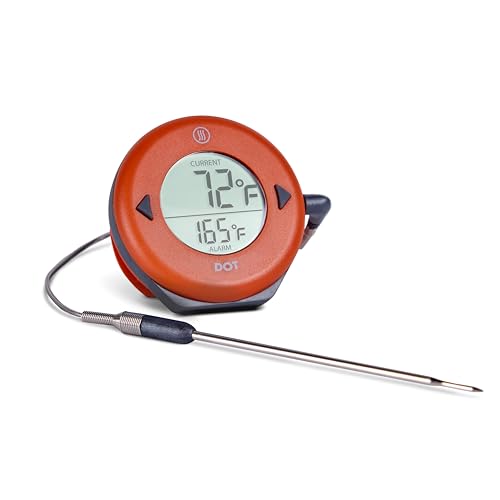
The DOT is a probe-style thermometer designed to stay inside the cake, providing a continuous temperature reading on an external display. This is the equivalent of using a row counter during a complex cable pattern, allowing for constant tracking without ever needing to pause or interrupt the process.
This setup is ideal for larger, denser cakes that take a long time to bake through. By tracking the climb in temperature, you can avoid the common mistake of opening the oven door repeatedly, which can cause sudden temperature drops and potential collapses.
The tradeoff here is the wire tether, which requires a bit more management than a cordless instant-read model. However, for precise, slow-baked items like fruitcakes or heavy chocolate tortes, the set-it-and-forget-it convenience is unmatched.
Taylor Precision Splash-Proof: A Durable Workhorse
The Taylor Precision Splash-Proof thermometer is designed for those who value rugged durability above all else. Its robust construction is reminiscent of heavy-duty circular needles capable of handling thick, worsted-weight wool without bending.
This device is intentionally built to endure the rough-and-tumble of a high-traffic kitchen. It is accurate enough for daily baking and is easily calibrated if it ever starts to drift, ensuring long-term utility.
While it may lack the sleek interface of some modern competitors, its reliability is its greatest asset. It is a tool that thrives on consistency and hard work, making it perfect for bakers who value longevity over modern aesthetics.
Why a Thermometer is a Baker’s Secret Weapon
Relying on timing alone is a gamble, just as relying on a visual estimate for sweater length often leads to an ill-fitting garment. Ovens, much like knitting tension, are rarely identical; two different ovens set to 350°F may produce vastly different results.
A thermometer provides the “objective truth” about your bake. It ensures that the center of the cake has reached the temperature required to set the proteins and starches, guaranteeing a professional texture.
Using a thermometer helps you move from following a recipe to truly understanding the science of baking. It eliminates the guesswork and allows you to diagnose why a cake might be too dry or underdone.
The Perfect Done-Temp for Different Cake Types
Understanding the target temperature is just as important as choosing the right fiber for a project. Just as a lace-weight alpaca requires different handling than a hardy wool, different cakes require different internal temperatures to be considered “done.”
- Light, airy sponge cakes: These are delicate and should be pulled at approximately 200°F–205°F to ensure they don’t dry out.
- Dense, butter-based cakes: These benefit from a slightly higher internal temp, usually around 205°F–210°F, to ensure the fat is fully integrated and the structure is set.
- Rich, flourless or chocolate cakes: These require care; pulling them too late leads to a crumbly mess, so aim for 195°F–200°F.
Always remember that carry-over cooking exists. Pulling a cake just a few degrees shy of the target is often the professional secret to a perfectly moist result.
How to Properly Temp a Cake Without Ruining It
The method of inserting the probe is just as vital as the tool itself. Always aim for the deepest, thickest part of the cake, usually the center, as this is the last area to reach the target temperature.
Insert the probe at an angle rather than straight down. This hides the puncture mark under a layer of frosting later, keeping the presentation as neat as a perfectly grafted kitchener stitch.
Clean the probe thoroughly between uses to prevent cross-contamination. Most importantly, ensure the thermometer is calibrated regularly to keep the readings accurate; even the best tool is useless if it has drifted from the true temperature.
Instant-Read vs. Probe: Which Do You Need?
Choosing between an instant-read and a probe is a matter of your specific baking habits. Instant-read models are better for bakers who make a variety of items and need a quick, portable solution that can move from the oven to the stovetop for candy-making.
Probe-style models are superior for those who bake large, slow-cooking items that require constant monitoring. If you find that you are constantly hovering by the oven, the peace of mind offered by a leave-in probe is worth the slight hassle of the cord.
Think about your most common projects. If you prioritize versatility, an instant-read is the versatile workhorse of your kitchen. If you crave data and precision during long bakes, a probe will be your most trusted companion.
Equipping your kitchen with the right thermometer is the final step in mastering the craft of baking, ensuring that your efforts yield consistent, professional results every time. Just as you wouldn’t start a large project without checking your gauge, you shouldn’t start a bake without the precision of a digital temperature reading. Select the tool that matches your baking style, maintain it with care, and enjoy the confidence that comes with knowing exactly when your masterpiece is ready to leave the oven.
