6 Beading Needles For Delicate Fabric Applique
Struggling with fabric damage? Discover the 6 best beading needles for delicate fabric applique to ensure smooth stitching and professional results. Shop now!
Embroidery and beadwork on fine knits transform a simple sweater or scarf into a couture-level heirloom. Achieving this detail requires needles that glide through delicate fibers without causing pulls, runs, or structural damage. Choosing the correct tool is just as vital as selecting the right mohair or silk yarn for a complex lace pattern. This guide highlights the best needles to ensure your surface embellishments maintain the integrity of your fabric.
Tulip Hiroshima Beading Needles: Best for Silk


Tulip Hiroshima needles are widely considered the gold standard for those working with delicate, high-tension fabrics. These needles feature a unique polished surface that reduces friction, allowing them to slip through dense weaves like silk or fine-gauge wool without catching.
The consistency of the metal and the precision of the point prevent the “snag and pull” phenomenon that ruins a finished project. While they carry a higher price point than mass-market options, the durability of the tip means fewer replacements over time.
For the most delicate silk embroidery or beaded accents on a finished garment, these needles provide the necessary smoothness. They are the go-to choice when the margin for error is non-existent.
John James English Needles: The Trusted Standard
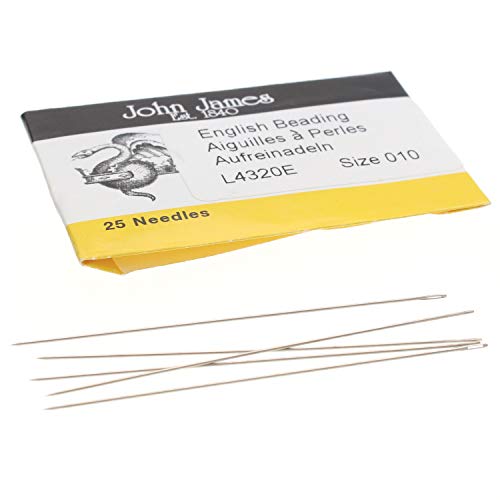
John James has a long-standing reputation in the textile world for producing consistent, reliable needles. These are the workhorses of the beading community, providing a balanced weight and a sharp point that works across a variety of bead sizes.
If you are a knitter who occasionally adds embellishments, keeping a pack of John James needles in your notions kit is a prudent decision. They are stiff enough to handle firm fabrics but thin enough to slide through the most intricate bead holes.
They are the “standard” for a reason, offering predictable performance without unnecessary flair. When working on a medium-weight project where you need reliability above all else, reach for these.
Beadalon Big Eye Needles: Easiest to Thread
Threading a fine beading needle is often the most frustrating part of the craft, especially for those with tired eyes or stiff fingers. Beadalon Big Eye needles solve this by splitting open for almost the entire length of the needle.
These needles are ideal for those who struggle with traditional needle eyes, as the entire body of the needle effectively becomes an oversized opening. However, the tradeoff is that they are less rigid than solid steel needles and can bend if pushed through heavy fabrics.
They work beautifully for adding beads to a lace shawl where the thread is thin and the needle needs to navigate through delicate loops. Use them when ease of threading is your primary priority.
Clover Gold Eye Needles: Top Pick for Applique

Clover needles are engineered for comfort, often featuring slightly larger eyes that facilitate easier threading while maintaining a sharp, high-quality point. The gold-plated eye is more than just an aesthetic choice; it often provides a smoother transition for the thread to pass through.
For applique, where you are stitching one fabric layer onto another, these needles offer a sturdy grip. They are substantial enough to hold while pushing through multiple layers, yet fine enough to avoid leaving visible holes in the underlying knit.
Consider these the ideal middle ground between industrial durability and refined precision. They are a staple for any serious fiber artist.
Pony Beading Needles: Best Budget-Friendly Set

Pony offers an accessible entry point for those just beginning to experiment with beaded embellishments. Their sets usually include a variety of sizes, which is essential for testing which needle works best with a specific bead diameter.
While they may not possess the same polished finish as Japanese-manufactured needles, they are surprisingly resilient. They are an excellent way to experiment with different techniques without committing to a significant investment.
If you are just starting out and need to figure out which size needle fits your specific beads, start here. The variety pack ensures you will have the right tool on hand regardless of the bead size.
Tulip Twisted Wire Needles: For Awkward Angles

When you need to navigate tight corners or work through intricate textures where a rigid needle fails, a twisted wire needle is the solution. These are highly flexible, allowing them to bend around curves without snapping.
These are particularly useful when you need to pick up a bead or stitch an applique piece in a hard-to-reach area of a knitted garment. They can conform to the shape of the work, providing a dexterity that traditional steel needles simply cannot match.
Be aware that they lack the stiffness for pushing through dense fabric layers. Use them as a supplemental tool for complex, sculptural work.
Matching Needle Size to Your Bead and Fabric
The rule of thumb for beading is that the needle must be small enough to fit through the bead hole with the thread. However, it must also be thick enough to be structurally sound.
If you use a needle that is too thick, you risk stretching the holes in your delicate fabric. If the needle is too thin, it will bend and warp as you pull the thread through the bead.
- Size 10-12: Ideal for standard seed beads and delicate silk fabrics.
- Size 13-15: Best for ultra-fine micro-beads and high-density weaves.
- Always test: Run the needle through your bead with your chosen thread before starting your project.
How to Avoid Snagging Delicate Fabrics While Beading
Snagging occurs when a burr on the needle or a blunt point catches a fiber in your knit. To prevent this, always inspect your needles for signs of wear, such as dark spots or rough patches near the eye.
When working on a knit, try to pass the needle between the plies of the yarn rather than piercing the individual strands. This keeps the structural integrity of your knitting intact.
Using a silk-weight thread also helps, as it is less likely to create tension that pulls at the fabric. A steady, deliberate hand movement is more effective than pulling the needle through quickly.
Pro Tips for Threading Ultra-Fine Beading Needles
Threading is the most common point of failure for beginners. Use a stiff thread or a piece of monofilament to create a “leader” if the thread is fraying at the end.
If the eye of the needle is too small, try waxing your thread with a bit of beeswax. This binds the fibers of the thread together and stiffens the tip for easier insertion.
If you find yourself struggling, do not force it; take a breath and re-cut the thread at a sharp, 45-degree angle. Sharp, clean ends are significantly easier to guide through the eye than frayed ones.
English vs. Japanese Needles: Which Is Right for You?
Japanese needles, such as the Tulip Hiroshima line, are famous for their high-carbon steel construction and superior polishing. They are generally stiffer, sharper, and smoother, making them the preferred choice for professional-level work.
English needles, represented by brands like John James, prioritize consistency and value. They are generally slightly more flexible and offer a wider range of specialty shapes and sizes.
If your project requires high-precision, repetitive work, invest in Japanese needles for the long-term comfort of your hands. If you are doing general-purpose repair or light embellishment, English needles will serve your needs perfectly.
Choosing the right beading needle is an investment in the longevity of your hand-knit garments. By selecting the correct material and size, you ensure that your artistic flourishes enhance, rather than detract from, the beauty of your stitches. Take the time to test your tools, and your finishing work will look as professional as the knitting itself.