6 Scratch Awls For Marking Punch Locations To Own
Find the best scratch awls for precision marking on your next project. Explore our top 6 recommendations and upgrade your tool collection for accuracy today.
Precision is the silent partner of every great fiber arts project, whether marking the exact center of a complex lace chart or indicating where to pierce stiff interlining for a custom bag handle. While many makers rely on simple sewing pins, a dedicated scratch awl offers superior control and visibility when marking punch locations on heavy fabrics or leather. These tools provide the necessary leverage to create clear, consistent markers that won’t migrate or vanish during assembly. Mastering the use of an awl elevates professional finishing techniques from an aspiration to a daily habit.
C.S. Osborne Scratch Awl: The Heritage Choice


The C.S. Osborne brand represents a long-standing commitment to industrial-grade durability that rarely exists in modern craft supplies. These awls are built with a distinctive square-shank blade, which provides exceptional strength and rigidity when punching through multiple layers of dense wool felt or thick canvas.
Because the handle is shaped for a firm, ergonomic grip, it minimizes hand fatigue during long marking sessions for large-scale upholstery or bag-making projects. The steel is hardened to withstand significant pressure, meaning the tip remains sharp and true over years of heavy-duty use.
This is the tool for the maker who views their equipment as a lifetime investment rather than a disposable convenience. It is undeniably heavy and industrial, which might feel overkill for light-duty work, but it is the gold standard for structural precision.
Clover Tapered Awl: For Precision Fabric Work

Clover is synonymous with thoughtful, user-friendly design, and their tapered awl reflects this reputation perfectly. Unlike heavy industrial options, this tool features a fine, smooth taper that is designed specifically for delicate fabrics that might fray if punctured by a rough, oversized tip.
This awl excels when working with tight weaves or delicate silk linings where visibility is paramount and damage must be avoided. The slim profile allows for precise placement on small marking dots without obscuring the target area during the actual punch.
Consider this the “fine needle” of the awl world, perfect for high-stakes projects where precision is more important than raw force. It is the ideal companion for makers focusing on garment tailoring and intricate accessories.
General Tools Scriber: A Versatile Workhorse
The General Tools Scriber is a multipurpose marvel often found in hardware stores, but it earns its keep in the sewing studio by offering extreme versatility. Its thin, needle-like tip is perfect for reaching into tight corners or picking out accidental stitches in dense, dark-colored yarn.
The lightweight design makes it exceptionally easy to handle for quick marking tasks, though it lacks the sheer force of a heavier wood-handled awl. It works best on medium-weight fabrics where the goal is a clean, singular point of reference rather than a larger hole.
Choose this tool if the workspace is shared with other hobbies like woodworking or model building. It is a cost-effective, high-utility item that punches well above its weight class in terms of daily necessity.
Tandy Leather Scratch Awl: The Go-To for Leather

Leather requires a specific kind of puncture that pushes fibers aside rather than cutting them, and the Tandy Leather Scratch Awl is engineered precisely for this. The shape of the blade creates a neat, clean hole that allows for easier needle passage during hand-stitching with waxed thread.
When working with vegetable-tanned leather, this awl glides through the material with minimal resistance, creating uniform holes that contribute to a professional aesthetic. The handle design is optimized for the specific palm-pressure technique required to pierce thick hides accurately.
If the fiber arts practice includes leather straps, reinforced bases for knitted bags, or custom tags, this is the essential choice. It is a specialized tool that ensures the leather itself remains durable and structurally sound at every stitch point.
UJ Ramelson Hardwood Awl: Classic & Affordable
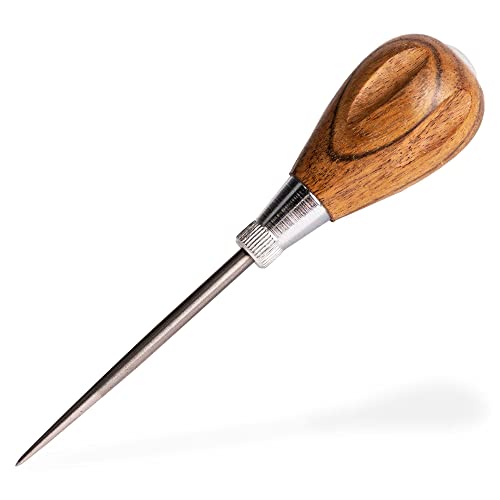
The UJ Ramelson Hardwood Awl offers a classic, stripped-back aesthetic that prioritizes function above all else. With a solid, turned wooden handle and a tempered steel blade, it provides a tactile experience that connects the maker to the tool in a meaningful way.
This awl is particularly well-suited for makers who appreciate the feel of natural materials in their hand. While it is simple in design, it is rugged enough to handle a variety of materials, from heavy denim to thick felted wool, without compromising its integrity.
It represents the perfect balance between professional performance and an accessible price point for the mid-level maker. It is a reliable, no-nonsense tool that performs consistently whenever a mark needs to be made.
Excel Blades Retractable Awl: Safest For Your Bag
Safety is a critical consideration for makers who take their projects to workshops, knitting circles, or on long travels. The Excel Blades Retractable Awl keeps a razor-sharp point shielded inside its barrel when not in use, preventing accidental punctures in bags or fingers.
The retractable mechanism is smooth and intuitive, allowing for a quick transition from storage to active use. Even when retracted, the tool feels sturdy, which speaks to the quality of the internal housing and spring mechanism.
For the mobile maker, this is an indispensable piece of kit that provides peace of mind without sacrificing the utility of a standard scratch awl. It is the smartest option for anyone who packs a dedicated project bag for sessions away from the home studio.
Choosing Your Awl: Tapered vs. Straight Points
Understanding the difference between tapered and straight points is essential for achieving the intended outcome in any sewing project. A tapered point gradually widens, which is excellent for creating a hole that fits the exact diameter of the needle or tool being inserted next.
A straight-point awl, by contrast, maintains a consistent diameter until near the very tip. This design is superior for marking punch locations that need to remain small and discrete, as it prevents the material from being stretched unnecessarily by the tool’s shank.
- Tapered: Best for larger punctures, grommet installation, or easing thick layers into alignment.
- Straight: Best for precision marking, fine embroidery, or piercing delicate woven fabrics.
When in doubt, evaluate the thickness of the material and the intended size of the final hole. Matching the tool geometry to the material ensures that the fibers are managed correctly rather than mangled.
How to Safely Use and Store Your Scratch Awl
An awl is a piercing tool, and safety must be the top priority during every step of the process. Always orient the work surface so that the direction of the punch is directed away from the body, and ensure the work is supported by a self-healing mat or a piece of scrap wood to prevent damage to the table.
When storing an awl, never leave it lying exposed on a table where it could roll off or be accidentally grabbed. Use a dedicated tool block, a magnetic strip, or a protective sheath if one was provided with the purchase.
- Keep fingers clear of the puncture path at all times.
- Use a protective cap if the awl does not feature a retractable mechanism.
- Never use an awl as a prying tool, as this can snap the hardened steel tip.
Awl Maintenance: Keeping Your Tool Sharp & Clean
A dull awl is a dangerous tool because it requires more force to penetrate the material, increasing the risk of a slip. Periodically hone the tip using a fine sharpening stone, maintaining the original angle of the grind to ensure the blade remains piercing-sharp.
Clean the blade after every use, particularly if working with leather or waxed fabrics, to prevent residue buildup that can catch on delicate yarn or fibers. A light wipe with a silicone-treated cloth can protect the metal from rust in humid environments.
If the tip begins to feel “gritty” or resists movement through fabric, it is a sign that the metal needs dressing. Taking five minutes to maintain the tool ensures it performs consistently, saving time and preventing frustration on future projects.
Beyond Punching: Other Uses for Your Scratch Awl
While the primary function is to mark and punch, an awl is one of the most versatile accessories in a knitting kit. It is an excellent tool for correcting cable crosses that have drifted or for safely guiding a stitch that has dropped down a few rows in a complex lace pattern.
The tapered end can also act as a temporary holder for a single stitch when a stitch marker isn’t available, or as a precise tool for tucking in yarn ends after weaving. Some makers even use the handle as a makeshift point-protector for circular needles during a break in knitting.
Ultimately, the scratch awl is a multifunctional utility player that bridges the gap between textile construction and structural finishing. Its value lies not just in its ability to mark punch locations, but in its reliability as an all-purpose tool for managing stitches and materials.
Selecting the right scratch awl is a practical step toward ensuring that every marking task is handled with confidence and precision. By matching the tool’s geometry to the material and maintaining it with care, you equip yourself for a lifetime of successful and accurate project assembly.