6 Best Book Repair Scalpels For Precision Work
Looking for the best book repair scalpels? Explore our top 6 picks for precision work to ensure your restoration projects are clean, accurate, and professional.
Precision work in fiber arts often requires tools that transcend traditional notions of utility. Whether removing a stubborn errant thread from a delicate silk lace shawl or precisely cutting a stiff backing for an heirloom-quality needlepoint display, the right scalpel serves as an extension of the hand. While many turn to standard craft cutters, professional-grade scalpels offer the surgical sharpness necessary for intricate repair work. Choosing the correct instrument ensures fibers remain intact and patterns stay preserved through every restorative step.
Swann-Morton No. 3: The Surgeon’s Choice


The Swann-Morton No. 3 handle is widely recognized as the industry standard for precision cutting in professional restoration. Its slim, balanced profile allows for exceptional control, essential when maneuvering around delicate, high-twist yarns where a slip could jeopardize the entire structure of a project.
This handle is designed specifically to accept the #10, #11, and #15 blades, which are favored for their ability to navigate tight spaces. If working with fine linen or fragile vintage lace, the rigidity of this handle ensures that the blade does not flex, preventing unintentional damage to the fiber.
The primary trade-off is the learning curve involved in attaching and removing the blades. Because these are medical-grade components, handling them requires care and strict adherence to safety protocols to prevent injury.
Excel Blades K1 Knife: Best For Versatility
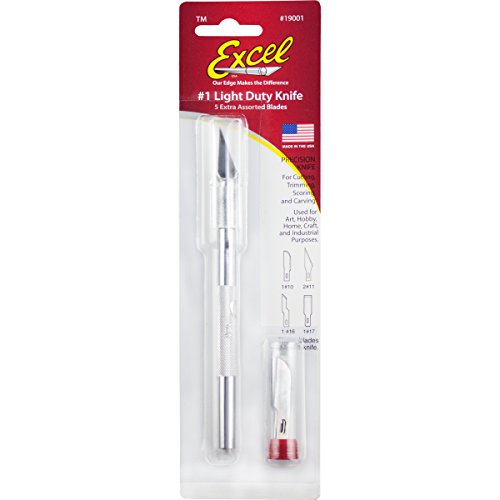
The Excel Blades K1 is a familiar sight in workshops where versatility takes precedence over specialized tasks. It features a lightweight aluminum body that mimics the feel of a knitting needle, making it an intuitive choice for those accustomed to long hours of repetitive hand work.
This tool shines when moving between different media, such as trimming edge reinforcement on felted projects or scoring paper patterns for complex garment construction. Its universal collet system accommodates a wide array of blade shapes, ensuring that one handle can adapt to various project requirements.
While it lacks the extreme, fixed rigidity of a surgical handle, it offers a level of comfort that prevents hand fatigue during extended sessions. For the multi-craft maker who values efficiency, the K1 is an indispensable, reliable workhorse.
X-Acto #1 Knife: The Crafter’s Classic Pick

The X-Acto #1 is often the first tool encountered by those entering the world of precision craft, and its longevity is a testament to its design. Its hexagonal shape prevents the knife from rolling off workstations, a feature that saves both the tool and the delicate project lying nearby from unexpected damage.
This knife excels in general-purpose precision, such as cleaning up the edges of mounted embroidery or trimming loose floats on the back of stranded colorwork. Its ease of use makes it a perfect entry point for those intimidated by more industrial-grade surgical tools.
However, the chuck mechanism can wear down over time, occasionally leading to slight blade wobble under heavy pressure. For standard, light-duty fiber repairs, this remains a cornerstone tool that offers a perfect balance of cost and functionality.
Feather Mini Scalpel: Ultimate Precision Tool

When the task demands absolute microscopic control, the Feather Mini Scalpel is the preferred instrument. Known for high-quality Japanese steel, these scalpels provide a sharpness that remains unmatched by standard utility blades.
These tools are ideal for deconstructing complex woven structures or removing microscopic debris caught within a tight gauge. Their tiny, delicate profile allows for pinpoint accuracy that larger craft knives simply cannot replicate, making them a secret weapon for restoration experts.
Because they are so sharp, they can easily bite into dense fibers if used with too much force. Use these exclusively for delicate, controlled movements where surgical precision is required to save an irreplaceable piece of work.
NT Cutter D-400: The Ergonomic Grip Option

The NT Cutter D-400 features a unique ergonomic design that prioritizes long-term comfort for the maker. Its substantial grip reduces the strain on fingers and wrists, which is particularly beneficial for those who struggle with joint stiffness after hours of intricate needlework.
This tool is exceptionally stable, providing a level of pressure consistency that is vital when cutting through multi-layered fabrics or thick interfacing. The integrated pocket clip doubles as an anti-roll device, keeping the workspace tidy and safe.
The heavier build may feel cumbersome to those accustomed to the weightlessness of a knitting needle, but the stability gained in return is worth the adjustment. It stands as a top contender for anyone performing repetitive, precision-based repair work.
Havels Combo Set: Best Value For Multiple Blades
The Havels Combo Set is an excellent solution for those who prefer to have a variety of blade profiles at their immediate disposal. Having a mix of curved and pointed blades allows for immediate transitions between different cutting angles without the need to switch tools or change blades mid-project.
This kit provides significant value, offering a high-quality handle alongside a selection of blades designed for different textures and material densities. It is a practical choice for a studio setting where one might transition from cutting heavy wool felt to delicate lace stabilization.
While the blades may require more frequent replacement than premium surgical brands, the convenience of the set is unmatched for beginners. It encourages the maker to experiment with different blade geometries to see which best suits their specific crafting style.
Choosing Your Scalpel: Blade Shape and Handle
Selecting a scalpel involves balancing the mechanical properties of the blade against the ergonomics of the handle. For fine fiber work, a #11 blade with its sharp, pointed tip is usually superior for picking out threads or working within narrow gaps, whereas a curved #10 or #15 blade is better for slicing through flat surfaces.
Handle material also dictates performance; aluminum handles are generally lighter and better for long-term comfort, while stainless steel offers a heavier, more stable feel for deep, precise cuts. Consider how the handle fits into the hand—if it feels too thin, it may lead to cramping during prolonged use.
Always match the handle collet to the blade shank size to ensure a secure fit. A loose blade is not only a safety risk but also ruins the accuracy of the cut, which can be catastrophic when working on an heirloom project.
Essential Scalpel Safety Tips For Your Workshop
Scalpels are significantly sharper than standard utility knives, making them prone to causing deep, clean cuts that require immediate medical attention. Always cut away from the body and ensure your hands are positioned well behind the cutting path to prevent accidents during a slip.
Use a dedicated cutting mat to protect both the blade and the underlying work surface, ensuring the mat is clear of debris that could dull the edge. When not in use, always employ a protective cap or a retractable mechanism to keep the edge shielded from accidental contact.
Never attempt to catch a falling scalpel; it is far easier to replace a damaged blade or clean a workbench than it is to treat a deep wound. Treat every tool with the same respect used when handling delicate needles or high-end scissors.
Keeping Your Blades Sharp: Honing and Stropping
A dull blade is often more dangerous than a sharp one, as it requires excessive pressure to perform, which inevitably leads to a lack of control. While most scalpel blades are intended for single use, high-quality steel can occasionally be refreshed for minor touch-ups using a fine honing stone or a leather strop.
To strop a blade, gently draw the cutting edge backward across the leather at the same angle as the bevel, ensuring you do not dig the tip into the material. This realigns the microscopic edge of the steel, extending the life of the blade between full replacements.
However, once a blade begins to show signs of corrosion or chipping, it must be discarded immediately. No amount of stropping can fix a damaged edge, and trying to force a dull blade will only result in frayed fibers and poor results.
Scalpel vs. Craft Knife: What’s The Difference?
The fundamental difference lies in the steel quality and the bevel geometry of the blade. Scalpels utilize surgical-grade carbon or stainless steel, which allows for a much thinner, sharper bevel than the thicker blades found on standard craft knives.
Craft knives are engineered for general utility, meaning they are designed to withstand a fair amount of lateral pressure without snapping. Scalpels, by contrast, are optimized for vertical pressure and pure slicing, offering a level of finesse that is essential for fiber arts repair.
If a project requires removing a single ply from a twisted yarn or cutting through a single layer of fine silk, choose the scalpel. If the task is heavy-duty cutting, such as trimming thick cardboard backing or multiple layers of heavy denim, opt for a sturdy craft knife.
Equipping a workshop with the right scalpel elevates the quality of repair work, turning a potentially frustrating task into a seamless part of the crafting process. By understanding the specific strengths and safety requirements of these precision tools, makers can approach even the most daunting fiber restoration projects with confidence. Consistent practice and careful maintenance will ensure these tools remain an asset for years to come.