6 Best Patchwork Patterns For Beginner Skill Building
Master quilting with these 6 best patchwork patterns for beginner skill building. Follow our simple, step-by-step guide to start your first project today!
Patchwork knitting offers a unique journey for those looking to build their skills one block at a time. By focusing on smaller, modular pieces, the daunting task of knitting a full garment or blanket becomes a series of achievable milestones. Mastering these patterns builds confidence in shaping, tension control, and finishing techniques that define a polished maker. This collection of six essential patterns provides the perfect curriculum for any knitter ready to elevate their craft.
The Garter Block Throw: Best for First-Timers
The garter stitch square is the foundational unit of all modular knitting. Because it requires only the knit stitch, it allows a beginner to focus entirely on maintaining consistent tension across different blocks.


Avoid the trap of focusing on speed. Focus instead on the edges of the square, as these stitches will eventually be used for seaming. If the edge stitches are too tight or loose, the final assembly will look uneven regardless of the quality of the individual blocks.
Choose a wool-blend yarn with a medium twist for this project. Pure cotton can feel unforgiving on the hands during long sessions, while a high-twist wool provides enough elasticity to keep the stitches uniform.
Mitered Square Scarf: Mastering Basic Decreases

Mitered squares are formed by working back and forth while performing centered double decreases at the center point. This shape creates a distinct diagonal texture that looks sophisticated despite its simple construction.
This project introduces the concept of the “spine” in knitting. By decreasing two stitches every other row, the work naturally folds into a corner, teaching the relationship between stitch count and fabric geometry.
Use markers to track the center decrease stitch. If the stitches look messy, the tension might be too tight; don’t hesitate to use a slightly larger needle size to ensure the decrease row remains easy to work.
Purl Soho’s Log Cabin: Picking Up Stitches
Log Cabin patterns involve knitting long strips directly onto the edge of an existing square. This technique requires picking up stitches along a finished edge, a skill essential for knitting button bands, necklines, and pockets later in a knitter’s journey.
Picking up stitches can feel awkward initially. The key is to insert the needle under both loops of the edge stitch to prevent the fabric from stretching out. Consistent spacing is more important than perfect mathematical accuracy.
If the fabric pulls inward at the join, the pick-up ratio might be too low. Experiment with picking up three stitches for every four rows worked to maintain a flat, professional-looking boundary.
Texture Sampler Blanket: For Exploring Stitches
A texture sampler is an exercise in stitch variety, utilizing everything from seed stitch and moss stitch to cables and basic eyelets. It transforms a collection of mismatched blocks into an intentional design feature.
This project serves as a stress-free laboratory. Because each block is independent, mistakes are contained to small areas, minimizing the need for full-project frogging—the process of ripping out work when an error occurs.
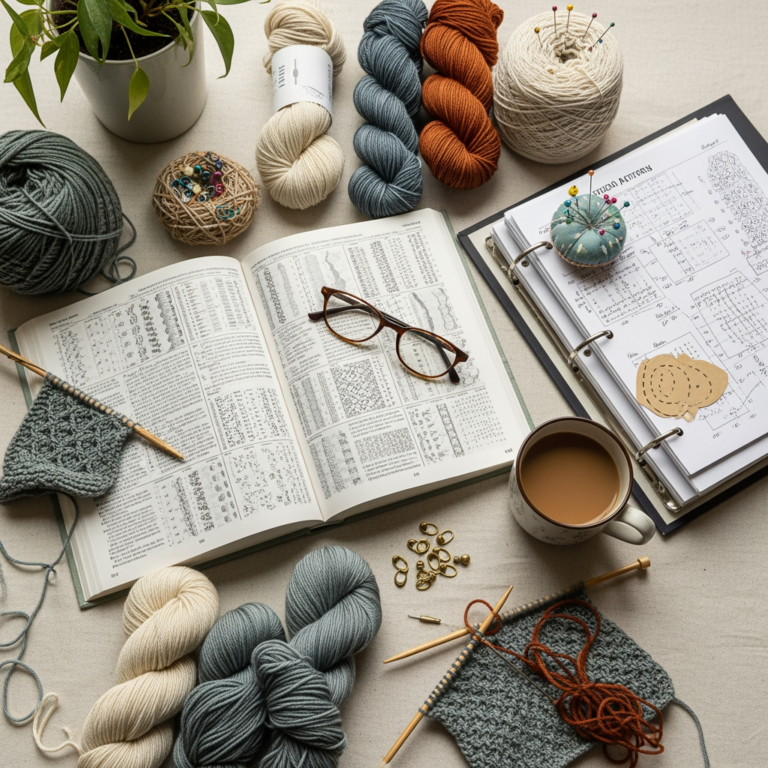
Keep a stitch dictionary handy to reference new patterns. Aim to finish one square before moving to the next, as this prevents boredom and keeps the momentum high as the blanket grows.
Two-Color Check Cowl: Intro to Color Changes
Working with two colors in a patchwork format introduces the basics of carrying yarn and managing joins. By alternating colors between blocks, the visual impact is maximized without the complexity of stranded colorwork.
Always catch the float if the unused yarn spans more than three stitches. This prevents the fabric from snagging on jewelry or fingers while wearing the finished piece.
Be wary of combining fibers with different shrinkage rates. Using a superwash wool alongside a non-superwash wool can lead to warping after the first wash, so ensure the yarns are compatible before starting.
Geo-Block Shawl: Combining Simple Shapes
Triangles and rectangles can be combined in endless variations to create modern, geometric shawls. This pattern focuses on the modular construction of different shapes that must align perfectly to form a cohesive garment.
Pay close attention to gauge here. If one shape is worked at a looser tension than another, the final assembly will ripple. If the fabric feels stiff, check if the yarn is being held too tightly during the color-change transitions.
Layout the finished pieces on a flat surface before sewing. This allows for adjustments in placement, ensuring the color flow or shape arrangement meets the desired design goals.
How to Choose Yarn for a Patchwork Project
The success of a patchwork project relies on yarn compatibility. Choose yarns with similar weights and fiber compositions to ensure that each block wears and drapes identically.
Check the WPI (wraps per inch) if using different brands of yarn to ensure they are truly a match. Even if two yarns are labeled as “worsted,” their actual diameter can vary, which will cause inconsistencies in the finished modular piece.
Stick to machine-washable wools for blankets and high-use items. If the project is for decorative wall art, high-twist alpaca or linen adds a beautiful drape that synthetic fibers cannot replicate.
Seaming Your Squares: Mattress Stitch and More
The mattress stitch is the gold standard for joining knitted pieces. It creates a nearly invisible seam that lies flat, mimicking the appearance of the knit stitch itself.
To perform this, lay pieces side-by-side with the right sides facing up. Use a blunt tapestry needle to pick up the horizontal bars between the edge stitches on both pieces, pulling gently to close the seam.
Never skip the seaming phase. While it is the most time-consuming part of patchwork, a sloppy seam will undo the effort spent on perfect, even knitting.
Weaving in Ends: A Guide for Tidy Patchwork
Patchwork projects generate an abundance of ends. Develop the habit of weaving them in as the project progresses to avoid a overwhelming mountain of finishing work at the end.
Always weave ends into the back side of the work, following the path of the existing stitches. Use a duplicate stitch method to mimic the path of the yarn, which secures the end without adding bulk.
Avoid knots. They create lumps in the fabric that are visible on the right side and can eventually work loose with use.
Blocking Your Patchwork for a Professional Look
Blocking is the final, essential step that transforms a collection of blocks into a unified fabric. By soaking the pieces in water and pinning them to specific measurements, the stitches settle and the fabric achieves an even, professional finish.
Use blocking wires for straight edges and ensure the squares are pinned to identical sizes. Even if the knitting looks slightly irregular, proper blocking can correct minor tension discrepancies.
Always use a mat designed for blocking to keep pins secure. Let the pieces dry completely, as removing them too early will cause the fibers to lose their shape before they have set.
Modular knitting is a meditative practice that rewards the knitter with both technical growth and a finished piece that carries a signature aesthetic. Whether creating a blanket or a shawl, the modular approach allows for total control over the creative process. Embrace the process of learning each technique, as these skills are the building blocks for every advanced project in the future.